Yesterday saw the first post of a new series of posts highlighting the risk to reward options of various tennis trades. In this post I outlined 4 possible trades that were available to us on the very first game of the fist set. To visit this post click on this link.
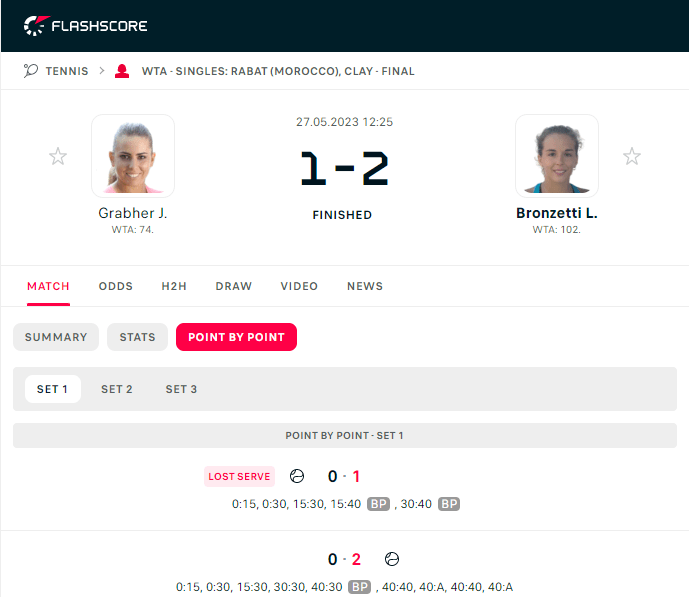
The image below is a screenshot of the flashscore site showing the result of the first game and how it was won.
As you can see Bronzetti won this game breaking Grabhers service after 2 break points. The image below is the set matrix shown in yesterdays post and I have ringed the end of set odds.
There is another feature of Bet Angel that can help us analyse our trades and this is an ability to log each players odds at whatever intervals you wish throughout the match. This enables you to see the way the odds moved as each point is won or lost. I have provided a screenshot of the 1st 6 1/2 minutes of the 1st game below.
The time elemnts of this spreadsheet are actual time ie 12:24:11 pm and if you follow the odds for Bronzetti which in this case are logged every 30 seconds you can see that her odds in the first game after 6 minutes play (12:30:14) they bottomed out at 1.39. In the next screen shot I have added the scores and you can see that when Bronzetti won a point her odds dropped and when Grabher served her 2 points that she won the odds rose slightly
Yesterday I outlined 4 different trades that we could have done on this first game in the match and Trade 2 had the best risk to reward option for us. The odds for Bronzetti to win the match at the time of writing yesterdays post was 1.74 however this was at 7 am – 5 hours before the start of the match. When the match finally started at 12:24 pm her odds had dropped to 1.69. Tennis Trader predicted that if Bronzetti won the game then her odds would be around 1.44 they actually reached 1.39.
In this case our best trade option won out and we profited by it Please subscribe to my blog if this has peaked an interest in trading tennis as I will be sharing lots more opportunities for making educated decisions on trading tennis matches and its more exciting than laying the draw in a football match.
Tennis markets are primarily driven by what is actually going on in the match itself. Unlike football markets which flow in a determined direction and only react after a goal is scored, tennis markets can fluctuate wildly to the uneducated eye but there are certain points within tennis matches that can present us with a good “low risk high reward” opportunities. One of these points is the break of serve. There are always breaks of serve in tennis matches – that is how they are won or lost but finding the right point to make a trade needn’t be rocket science. At this point I must make it clear that I have a distinct advantage as I have a subscription to a piece of software called Bet Angel and this particular, and at the present time subsequent posts on this subject, come from watching and understanding videos made by the founder of the software, Peter Webb. Knowing at what point to try and trade a break of serve and how to gain the maximum profit or lose the minimum loss can be determined by oberving countless tennis matches and noting the odds of each player at each point of the game and building your own giant database which might be ready to use in perhaps 10 years or you could use a feature of bet angel called Tennis Trader. The figures I have used below are from Tennis Trader and are from the WTA Rabat2023 Final being played today at 12:00 between Julia Grabher and Lucia Bronzetti, and at the time of writing this blog the Match odds are Bronzetti 1.74 and Grabher 2.35 giving a near perfect “book” of 100.5%. This fact is however irrelevant as we are just interested in who is the favourite and the possibilities of what could happen in the course of the first set. Using Tennis Trader I am going to investigate various scenarios where a break of serve happens and what effect it would have on the market and the risk to reward. Below you will see a screenshot of the Tennis Trader Set Matrix for the first set which when calibrated to the match gives a fair representation of how the market would behave.
If we assume that Grabher is serving first and she wins her first game then the odds for her to win the match would move from 2.35 to 2.21 giving just a 6 tick move but if Bronzetti breaks her serve in the first game then her odds would move out to 3.29 this is a move of 39 ticks. The odds for Bronzetti in the same instances would be as follows Bronzettis odds if Grabher holds serve 1.74 to 1.83 – 9 ticks Bronzettis odds if Grabher loses her serve 1.74 to 1.44 -30 ticks
In money terms as a trade using £10 stakes for both back and lay bets and “Greening” or hedging the trade at the end of the game (remember tennis is split into games sets and matches dont get confused when i say end of game – it means the end of the present game – not the entire match) the following scenarios would produce the following profit and losses.
TRADE OPTION 1 We BACKED Grabher at odds of 2.35 – Liability £10 potential Profit £13.50 less 2% commission. Grabher Won the game: We hedged our stake at odds of 2.21 with a lay bet of £10.61 – after commission we gained 40p Grabher Lost the game: We Traded out our stake at odds of 3.29 with a lay stake of £7.10 – We lost £3.02. The risk to reward on this trade would be lose £3.02 or win 40p
TRADE OPTION 2 We BACKED Bronzetti at odds of 1.74 – Liability £10 Potential profit £7.40 less 2% commission. Grabher Won the game: We hedged our stake at odds of 1.83 with a lay bet of £9.53 – after commission we lost 65p Grabher Lost the game: We Traded out our stake at odds of 1.44 with a lay stake of £12.15 – We Won £1.91 The risk to reward on this trade would be lose 65p or win £1.91 As you can see the most we would have lost would have been £3.02 roughly a third of our stake in the first scenario or 65p in the second scenario. The most we would have won is £1.91 in the second scenario as opposed to 40p in the first scenario. Peter Webb refers this to “Framing a Trade” which is to say you can determine your potential for losses and gains and so determine the better strategy.
If we now look at the same game but we LAY our players at the onset of the game. TRADE OPTION 3 We LAY Grabher at odds of 2.35 for a stake of £10 making our liability £13.50 Grabher Won the game: We hedged our stake at odds of 2.21 with a BACK bet of £10.63 – We LOST 63p Grabher Lost the game: We Traded out our stake at odds of 3.29 with a lay stake of £7.14 – After commission We Won £2.80. The risk to reward on this trade would be lose 63p or win £2.80 TRADE OPTION 4 We LAY Bronzetti at odds of 1.74 for a stake of £10 making our liability £7.40 Grabher Won the game: We hedged our stake at odds of 1.83 with a BACK bet of £9.43 – We WON 53p after Commission Grabher Lost the game: We Traded out our stake at odds of 1.44 with a BACK stake of £12.08 – We LOST £2.08. The risk to reward on this trade would be lose £2.08 or win 53p
The scenarios above each have their merits and pitfalls and this is the essence of framing a trade so that you have the potential for a maximum gain against a minimal loss. With this particular trade strategy where the players are priced similarly to this and the Favourite is not serving first then we could lose 3 out of 4 of these trades and still bet at a break even point in our money. getting a 50% strike rate would see us building our bank nicely to increase our stakes steadily as our bank grows. The screenshot below depicts the scenario of Bronzetti serving first in the first set and if you compare the differences you will see that the odds predicted by Tennis Trader are slightly different from that of Grabner serving first. This highlights the need to do some basic research before we jump into trades and knowing our entry and exit points
There are other basic factors which should be taken into consideration such as the playing surface – On grass courts the speed of the ball at serve is quicker and the bounce lower making return of serve just that little bit harder than on clay courts which are slower and the bounce higher giving a better chance of return serve Gender also can play a big part in the way you frame your trades. Ladies tennis matches tend to see a greater number of breaks of serve than in mens matches.
The match highlighted today was picked at random and if you read this post before the match starts try watching the first game just to see which scenario played out and which scenario you would have traded. As with all trading and betting systems the risk is always present and you should fully understand how any market works before jumping in with both feet. Having said that however this is a trading opportunity which has a relatively low risk attached to it and as such could be pursued after doing some sample trades on paper. Tennis Trader can be an invaluable tool in this but these trades are entirely possible with just a little caution and research.
Next post will look at doing the same sort of trade but further into the set when there can be more movement in the markets which we can benefit from while keeping our risk to a minimum. If you want to keep abreast of this trading series and how well the trades go please subscribe to my blog to receive these posts as I produce them.
If you are more interested and want to try betangel software please click this link below where you can download a trial copy of the full package. The software has a practice mode where by you can place trades into the markets without any risk to your betfair bank.



 Betornot