Mastering Strategy #5: Trade a Player After They Lose Their Serve

In our overview post on Tennis Trading: The Different Trades You Can Make on a Tennis Match, we introduced the concept of backing a strong player after they drop a service game.

When a favourite gets broken, the market often overreacts, causing their back odds to drift significantly higher. This creates a prime value entry for traders anticipating an immediate bounce-back or a break-back in the following games. However, simply buying every broken favourite blindly is a fast track to draining your bankroll. Success requires precise entry criteria, clear profit targets, and disciplined stop-loss management.

Here is a deep dive into how to trade this setup, complete with real-world profitable and losing trade examples using a standard base stake of £10.

The Core Concept & Entry Checklist

When a player loses serve, their odds instantly jump (for example, moving from 1.40 up to 1.80 or higher). This strategy aims to back the broken player at inflated odds and exit the market once momentum stabilizes or a break-back occurs.

Before entering a position, run through this checklist:

  • Return Profile: Is the broken player a strong returner (high break-back percentage)?
  • Server Vulnerability: Is the opponent’s serve historically weak or unreliable under pressure?
  • Body Language/Stats: Is the favourite creating break points despite losing serve, or are they struggling physically/mentally?

Example 1: The Profitable Trade (Successful Break-Back)

Scenario Setup

  • Pre-match Favourite: Player A (Trading pre-match at 1.40)
  • Match Situation: Player A wins Set 1 easily (6–3). In Set 2, at 1–1, Player A plays a sloppy game and gets broken to go 1–2 down.

Trade Execution

  1. Entry Point: Following the break at 1–2, Player A’s odds drift from 1.42 up to 1.85. Seeing that Player A generated three break points in their previous return game, you back Player A for £10 at 1.85.
    • Outlay / Risk: £10 stake to return £18.50 (£8.50 potential profit).
  2. In-Play Dynamics: In the very next game (1–2), Player A applies heavy pressure on the return, forcing errors and successfully securing the break-back to level the set at 2–2.
  3. Exit Point: Immediately following the break-back, the market re-adjusts. Player A’s odds contract rapidly back down to 1.48. You lay Player A for £12.50 at 1.48 to trade out and green up across all outcomes.

Outcome & Profit

  • Back Stake: £10 @ 1.85
  • Lay Stake: £12.50 @ 1.48 (Liability = £6.00)
  • Result: Guaranteed profit of approximately £2.50 regardless of who goes on to win the match (before exchange commission), completely risk-free for the rest of the game.

Example 2: The Losing Trade (Disciplined Stop-Loss)

Not every broken favourite bounces back immediately. Having a hard stop-loss strategy is crucial to prevent a minor setback from turning into a devastating loss.

Scenario Setup

  • Pre-match Favourite: Player B (Trading pre-match at 1.35)
  • Match Situation: Set 1 is tied at 3–3. Player B serves poorly and suffers a break, putting them 3–4 down.

Trade Execution

  1. Entry Point: Player B’s odds drift from 1.40 to 1.75. You enter the market by backing Player B for £10 at 1.75, anticipating a swift response.
  2. Stop-Loss Strategy: Define a strict exit rule prior to entry: If Player B fails to break back on the next game AND faces serious pressure on their subsequent service game (or if their odds cross 2.25), close the position immediately.
  3. In-Play Dynamics:
    • Game 8 (3–4): Player B fails to convert break points; the opponent holds serve (3–5). Odds move to 1.95.
    • Game 9 (3–5): Player B drops to 0–40 on their own serve due to consecutive unforced errors.
  4. Exit Point (Stop-Loss Trigger): Rather than hoping for a miracle save from 0–40 down, execute your stop-loss and lay Player B for £10 at 2.25 to cap your loss.

Outcome & Loss Management

  • Back Stake: £10 @ 1.75
  • Lay Stake: £10 @ 2.25
  • Result: Total loss limited to £5.00 (or ~£2.22 if hedged equally across both outcomes).

By executing your stop-loss at 2.25, you prevented a potential £10.00 total loss had Player B gone on to lose the set 3–6 and drifted past 3.50.

Key Takeaways for Execution

  1. Pre-define Your Exit: Never enter a position without knowing the exact score line or odds trigger where you will cut your losses.
  2. Avoid “Hope Trading”: If a player drops serve because of double faults, sluggish movement, or visible physical pain, skip the trade—the price drift is justified.
  3. Lock in Green: When the break-back occurs, trade out immediately to secure your profit rather than holding out for a full match victory.

Podcast Episode: Tennis Trading Strategies Explained

Pip: Betornot, where the question is always whether to bet — and this week the answer is: yes, but please have a plan first.

Mara: That's a fair summary. shakey775 has been building out a proper tennis trading curriculum, and today we're working through the core mechanics — how these exchange trades are structured, and how the data shapes which ones to use when.

Pip: Let's start with the foundational methods — backing, laying, and the art of getting out before the final point.

The mechanics of tennis exchange trading

Mara: The question at the heart of this segment is deceptively simple: if you don't need to predict the winner, what exactly are you doing when you trade a tennis match?

Pip: The overview piece puts it plainly, and it's worth quoting directly: "A tennis trader does not necessarily need to predict the winner. Instead, the trader is trying to identify when the market price is likely to move."

Mara: That reframe matters enormously in practice. You're not backing a player to win — you're backing a price to move. The match result is almost incidental to whether the trade was sound.

Pip: Which is why the overview catalogues so many distinct entry points — breaks of serve, tie-breaks, momentum shifts, injuries, even retirement markets. Each one is really just a different trigger for price movement, not a different prediction about who wins.

Mara: The deep-dive into "Back the Favourite and Trade Out" makes the mechanics concrete. You back a player at, say, 2.50, they win the opening set and their odds shorten to 1.70, and you lay at that new price. The post walks through the numbers: lay £14.71 at 1.70, and you lock in roughly £4.70 profit regardless of the final result.

Pip: The maths is almost beside the point — the key move is psychological. You have to resist converting a trade into a bet by holding on for the full match win.

Mara: The post is explicit about that: "Avoid Holding to the End: Resist the temptation to convert a trade into a standard bet. The goal of tennis trading is consistency through active price management."

Mara: The Back-to-Lay deep-dive adds three specific entry triggers worth naming: fading a cold favourite whose underlying serve statistics still look solid, scalping a dominant server who momentarily faces break point, and backing a heavy-hitting underdog early on a fast surface before laying them off after an early break.

Pip: The WTA note is useful there — women's matches statistically see more frequent service breaks, so price swings are wider and you need to adjust your profit targets accordingly.

Mara: Then there's the mirror image: Lay-to-Back. Instead of backing high and laying low, you open by laying a player at short odds — say 1.50 — and exit by backing them at higher odds once they've dropped a set or been broken. The worked example shows a £10 net profit secured on both outcomes after a favourite drifts from 1.50 to 3.00.

Pip: So you're essentially selling the market's overconfidence and buying it back when it panics. Which, when you put it that way, sounds less like sports trading and more like a Tuesday on any financial exchange.

Mara: The data-focused Lay-to-Back piece takes that logic further by grouping pre-match favourites by odds range and measuring how often each group actually loses the first set. Favourites priced 1.21 to 1.40 — Group B — are described as "The Optimum Sweet Spot": they win 74 percent of matches overall, but fail to win straight sets in nearly half their matches.

Pip: So nearly every other match in that range hands you a drift window, and the favourite's underlying quality means they're likely to recover — which is exactly what you need for the back leg of the trade.

Mara: Group C, the 1.41 to 1.60 range, is labelled the volatility trader's choice — favourites there lose Set 1 in 22.2 percent of matches, and when they do, the price often drifts to 2.80 or higher, giving meaningful tick movement for the exit.

Pip: The framework across all of these comes down to one discipline the overview calls the golden rule — have an entry price, a target exit, and a stop-loss in place before emotions arrive.

Mara: The data insights piece reinforces that with strict execution rules: pre-set stop-losses if a favourite falls behind a double-break in Set 2, surface adjustments for clay where break rates are higher, and always greening up equally across both outcomes rather than riding one side.

Pip: Price management as a practice, not a reaction — that's the thread running through all of it.


Mara: The through-line across all of this is the same idea restated in different forms: the trade is a price-management exercise, not a prediction.

Pip: And the data gives you the map — which odds range, which surface, which trigger. Next time we'll see where else on Betornot that kind of structured thinking shows up.

Master the “Lay to Back” Tennis Trading Strategy: Optimum Odds Groups & Data Insights

In tennis sports trading, Lay to Back (L2B) is one of the most structured, high-probability trading methodologies available. Rather than backing a player and hoping they win the entire match, laying a player (selling their probability) allows traders to capitalize on market overreactions, momentum swings, and in-play score volatility before backing them back at higher odds to lock in a guaranteed profit.

Analyzing 2026 ATP tour match data reveals how performance dynamics, set-loss recovery rates, and odds movement vary across pre-match price ranges. Choosing the correct Odds Group is essential for determining liability risk, entry triggers, and trade execution.

Data Insights: Player Behavior Across Odds Groups

Using full ATP match data across Grand Slams, Masters, ATP 500, and ATP 250 events, pre-match favorites can be grouped by average implied probability to observe set-loss frequency and match stretch rates:

Odds GroupFavorite Price RangeFavorite Win RateLoser Wins Set 1 Rate3+ Set Match RatePrimary Risk Profile
Group A: Heavy Favorites1.01 – 1.2086.2%17.4%56.4%Low liability / High swing threshold
Group B: Moderate Favorites1.21 – 1.4074.0%19.3%48.9%Optimum L2B Sweet Spot
Group C: Lean Favorites1.41 – 1.6063.3%22.2%49.8%Medium risk / High in-play volatility
Group D: Coin-Flip Matches1.61 – 2.0056.6%21.7%47.4%High liability / High match turnover

The Optimum Odds Groups for Lay to Back Trades

1. Group B: 1.21 – 1.40 (The Optimum Sweet Spot)

  • Why it works: Short favorites in this band win 74.0% of their matches overall, but fail to win straight sets in over 48.9% of matches.
  • The Opportunity: When a 1.25–1.35 favorite loses the opening service game or drops the first set, their odds typically float up into the 1.70–2.20 range. Because their baseline quality remains superior, their recovery rate is exceptionally strong.
  • Trade Mechanics: Lay the favorite early when they face break points or drop behind, then Back to hedge once they steady their service game or reclaim the break.

2. Group C: 1.41 – 1.60 (The Volatility Trader’s Choice)

  • Why it works: Favorites in this category lose Set 1 in 22.2% of matches. When a 1.50 favorite goes down a set, their price often drifts to 2.80–3.20.
  • The Opportunity: This price drift offers significant tick movement for Lay to Back entries on the favorite before or during set 2, as market resistance creates price elasticity.

3. Group A: 1.01 – 1.20 (The Recovery Trade)

  • Why it works: Heavy favorites rarely lose outright (86.2% win rate), but they go to 3 or more sets in 56.4% of matches (including Grand Slams).
  • The Opportunity: Laying a 1.10 favorite at start-of-match carries minimal liability. If they lose an early service game, the price inflates sharply (e.g., from 1.10 to 1.35+), yielding an immediate hedge window.

Step-by-Step L2B Execution Workflow

[ Pre-Match Identification ]
│
▼
[ Filter: Fav Odds Range 1.21 - 1.50 ]
│
▼
[ In-Play Trigger: Fav drops early serve or drops Set 1 ]
│
▼
[ ACTION: LAY the Favorite at inflated low price ]
│
▼
[ Price Movement: Favorite breaks back or stabilizes ]
│
▼
[ ACTION: BACK the Favorite at higher odds to hedge profit ]

Execution Rules & Risk Management

  1. Strict Stop-Loss Discipline: If laying a favorite after they drop Set 1, set a clear stop-loss trigger if they fall behind an additional double-break in Set 2.
  2. Beware of Surface Variations: Clay court matches feature higher break rates and wider price swings compared to Fast Hard or Grass courts. Factor surface speed into tick targets.
  3. Green-Up Equally: Always use exchange auto-hedging (“Cash Out” / “Green Up”) to spread profit evenly across both outcomes regardless of who completes the match victory.

Disclaimer:

The information, data, and strategies shared in this post are for educational and informational purposes only and do not constitute financial or betting advice. Sports trading carries inherent risks, and past performance or statistical insights do not guarantee future outcomes. Always manage your risk responsibly, bet only what you can afford to lose, and adhere to local gambling regulations.

Mastering the Lay-to-Back Tennis Trading Strategy

In tennis exchange trading, success isn’t about predicting who will hold the trophy at the end of the match—it’s about capitalizing on market overreactions and price swings.

While backing a favorite is intuitive, one of the most effective strategies for value-focused traders is the Lay-to-Back trade. This strategy flips traditional betting on its head: you start by betting against a player at short odds and exit by betting for them once their odds rise.

What is a Lay-to-Back Trade?

A Lay-to-Back trade is a two-step position:

  1. The Entry (Lay): You lay a player at relatively low odds (e.g., 1.50), betting that they will struggle or that the market has overvalued their immediate probability of winning.
  2. The Exit (Back): If the player loses a set, gets broken on serve, or drifts in price due to visible fatigue or momentum shifts, you back that same player at higher odds (e.g., 3.00).

By doing this, you lock in a profit or hedge your exposure before the final match result is ever decided.

Visualizing the Strategy: The Odds Movement

Here is a simple flow showing how a Lay-to-Back trade unfolds over the course of a match:

[ ENTRY: PRE-MATCH / EARLY GAME ]
│
▼
Lay Player A @ 1.50
(Risking liability on a low-odds favorite)
│
▼
[ IN-PLAY EVENT ]
Player A loses Set 1 or gets broken on serve
│
▼
[ EXIT: TRADE OUT ]
Back Player A @ 3.00
│
▼
[ RESULT ]
Profit locked in across all outcomes (Green-up)

Worked Example: Laying a Vulnerable Favorite

Let’s walk through a concrete scenario on a betting exchange like Smarkets or Betfair.

Scenario

  • Match: Player A vs. Player B
  • Pre-Match Odds: Player A is trading at 1.50.
  • Assessment: Player A historically starts slowly or struggles on their second serve, making 1.50 too short of a price.

Step-by-Step Execution

1. Initial Lay Bet

You lay Player A for £20 at odds of 1.50.

  • Liability (Risk):Stake x (Odds} – 1) = £20 x (1.50 – 1) = £10.00
  • Potential Gain: £20 (if Player A loses or drifts)

2. Match Progression

Player A drops serve early in the first set and ultimately loses Set 1 6–4. The exchange market reacts immediately to the setback, and Player A’s odds drift from 1.50 up to 3.00.

3. Exit Back Bet

With Player A now at 3.00, you back Player A for £10 to close your liability and hedge your position.

Outcome Breakdown

Player A WinsPlayer B Wins
Lay Outcome: -£10.00 (lost liability)Lay Outcome: +£20.00 (kept lay stake)
Back Outcome: +£20.00 ({Profit} = £10 \times (3.00 – 1))Back Outcome: -£10.00 (lost back stake)
Net Profit: +£10.00Net Profit: +£10.00

By spreading your stakes, you secure a £10 profit regardless of who goes on to win the match.

Key Triggers for a Lay-to-Back Trade

Knowing when to execute a Lay-to-Back trade is crucial. Look out for these high-probability setups:

  • Slow Starters: Players who take time to adjust to match conditions or opponent rhythms.
  • Weak Second Serves: Favorites whose second-serve win percentage is low, making them prone to early breaks.
  • Underdog Momentum: An opponent who returns aggressively and puts early pressure on the favorite’s service games.
  • Physical Flips: Signs of minor injury, lethargy, or frustration during warm-ups or early games.

Summary Checklist

  • Entry: Lay short odds (1.20 – 1.60) when a favorite is overpriced.
  • Target Exit: Back the player at double their original odds or higher after a set loss or serve break.
  • Risk Management: Always pre-determine a stop-loss point (e.g., if the favorite dominates early and drops to 1.20, take a small controlled loss).

Disclaimer: The content provided in this post is for educational and informational purposes only and does not constitute financial or sports betting advice. Sports trading and betting on exchanges carry inherent financial risks, and past market performance or specific trading strategies do not guarantee future results. Never stake more than you can afford to lose. Please gamble responsibly.

Master the “Back to Lay” Strategy in Tennis Trading

In our introductory post, Tennis Trading: The Different Trades You Can Make on a Tennis Match, we broke down the core pillars of operating on a betting exchange like Betfair.

Today, we are diving into item #2 on that list: The Back to Lay Strategy.

If you’ve ever watched a tennis match and known deep down that a player was about to mount a comeback, go on a hot streak, or break serve, Back to Lay is the execution tool you need. Unlike standard betting, where you need a player to win the entire match to collect a payout, Back to Lay allows you to lock in guaranteed profit before the final point is even played.

What is a “Back to Lay” Trade?

At its simplest, Back to Lay is the sports trading equivalent of buying low and selling high:

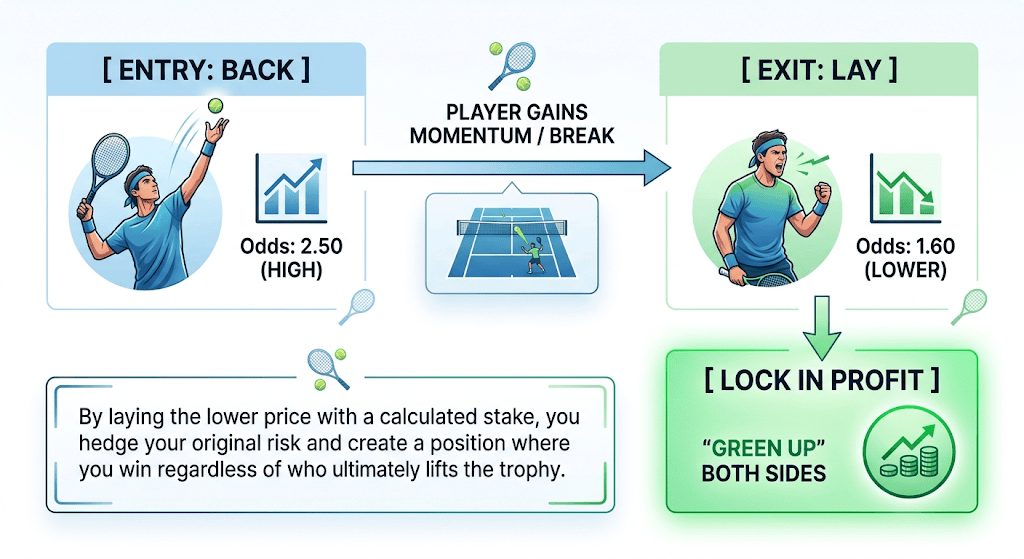
  1. BACK (Buy): You place a £10 bet on a player at high odds when the market understates their immediate chances.
  2. WAIT: The player gains momentum, scores key points, or wins a game/set, causing their decimal odds to shorten (drop).
  3. LAY (Sell): You bet against that same player using a £10 stake at lower odds to lock in a profit across all outcomes (“greening up”).

By placing a £10 Lay bet at lower odds, you hedge your original risk and create a position where you earn a profit regardless of who ultimately lifts the trophy.

Entry Points: When Should You Back to Lay?

Winning at Back to Lay comes down to spotting market overreactions or structural pivot points. Here are three prime entry triggers:

1. Fading the Cold Favorite

A strong pre-match favorite drops the first set or gets broken early. Their odds drift sharply higher due to panic selling in the market. If underlying match statistics (first-serve percentage, unforced errors) show they are simply cold rather than injured, backing them with a £10 stake at peak odds offers tremendous value before their inevitable response.

2. High-Stress Game Pivots (Scalping the Server)

When a dominant server drops to $0-30$ or $15-40$ in a service game, their match odds momentarily spike. If you place a £10 Back bet on them to fight back and hold serve, their odds will drop right back down after two or three big serves, giving you a quick exit window to Lay them for £10.

3. Surface & Matchup Advantage

Underdogs often start aggressively on fast surfaces (like grass or indoor hard courts). Backing a heavy-hitting underdog with a £10 stake pre-game or early in Set 1, then laying them off for £10 the moment they score an early break or force a tiebreak, yields quick tick profits.

Real Match Walkthroughs

Example 1: The Favorite Recovery

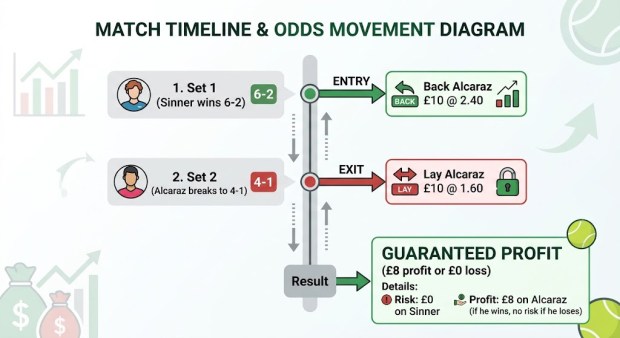
  • Match: Carlos Alcaraz vs. Jannik Sinner
  • Situation: Pre-match, Alcaraz is trading at 1.50. Early in Set 1, Sinner plays lights-out tennis, breaks twice, and takes the set 6-2.
  • Market Shift: Alcaraz’s match odds drift up to 2.40.

Net Result:

  • If Alcaraz Wins: You win £14 from your Back bet and lose £6 on your Lay bet liability = +£8 Profit.
  • If Sinner Wins: You lose your £10 Back bet and win the £10 Lay stake = £0 (Break-even).

Example 2: Break-Point Scalp

  • Match: Aryna Sabalenka vs. Elena Rybakina
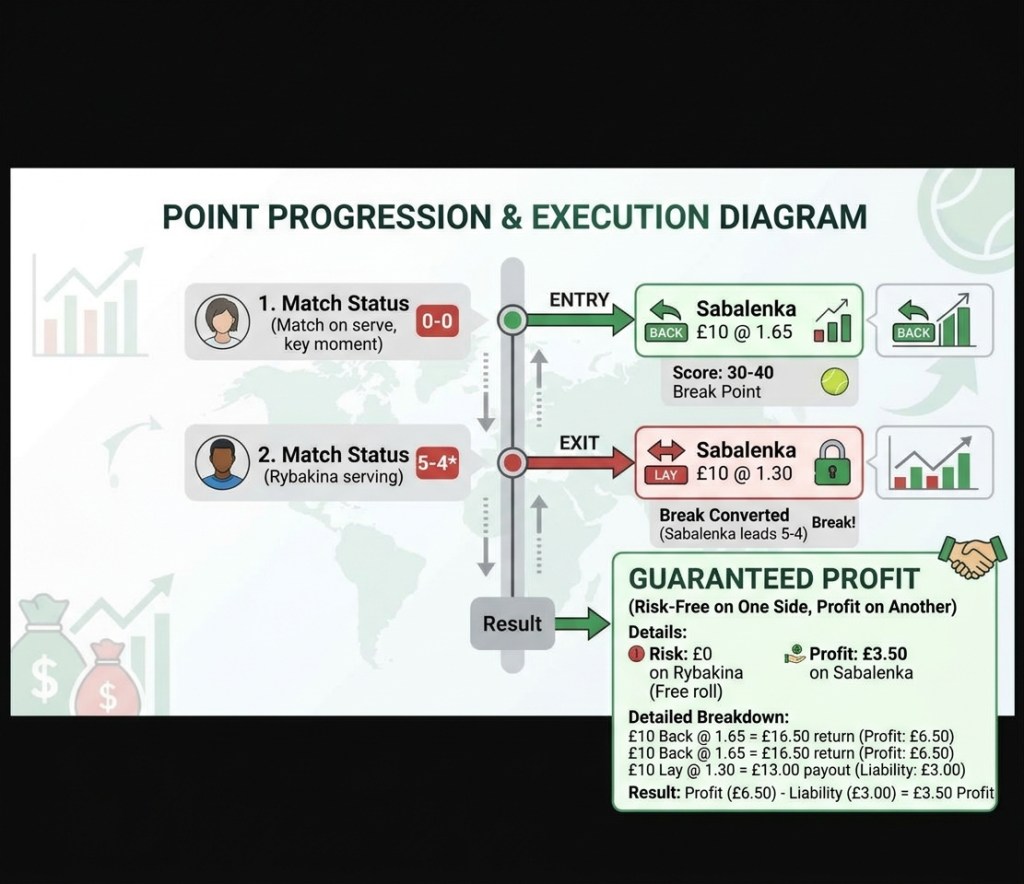
  • Situation: Set 1 is tied at 4-4, 30-30 on Rybakina’s serve. Rybakina misses a first serve and commits an unforced error to bring up Break Point (30-40).
  • Market Shift: Sabalenka’s odds drop to 1.65 anticipating the break.
  1. Trade Entry: You Back Sabalenka at 1.65 for £10 (Potential profit: £6.50).
  2. Match Event: Sabalenka strikes a deep return-winner to convert the break and go up 5-4, serving for the set.
  3. Price Movement: Sabalenka’s odds instantly shorten to 1.30.
  4. Trade Exit: You Lay Sabalenka for £10 at 1.30 (Liability: £3.00).

Net Result:

  • If Sabalenka Wins: You win £6.50 on the Back bet minus the £3.00 Lay liability = +£3.50 Profit.
  • If Rybakina Wins: You lose the £10 Back bet and win the £10 Lay stake = £0 (No Loss).

3 Essential Rules for Back to Lay Trading

  1. Always Set a Stop-Loss Before Entering: If you Back a player with a £10 stake expecting a turnaround, but they get broken again, execute your £10 Lay trade at higher odds to cut losses quickly. Never convert a trade into a standard “hope” bet.
  2. Watch the Live Feed, Not Just the Scoreboard: Television and betting exchange streams often have a 3–7 second delay. Use courtside data or live video feeds where possible to avoid getting caught out by fast-moving points.
  3. Account for Serve Dynamics: WTA (women’s) matches statistically see a higher frequency of service breaks, leading to larger price swings than ATP (men’s) matches. Adjust your profit targets and volatility expectations accordingly.

For a visual breakdown of entry points and odds movement on betting exchanges, watch How to Trade Tennis on Betfair. This video walks through real-time exchange ladder movements and execution techniques.

Mastering the “Back the Favourite and Trade Out” Tennis Strategy

If you are entering the world of exchange trading on platforms like Smarkets or Betfair, “Back the Favourite and Trade Out” is one of the foundational position trades you need in your toolkit.

Unlike traditional sports betting, where you back a player and pray they win the entire match, tennis exchange trading focuses purely on price movement. You enter a position when you believe a price is overly generous, wait for the market to adjust in your favor, and lay off the position to lock in a profit before the final handshake at the net.

In this guide, we break down exactly how this strategy works, walk through step-by-step mathematical examples, explore when to deploy it, and examine how to manage your risk when things don’t go to plan.


What is “Back the Favourite and Trade Out”?

At its core, this strategy involves backing a player at a higher price (decimal odds) with the intention of laying that same player at a lower price later in the match.

  • Backing: Betting on an outcome to happen (acting like a traditional bettor).
  • Laying: Betting against an outcome happening (acting like the bookmaker).

When you back a player and their odds drop—for example, because they won the opening set or broke their opponent’s serve—you can lay them at the new, lower odds. This locks in an equal profit across all outcomes or completely eliminates your financial exposure.

The key takeaway? You are trading the movement in price, not necessarily predicting the eventual match winner.


Step-by-Step Example

Let’s look at a concrete breakdown to see how the numbers play out in real-time.

Phase 1: The Entry

Imagine a ATP/WTA match where Player A is expected to perform well, but due to market conditions, is trading at decimal odds of 2.50.

  • Action: You Back Player A for £10 at 2.50.
  • Your Exposure: £10 (if Player A loses, you lose £10).
  • Potential Return: £25 total (£15 profit) if Player A wins without trading out.

Phase 2: The In-Play Shift

Player A starts strong, holding serve comfortably and breaking their opponent early to take the first set 6–3.

Because Player A is now in a dominant position to win the match, the market reacts quickly. Their odds shorten significantly from 2.50 down to 1.70.

Phase 3: The Exit (Trading Out)

Instead of letting the match run and taking the risk of a comeback, you choose to trade out by laying Player A at 1.70.

To create an equal profit on both players (a “green screen”):

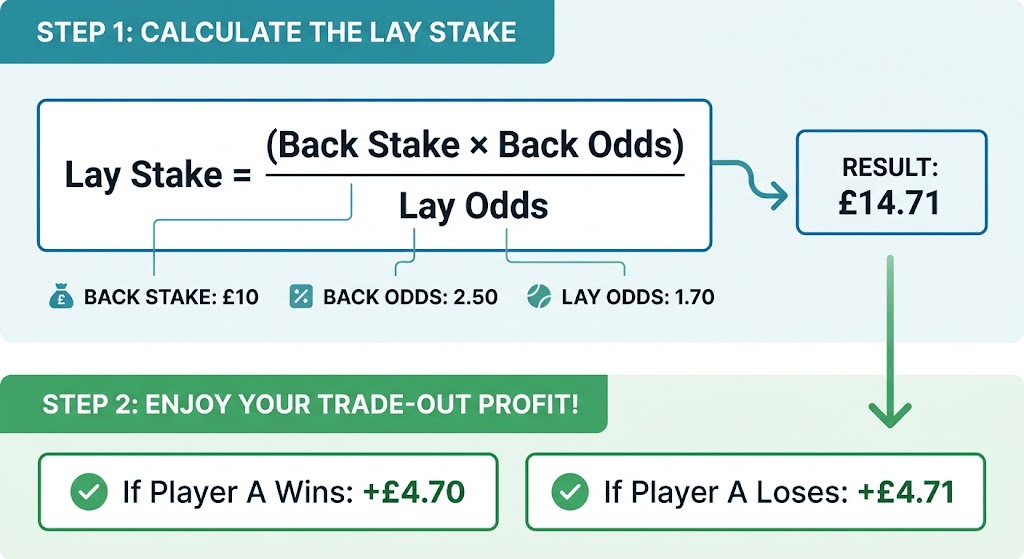
  • Action: Lay Player A for £14.71 at 1.70.

The Resulting Profit Matrix:

  • If Player A wins: You make £15 (from back) minus £10.30 (lay liability: $14.71 \times 0.70$) = +£4.70 profit
  • If Player A loses: You lose £10 (from back) plus £14.71 (from lay stake) = +£4.71 profit

(Note: Exact figures will vary slightly depending on exchange commission fees.)

Regardless of who goes on to win the match, you have successfully locked in roughly £4.70 profit.


When Does This Strategy Work Best?

This trade relies on predicting an early shift in momentum or market sentiment. Look for matches where:

  1. Strong Servers: Players with heavy first serves who rarely get broken early on. A simple hold-and-break pattern in the first set triggers quick price contractions.
  2. Fast Starters: Players who statistically perform best in first sets, even if their overall match endurance is questionable.
  3. Favourable Surface/Head-to-Head: A player whose game style specifically counters their opponent on a given surface (e.g., a clay court specialist against a flat-hitter).
  4. Underestimated Chances: Situations where pre-match odds feel inflated due to a minor recent loss, creating value at entry.

Risk Management & What to Avoid

The single biggest danger when backing a favourite to trade out is a price drift. If your player starts slowly, gets broken early, or drops the first set, their odds will drift outwards (e.g., from 2.50 to 3.50+).

To protect your bankroll, always establish a clear plan before placing your initial back bet:

  • Set a Target Exit: Know the price at which you will take your profit (e.g., exit when odds hit 1.70).
  • Set a Stop-Loss: Determine the maximum price drift or scoreline (e.g., if Player A gets broken in Set 1) where you will accept a minor loss and exit the trade rather than hoping for a Miracle comeback.
  • Avoid Holding to the End: Resist the temptation to convert a trade into a standard bet. The goal of tennis trading is consistency through active price management.

Final Thoughts

Backing the favourite and trading out is an ideal strategy for traders learning how to manage in-play odds movement. By focusing on early momentum and executing calculated exits, you turn unpredictable match outcomes into controlled, manageable trades.

Tennis Trading: The Different Trades You Can Make on a Tennis Match

Tennis is one of the most interesting sports for exchange trading.

Unlike traditional betting, tennis trading allows you to enter a position and then potentially close it before the match has finished. Prices can move dramatically after a single break of serve, a set win, an injury, or even a change in momentum.

That creates opportunities for traders who are prepared to manage both their entries and exits.

On an exchange such as Smarkets, there are several different ways to trade a tennis match. Some trades are relatively straightforward, while others require a much better understanding of tennis, momentum and probability.

This guide looks at the main tennis trades and explains how they work.


1. Back the Favourite and Trade Out

This is probably the simplest tennis position trade.

You back a player at relatively high odds and hope their price shortens as they move closer to winning.

Example

Player A is trading at:

2.50

You back them for £10.

If Player A wins the first set and their price subsequently falls to:

1.70

you can lay the same player to lock in a profit.

The important point is that you don’t necessarily need Player A to win the match.

You’re trading the movement in the price.

When can it work?

This type of trade can be particularly interesting when:

  • The player is expected to start strongly.
  • They are a strong server.
  • They have a favourable matchup.
  • Their opponent has poor recent form.
  • The market appears to have underestimated their chances.

However, the biggest danger is backing a player whose price continues to drift.


2. Back-to-Lay

The classic back-to-lay trade involves backing a player and then laying them at shorter odds.

For example:

Back £10 @ 3.00

If the price falls to:

Lay @ 2.00

you can trade out.

The amount you can win depends on the exact stake and exchange commission, so traders should calculate their green-up position before entering.

The advantage is that the trade can be closed before the final result.


3. Lay-to-Back

The opposite strategy is to lay a player at relatively short odds and hope their price drifts.

For example:

Lay Player A @ 1.50

Player A then loses the first set and their price moves to:

3.00

You can back Player A at the higher price to close the trade.

This is effectively betting that the market has overestimated a player’s chances at the original price.

It can be particularly interesting when a short-priced player is struggling despite being the pre-match favourite.


4. Lay the Favourite

One of the most popular tennis trading strategies is laying a strong favourite.

Suppose:

Player A — 1.20

Player B — 5.50

You believe Player A is vulnerable.

Instead of backing Player B, you can lay Player A.

If Player A gets into trouble, their price can increase rapidly.

For example:

1.20 → 1.50 → 2.00 → 3.00

The trader can then back Player A at the higher price and potentially lock in a profit.

The attraction of this strategy is that tennis prices can move extremely quickly after a break of serve.


5. Trade a Player After They Lose Their Serve

A break of serve can produce a significant price movement.

Imagine Player A is trading at:

1.40

They are broken early in the second set.

Their price might move to:

1.80

or higher.

A trader could consider backing them after the price drift if they believe the break is likely to be recovered.

This is essentially trading a potential break-back.

However, this is not simply a case of “a player has been broken, therefore back them.”

You need to consider:

  • Who is serving?
  • How strong is the server?
  • What is the score?
  • How has the match been played?
  • Has the player been creating break opportunities?
  • Is the player physically struggling?

6. Trade the Break Back

The opposite situation can also create an opportunity.

Suppose Player A is serving for the set but is broken.

The market reacts quickly and their price drifts.

If you believe Player A can immediately break back, you could back them at the bigger price.

A successful break back can produce a rapid price contraction.

For example:

1.30 → 1.75 → 1.35

That can create a trading opportunity without requiring the player to win the match.


7. Set Betting Trades

You don’t have to trade the match-winner market.

Set markets can also provide opportunities.

For example:

Player A to win Set 1

You might back them before the match or early in the set.

If they move into a strong position, you can potentially trade out.

Set markets can sometimes react more dramatically than match markets because there is less time remaining for the outcome to change.

The downside is that liquidity can be lower.


8. Correct Score Trading

Correct-score markets can also be traded.

Examples include:

  • 2–0
  • 2–1
  • 0–2
  • 1–2

At the beginning of a match, a 2–0 correct score might be trading at a relatively high price.

If the favourite wins the first set, the 2–0 price can shorten considerably.

A trader can then close the position.

This is a much more aggressive form of trading because there are fewer ways for the trade to succeed.


9. Total Games Trading

Another interesting tennis market is total games.

Examples:

Over 22.5 games

or

Under 22.5 games

You can trade the total number of games in the match.

This can be particularly interesting when the match is expected to be close.

For example, a first set finishing:

7–6

can cause the Over price to shorten dramatically.

A trader who backed Over before the match may then have an opportunity to close the position.


10. Over/Under Games in a Set

The same principle can be applied to individual sets.

For example:

Over 9.5 games — Set 1

If the first set reaches 5–4, the market may react strongly.

Likewise, if a player races into a 5–1 lead, the Under price can shorten considerably.

These markets require traders to understand the relationship between the current score and the remaining games required.


11. Trading the First Set

The first set provides some particularly interesting trading opportunities.

Suppose Player A is priced at:

1.80

They start well and move to:

4–2

Their price might shorten substantially.

Rather than holding the position until the end of the match, a trader can potentially take the profit at that point.

The advantage is that you are reducing your exposure to what happens later in the match.


12. Trading Momentum

Momentum is one of the most discussed subjects in tennis trading.

Imagine:

Player A wins the first set.

Then Player B immediately goes a break ahead in the second.

The market may move rapidly.

A trader might believe the match has swung too far towards Player B and look for a position on Player A.

However, momentum should never be treated as a guarantee.

A player may have genuinely lost control of the match.

The key is determining whether the price movement is justified or excessive.


13. Trading the Server

Because tennis is based around service games, the current server can be extremely important.

Consider a player trading at:

1.50

They are serving at 5–4 for the set.

If they hold serve, they win the set and their price could shorten significantly.

If they are broken, however, the price can move sharply in the opposite direction.

This creates a potential short-term trading opportunity around important service games.


14. Trading Tie-Breaks

Tie-breaks can produce some of the fastest price movements in tennis.

At 6–6, the next few points can dramatically change the match price.

A player might move from:

1.70

to:

1.25

after gaining a significant lead.

But the reverse can happen just as quickly.

Tie-break trading therefore carries considerable risk.

A small number of points can completely change the position.


15. Trading a Favourite Who Starts Slowly

Sometimes a pre-match favourite starts badly.

For example:

Player A starts at:

1.30

They lose the first set and drift to:

2.80

A trader who believes the pre-match assessment remains valid may consider backing them at the larger price.

This is sometimes referred to as backing the favourite after a price drift.

But there is an important distinction between a player simply having a bad set and a player having a genuine problem.

Look for information such as:

  • Break-point opportunities
  • First-serve percentage
  • Unforced errors
  • Winners
  • Rally performance
  • Physical condition
  • Movement
  • Previous head-to-head results
  • Surface suitability

16. Trading an Underdog Who Starts Well

The opposite strategy is to back an underdog before the match and trade after they make a strong start.

For example:

Player B @ 4.50

Player B then takes the first set.

Their price might fall substantially.

Rather than continuing to hold the position, the trader can take the profit.

This can be attractive because the original objective was the price movement, not necessarily predicting the eventual winner.


17. Trading Around Match Points

Match points create enormous price movements.

If a player reaches match point, their price can collapse.

If they save match point, the price can immediately rebound.

This creates opportunities, but it is also one of the most dangerous areas of tennis trading.

A single point can turn a profitable position into a losing one.

Traders should be particularly careful with unmatched orders and fast-moving markets.


18. Trading an Injury or Medical Timeout

An injury can completely transform a tennis market.

A player who is struggling physically may suddenly drift dramatically.

However, attempting to anticipate an injury is extremely risky.

Instead, traders should react to observable information.

If a player takes a medical timeout and subsequently shows obvious physical problems, the market may reassess their chances.

This can create large price movements in both directions.


19. Trading Retirement Markets

Some exchanges provide markets relating to whether a player will retire.

These are specialist markets and require considerably more understanding of the rules and settlement conditions.

The key lesson is simple:

Always understand the market’s settlement rules before trading it.

Different markets can have different rules concerning retirements, walkovers and abandoned matches.


20. Trading the Match Handicap

Handicap markets can also be traded.

For example:

Player A -3.5 games

or

Player B +3.5 games

The price can move as the match develops.

These markets are particularly interesting when the match is expected to be relatively one-sided but the exact winner’s price is too short for a trader’s strategy.


21. Combining Pre-Match and In-Play Information

One of the most useful approaches is to combine pre-match analysis with what is actually happening on court.

Before entering a trade, consider:

Pre-match

  • Ranking
  • Recent form
  • Surface
  • Head-to-head
  • Serve statistics
  • Return statistics
  • Recent opponents
  • Injury history
  • Tournament conditions

In-play

  • Current score
  • Service performance
  • Break points
  • First-serve percentage
  • Unforced errors
  • Winners
  • Physical condition
  • Momentum
  • Body language
  • Quality of rallies

The market price should then be compared with your assessment.


22. Don’t Confuse Trading With Predicting

This is perhaps the most important concept.

A tennis trader does not necessarily need to predict the winner.

Instead, the trader is trying to identify when the market price is likely to move.

For example:

You might back Player A at 3.00 and lay at 2.20.

Player A could subsequently lose the match.

That doesn’t necessarily mean the trade was unsuccessful.

The trade was based on the price moving from 3.00 to 2.20.


A Simple Tennis Trading Framework

Before entering a position, ask five questions:

1. Why am I entering?

What do I believe the market has got wrong?

2. What price am I entering at?

Never enter simply because you “like” a player.

3. What is my target exit?

Know your target before placing the trade.

4. Where will I take a loss?

Every trade needs a point at which you accept that your original idea was wrong.

5. What could happen next?

Consider the next service game, break point, set point or tie-break.


The Golden Rule of Tennis Trading

The biggest mistake new traders make is waiting for the trade to become a winning bet.

A position trade should have an entry, a target and an exit plan.

For example:

Back Player A @ 2.50
Target exit @ 2.00
Maximum acceptable loss @ 3.20

The exact prices will depend on the match and the trader’s analysis.

The important thing is having the plan before emotions take over.


Final Thoughts

Tennis offers an unusually wide range of trading opportunities because the market is constantly responding to points, games, sets and changes in momentum.

The major strategies include:

  • Back-to-lay
  • Lay-to-back
  • Laying favourites
  • Backing drifting favourites
  • Trading underdogs
  • Trading breaks of serve
  • Trading break-backs
  • Set trading
  • Correct-score trading
  • Total-games trading
  • Set totals
  • Tie-break trading
  • Momentum trading
  • Service-game trading
  • Handicap trading
  • Injury-related trading

No strategy is guaranteed to make money.

The strongest approach is to treat every trade as a price-management exercise, rather than simply trying to pick the winner.

The objective isn’t necessarily to predict what happens at the end of the match.

It is to identify a price you believe is wrong, enter the market, manage the position and get out when the market moves in your favour.

That’s tennis trading.

AI Predictions For Day 1 of The Mens Singles Matches at Wimbledon

As with the Ladies I asked AI to do the same with the Mens 1st Round Matches Today

Here is what it produced

Here are my predictions for the key men’s singles matches on Day 1 at Wimbledon (Monday). These are based on current form, grass-court record, draw strength, and recent performances.

MatchPredictionConfidence
Jannik Sinner vs Miomir KecmanovićSinner in 3⭐⭐⭐⭐⭐
Novak Djokovic vs Wu YibingDjokovic in 3⭐⭐⭐⭐⭐
Daniil Medvedev vs Benjamin BonziMedvedev in 4⭐⭐⭐⭐
Cameron Norrie vs Tomás Martín EtcheverryNorrie in 4⭐⭐⭐
Lorenzo Musetti vs Fabio FogniniMusetti in 3⭐⭐⭐⭐
Alexander Bublik vs Thiago Seyboth WildBublik in 4⭐⭐⭐
Matteo Berrettini vs Alex MichelsenBerrettini in 5⭐⭐⭐
Hubert Hurkacz vs Jaume MunarHurkacz in 4⭐⭐⭐⭐

Jannik Sinner vs Miomir Kecmanović

Prediction: Sinner 6-4, 6-3, 6-2

Sinner begins the defence of his Wimbledon title. Kecmanović is a solid all-rounder, but he lacks the firepower to consistently trouble Sinner on grass unless Sinner is physically below his best.

Win probability

  • Sinner: 95%
  • Kecmanović: 5%

Novak Djokovic vs Wu Yibing

Prediction: Djokovic 6-3, 6-2, 6-4

Even at 39, Djokovic remains one of the best grass-court players in history. Wu has clean ball-striking but little success on grass and will struggle to earn free points on serve.

Win probability

  • Djokovic: 97%
  • Wu: 3%

Daniil Medvedev vs Benjamin Bonzi

Prediction: Medvedev 6-4, 3-6, 6-4, 6-2

Medvedev has become much more comfortable on grass over the past few years. Bonzi is capable of making this awkward, but over five sets Medvedev’s consistency should prevail.

Win probability

  • Medvedev: 80%
  • Bonzi: 20%

Cameron Norrie vs Tomás Martín Etcheverry

Prediction: Norrie 6-4, 4-6, 6-3, 6-4

A fascinating match.

Etcheverry is more comfortable on clay, while Norrie has a proven Wimbledon pedigree and will have strong home support.

Win probability

  • Norrie: 65%
  • Etcheverry: 35%

Lorenzo Musetti vs Fabio Fognini

Prediction: Musetti 6-4, 6-4, 7-5

Fognini still possesses wonderful shot-making, but Musetti is now the superior athlete and more reliable over five sets.

Win probability

  • Musetti: 88%
  • Fognini: 12%

Alexander Bublik vs Thiago Seyboth Wild

Prediction: Bublik 7-6, 4-6, 6-3, 6-4

Probably the most unpredictable match of the day.

Bublik’s huge serve makes him particularly dangerous on grass, but his concentration can fluctuate.

Win probability

  • Bublik: 68%
  • Seyboth Wild: 32%

Matteo Berrettini vs Alex Michelsen

Prediction: Berrettini 6-7, 6-4, 7-6, 3-6, 6-3

If Berrettini is fully fit, he’s one of the strongest grass-court players in the field thanks to his serve and forehand. Michelsen has the game to push him deep, making this a potential five-set thriller.

Win probability

  • Berrettini: 60%
  • Michelsen: 40%

Hubert Hurkacz vs Jaume Munar

Prediction: Hurkacz 7-6, 6-4, 3-6, 6-3

Grass rewards Hurkacz’s serve and first-strike tennis, whereas Munar is generally more effective on slower surfaces.

Win probability

  • Hurkacz: 78%
  • Munar: 22%

Best matches to watch

⭐ Berrettini vs Michelsen – likely to feature plenty of big serving and momentum swings.

⭐ Norrie vs Etcheverry – a competitive match with contrasting styles.

⭐ Bublik vs Seyboth Wild – high-upside shot-making and potential drama.

Biggest upset chances

  1. Alex Michelsen over Berrettini (~40%)
  2. Etcheverry over Norrie (~35%)
  3. Seyboth Wild over Bublik (~32%)

Best accumulator picks

  • ✅ Jannik Sinner
  • ✅ Novak Djokovic
  • ✅ Lorenzo Musetti
  • ✅ Hubert Hurkacz

Those four look like the strongest favourites among the men’s first-round matches scheduled today.

AI Predictions For Day 1 of The Ladies Singles Matches at Wimbledon.

My Question to an AI Bot this morning was

“Please analyse and predict each match in todays Ladies wimbledon matches”

Lets see what it disgorged

Here are my predictions for the headline women’s singles matches on Day 1 (Monday) based on current form, grass-court ability, draw position, and matchup dynamics.

MatchPredictionConfidence
Aryna Sabalenka vs Teodora KostovicSabalenka in 2⭐⭐⭐⭐⭐
Mirra Andreeva vs Magda LinetteAndreeva in 2⭐⭐⭐⭐
Jessica Pegula vs Darja VidmanovaPegula in 2⭐⭐⭐⭐⭐
Coco Gauff vs Tamara KorpatschGauff in 2⭐⭐⭐⭐
Naomi Osaka vs Elsa JacquemotOsaka in 2⭐⭐⭐⭐
Barbora Krejcikova vs Hannah KlugmanKrejcikova in 2⭐⭐⭐⭐
Karolina Muchova vs Anastasia ZakharovaMuchova in 2⭐⭐⭐⭐
Maja Chwalinska vs Mananchaya SawangkaewChwalinska in 3⭐⭐⭐

Aryna Sabalenka vs Teodora Kostovic

Prediction: Sabalenka 6-2, 6-1

The world No. 1 has one of the biggest serves in women’s tennis and has reached multiple Wimbledon semifinals. Kostovic is making her Grand Slam main-draw debut, making this a very difficult assignment. Sabalenka’s only real challenge is avoiding a slow start.

Win probability

  • Sabalenka 97%
  • Kostovic 3%

Mirra Andreeva vs Magda Linette

Prediction: Andreeva 6-4, 6-3

This is one of the better matches of the day.

Linette is experienced and comfortable on grass, but Andreeva has become one of the tour’s elite players this season. Her variety and movement should eventually wear Linette down.

Win probability

  • Andreeva 75%
  • Linette 25%

Jessica Pegula vs Darja Vidmanova

Prediction: Pegula 6-3, 6-2

Pegula’s consistency should be too much. Vidmanova is talented but lacks experience against top-five opponents on grass.

Win probability

  • Pegula 92%
  • Vidmanova 8%

Coco Gauff vs Tamara Korpatsch

Prediction: Gauff 6-3, 6-4

Grass isn’t Gauff’s strongest surface, but Korpatsch’s game doesn’t naturally exploit grass either.

If Gauff serves well, she should move through comfortably.

Win probability

  • Gauff 84%
  • Korpatsch 16%

Naomi Osaka vs Elsa Jacquemot

Prediction: Osaka 7-5, 6-3

Osaka’s power translates well to grass.

The only question is rhythm, as she has played relatively little grass-court tennis compared with some rivals.

Win probability

  • Osaka 80%
  • Jacquemot 20%

Barbora Krejcikova vs Hannah Klugman

Prediction: Krejcikova 6-2, 6-4

Klugman is one of Britain’s brightest prospects and will have home support.

However, Krejcikova’s all-court game and Wimbledon experience make her a heavy favourite.

Win probability

  • Krejcikova 88%
  • Klugman 12%

Karolina Muchova vs Anastasia Zakharova

Prediction: Muchova 6-4, 6-2

If healthy, Muchova is one of the most naturally gifted players on grass.

Her slice, touch and net play are perfectly suited to Wimbledon.

Win probability

  • Muchova 86%
  • Zakharova 14%

Maja Chwalinska vs Mananchaya Sawangkaew

Prediction: Chwalinska 6-4, 3-6, 6-3

This is the day’s most evenly matched contest.

Chwalinska’s left-handed variety gives her a slight edge, but this could easily go the distance.

Win probability

  • Chwalinska 58%
  • Sawangkaew 42%

Best value matches to watch

⭐ Andreeva vs Linette – the highest-quality tactical match.

⭐ Osaka vs Jacquemot – Osaka’s Wimbledon credentials will be tested.

⭐ Muchova vs Zakharova – if Muchova is healthy, she’s capable of a deep run.

Biggest upset chance

Magda Linette over Mirra Andreeva (around a 25% chance).

Linette has enough experience and grass-court know-how to trouble Andreeva if she serves well and keeps points short.

Accumulator picks

  • ✅ Sabalenka
  • ✅ Pegula
  • ✅ Gauff
  • ✅ Muchova
  • ✅ Krejcikova

Those five are, in my view, the strongest favourites among today’s women’s singles matches.

AI prediction for the Svitolina v Snigur 1st round match at Wimbledon

This looks like a classic favourite versus dangerous underdog first-round match.

My prediction

Winner: Elina Svitolina

Confidence: Around 75–80% in Svitolina’s favour, which is broadly in line with several independent predictive models.

Most likely score: 6-3, 6-4

Alternative: 6-4, 3-6, 6-2 if Snigur serves exceptionally well.

Why Svitolina is the favourite

1. Experience at Wimbledon

Svitolina is a proven performer at SW19, having reached the Wimbledon semi-finals twice. She knows how to construct points on grass and is one of the tour’s best defenders, turning defence into offence.

2. Excellent 2026 form

She arrives after an outstanding first half of the season:

Rome champion

Australian Open semi-finalist

French Open quarter-finalist

Strong grass preparation in Berlin and Bad Homburg despite not winning either event.

3. Ranking gap

Svitolina: World No. 8

Snigur: Around World No. 78

That gap reflects consistent results against elite opposition rather than just reputation.

Why Snigur shouldn’t be underestimated

Daria Snigur is more comfortable on grass than many players ranked outside the top 50.

She:

plays flat, aggressive tennis,

takes the ball early,

can rush opponents on faster courts,

has produced surprise wins on grass before.

If she serves well and keeps points short, she can make the match uncomfortable.

Tactical battle

Svitolina’s keys

Extend rallies.

Neutralise Snigur’s first strike.

Attack Snigur’s second serve.

Make Snigur hit extra balls.

Snigur’s keys

High first-serve percentage.

Short rallies.

Attack with the backhand early.

Finish points at the net whenever possible.

If rallies consistently reach 8–10 shots, the advantage swings heavily towards Svitolina.

Head-to-head

Interestingly, they have never played each other on the WTA Tour, so there are no previous meetings to draw on.

Factors that could change the outcome

Snigur’s chances improve if:

the grass is particularly quick,

Svitolina starts slowly,

Snigur serves above 70% first serves,

Snigur wins a high percentage of short rallies.

Otherwise, Svitolina’s consistency should gradually wear her down.

Predicted outcome

Elina Svitolina defeats Daria Snigur 6-3, 6-4.

I think Snigur is capable of producing some spectacular shot-making and may keep one set close, but over the course of the match Svitolina’s superior movement, consistency and big-match experience should prove decisive.