
Can a £200 Tennis Betting Bank Become a Profitable Strategy? What Our WTA Spreadsheet Actually Revealed

An exploration of favourites, underdogs, rankings, stake progression and promotional credit—and why the best-looking result is not always the best strategy.

By James Burnet | betornot.com

A betting spreadsheet can make almost any strategy look exciting if we ask enough questions. Narrow the odds, choose a particular round, select a tournament tier, increase the stakes—and eventually a striking profit figure appears.

But is that figure evidence of an advantage, or simply the result of finding a favourable pocket of history?

That was the question behind this workbook. We began with January match-price streams for four WTA players, then expanded the investigation to two season datasets. We tested backing and laying, ranking-based selections, odds bands, tournament rounds, different staking schedules and a £200 starting bank. Finally, we explored the effect of weekly and monthly promotional credit.

Some results were encouraging. Others were uncomfortable. The most useful finding was not a magic odds range: it was how differently the same rule could perform when the year, payout assumptions or staking schedule changed.

First, what did we actually test?

The initial files covered Coco Gauff, Iga Swiatek, Jessica Pegula and Marta Kostyuk. They contained 36 player–match records representing 34 distinct matches, including one doubles match. Shared matches were counted once in overall strategy totals.

The larger datasets contained:

  • 2025 season dataset: 2,505 match records, dated 29 December 2024 to 8 November 2025.
  • 2026 dataset: 2,457 match records, dated 4 January to 1 November 2026.

These are the dates and results supplied in the workbook, not independently verified match records. Neither dataset is a complete January-to-December calendar year. Opening-season December 2024 matches were retained in the 2025 dataset.

For the broader experiments, we used B365W and B365L: the supplied bookmaker prices for the eventual winner and loser. We excluded unfinished matches and invalid paired prices. Equal odds were excluded when choosing an odds favourite or underdog; ranking-based strategies instead required valid, unequal rankings.

Most simulations retained 6% commission on positive match profit to make the comparisons consistent. That is a modeling choice—not a statement that bookmaker back bets incur exchange commission.

The biggest limitation: bookmaker odds are not lay quotes

The January streams and season-level B365 data are different kinds of evidence. The latter do not tell us the first in-play price, the available exchange lay price, liquidity or whether an order would have matched.

A bookmaker back price cannot simply be assumed to be an executable exchange lay price. Consequently, the season-level lay profits in this article are hypothetical calculations at supplied prices, not proven trading returns.

This matters particularly when backing both sides produces losses but laying one side appears profitable. That apparent opportunity may reflect the assumed pricing rather than an advantage that can actually be traded.

£1 liability is not a £1 lay stake

For a lay bet, the liability is the maximum loss if the selected player wins. The stake is the amount won, before commission, if that player loses.

At odds of 1.20, a £1 liability requires a £5 lay stake:

Lay stake = liability ÷ (odds − 1).

If the player loses, the £5 profit becomes £4.70 after the modeled 6% commission. If the player wins, the loss is £1.

For a back bet, a £1 stake loses £1 if the player loses and earns £1 × (odds − 1) if the player wins.

Throughout the comparisons, ROI means net profit divided by total initial stakes or liabilities across bets—not return on the starting bank.

The first experiment: trade out, or hold to settlement?

Our original January idea was to lay a favourite at the first qualifying OPEN in-play update between 1.15 and 1.20, using £1 liability. The proposed exits were 1.50 for a profitable drift or 1.05 for a stop.

We modeled exact fills at those exit levels when subsequent OPEN prices crossed them. That assumption is important: an observed crossing does not establish that an order could have filled at the target price.

Across the 34 distinct matches, 25 entries qualified. Eleven reached the target, 13 reached the stop and one remained without a qualifying exit until settlement.

January strategyBetsNet P/LROI
Lay 1.15–1.20 and use modeled exits25£1.787.14%
Same entries, hold to settlement25−£5.03−20.11%
Lay the first OPEN in-play favourite, no odds filter34£5.9617.53%

The unrestricted opening-price test looked better, but two winning lays contributed £19.84. Without those two, the remaining bets lost £13.88.

This was our first warning: a profitable total can conceal heavy dependence on a very small number of outcomes.

Backing favourites and underdogs: winning frequently was not enough

The larger 2026 odds-based tests had 2,290 eligible matches.

Strategy, £1 initial risk per betNet P/LROI
Back the odds favourite−£119.50−5.22%
Back the odds underdog−£370.32−16.17%
Lay the odds favourite, £1 liability£90.143.94%

Favourites won 69.52% of those matches, yet backing them still lost money. Even before modeled commission, the loss was £82.57.

The lesson is straightforward: a high strike rate does not establish profitability. Prices and payouts matter as much as the number of winners.

The positive lay result needs the pricing caveat above. It must not be presented as proof that the exchange offered those same prices.

Rankings changed the selection—but did not remove the pricing problem

Using the match-supplied rankings, we defined the higher-ranked player as the one with the lower numeric rank. That player was not necessarily the odds favourite.

Across 2,349 eligible 2026 matches:

Ranking-based strategyNet P/LROI
Lay the higher-ranked player, £1 liability£174.287.42%
Back the lower-ranked player, £1 stake−£283.61−12.07%

Both strategies benefited from the same 846 match outcomes. They nevertheless had different returns because they used different prices and payout structures.

The timing also mattered. Higher-ranked lays earned £174.33 in January–June but were essentially break-even in July–November, losing £0.05. A strong overall number was therefore not evidence of an advantage sustained throughout the supplied period.

Quarterfinals stood out

Testing 435 intervals across the observed favourite odds identified 1.02–1.80 as the highest-total-profit range in the 2026 sample: £100.14 from 2,280 lays, or 4.39% ROI.

A range of 1.22–1.80 produced £88.00 from 1,805 lays, with a slightly higher 4.88% ROI. Removing its largest winning bet still left £83.73, so it was less dependent on one unusually large payout.

Breaking this range down by round revealed the following:

RoundBetsNet P/LROI
First round856£26.433.09%
Second round463−£20.22−4.37%
Third round130£14.3611.04%
Fourth round57−£0.04−0.06%
Quarterfinals173£62.9936.41%
Semifinals83−£4.34−5.23%
Finals43£8.8220.50%

Quarterfinals supplied most of the profit. Excluding the loss-making rounds would retrospectively have raised net profit to £112.59 and ROI to 9.37%.

However, those exclusions were selected after looking at the results. They are exploratory findings, not independently validated rules.

Were WTA500 quarterfinals the answer?

Within quarterfinals at 1.22–1.80, the 2026 tier comparison was striking:

TierBetsNet P/LROI
Grand Slam14−£1.37−9.77%
WTA100027£2.067.63%
WTA25078£23.4330.04%
WTA50054£38.8771.97%

WTA500 favourites lost 30 of 54 qualifying matches—55.6%. Those successful lays earned £62.87 after commission, offset by £24 of losses.

That explains the arithmetic. It does not explain the tennis. The workbook cannot establish that fatigue, motivation, scheduling or tournament importance caused those results.

Rankings did not provide a clean answer either. Most WTA500 quarterfinal profit came from favourites who were also better ranked: 47 bets produced £33.97. Rank-gap bands each contained only 11–15 bets, and their returns did not follow a simple consistent pattern.

The 2025 check changed the picture

Keeping the WTA500 quarterfinal rule at 1.22–1.80 unchanged produced:

DatasetBetsFixed £1 liability net P/LROI
202547£1.202.55%
202654£38.8771.97%

The 2025 result was only marginally profitable.

Narrowing the range to 1.22–1.50 made the contrast even clearer: 2025 lost £5.50 from 24 bets, while 2026 earned £27.00 from 27 bets.

This different-year check weakened the original conclusion. It was useful additional evidence, but not prospective validation: both datasets were historical, and we continued exploring them after seeing results.

A 20% increase after every tournament: impressive profits, alarming exposure

Next, we increased liability by 20% after each qualifying tournament, regardless of whether the previous event won or lost.

For WTA500 quarterfinals at 1.22–1.80, the 2026 progression earned £210.36. Yet the same approach lost £35.15 in 2025 and experienced an £80.91 tournament-end drawdown.

Expanding to all tiers and rounds at 1.20–1.40 made the exponential growth much more obvious:

DatasetFixed net P/LProgression net P/LFinal liability per bet
2025£30.70−£138,027.93£13,104.63
2026£11.65£103,759.63£9,100.44

These are uncapped simulations, not plans a £200 bank could fund. The 2025 tournament-end drawdown reached £157,780.37.

The progression did not make the selections more accurate. It gave later tournaments much more financial weight. Event overlap was also simplified: tournaments were indexed by first qualifying date, not actual completion-time bankroll availability.

What if liability increased monthly instead?

A monthly schedule was less explosive. New bets used 20% higher liability after each month-end, even inside a tournament; existing bets retained their original liability.

Each dataset restarted separately at £1 in its first qualifying month—December 2024 for the 2025 season and January 2026 for the 2026 dataset.

DatasetFixed £1 net P/LMonthly-growth net P/LMonthly-growth ROI
2025£30.70−£6.98−0.30%
2026£11.65£11.980.64%

The smaller escalation reduced exposure dramatically, but did not consistently improve the result. Fixed liability had the higher ROI in both datasets.

Could a £200 bank survive?

For the monthly-growth strategy at 1.20–1.40, the 2026 cumulative result fell £183.63 below its starting balance.

Assuming all bets on a day had to be funded before any settled—and all earlier dates had already settled—the historical starting-bank requirement was £196.53. Starting with £200 left just £3.47 free at the tightest point.

On 24 September 2026, previous losses were £175.03 and that day’s liabilities totaled £21.50. Together, they explain the £196.53 requirement.

A fresh £200 bank survived each year’s replay separately, ending at £193.02 in 2025 and £211.98 in 2026. This was not a test of one continuously carried bank under that monthly progression.

Nor is it a guarantee. Actual entry and settlement timestamps were missing. Multi-day unsettled bets could require more funding, and future losses could exceed the historical maximum.

Promotional credit: a different source of apparent profitability

The final experiment returned to fixed £1 liability, all tiers and rounds, favourite odds 1.22–1.80, and one cash bank carried between datasets.

Starting cash was £200. The modeled offers were £10 each Monday and £3 on the first of each month, usable for lay liability. Promotional credit was used before cash.

Under the chosen assumptions:

Result2025 dataset2026 dataset
Bets1,8311,805
New promotional credit£483.00£460.00
Cash winnings after commission£1,254.79£1,242.00
Cash-funded losses£699.00£694.00
Closing cash bank£755.79£1,303.79

The final £1,303.79 bank can be reconciled as:

£200 starting cash + £162.79 strategy profit + £941 of losses absorbed by promotional credit.

A further £2 of unused credit was kept separate from cash.

This is conditional, not a verified Betfair offer conversion. We assumed unused credit did not expire, winning lays released the promotional liability for reuse, winnings became cash and losses consumed the credit. The offer’s detailed terms were not confirmed. No qualifying-spend costs were included.

We also added no allowances during the missing 9 November 2025–3 January 2026 gap. This was not a full 104-week simulation.

The distinction is crucial: a promotional subsidy is not the same thing as a predictive trading advantage.

What would I take forward?

The workbook suggests a research candidate, not a ready-made money-making system. Quarterfinal favourite lays at 1.22–1.80 deserve further observation, but WTA500’s much weaker 2025 result prevents a confident claim of repeatability.

A sensible next experiment would freeze the selection rule and use paper trades at actual available exchange prices. It should record entry times, odds, available liquidity, fills, commission, settlement and rejected orders. Retirement treatment should be defined before testing rather than inferred after the result.

Keep liability fixed during that experiment. Do not escalate it simply because a month or tournament has ended.

Set a review point in advance—such as 100 qualifying paper bets—while recognising that a round number does not guarantee statistical reliability.

Review profit concentration, drawdown and performance by period, not just final ROI. Avoid repeatedly changing the rule to rescue a disappointing run: that produces another retrospective fit rather than a fair test.

The verdict: useful evidence, not a shortcut

This investigation showed why comparing strategies matters.

Backing frequently winning favourites still lost money. A highly profitable-looking quarterfinal filter weakened in another year. Stake increases amplified the ordering of results. A £200 bank could survive one modeled replay while leaving almost no funding margin. Promotional credit improved the cash outcome largely by paying for losses.

The most valuable result is therefore a better framework for asking questions:

Are the prices executable? Is the profit repeatable? What funds the losses? How much cash is tied up? And did we choose the rule before or after seeing the winners?

Until those questions have credible answers, a spreadsheet profit is a reason to investigate—not a reason to increase stakes.


Editorial disclosure

All figures above are retrospective workbook calculations using supplied match data. They are not independently verified sporting records, actual account statements or guaranteed betting returns. Figures are rounded for display.

Specific promotional terms have not been independently verified. The promotional-credit outcome depends on the assumptions stated in the article.

Betting can cause financial harm. Do not use essential funds, borrowing or automatic stake escalation to pursue losses.

Betting Trends at Wimbledon: Analyzing Top Seed Losses

Before the year 2000 you would have to go back to 1962 to find a player out of the top 5 seeding in the ladies tournament that won. Since and including 2000 there have only been 10 players that were within the top 5 seeding that have won the ladies tournament. Where did these players fall by the wayside and what odds on the exchange could you lay them off at?
2024 saw 31 seed Krejcikova winning the tournament with a 2-1 victory over 7 seed Paolini, but the top 10 seeds started falling out in the 1st round with the dismissal of Zheng and Vondrousova with sportsbook odds of 1.17 and 1.13 respectively. Round 2 saw 5 seed Pegula lose to unseeded Wang, her sportsbook odds were 1.25. The third round was a disaster for the seeded players with 1 seed Swiatek (Odds 1.08), 9 seed Sakkari (Odds 2.2) , and 10 seed Jabeur (Odds 1.5) all crashing out. This left just 4 of the top 10 seeded players progressing into the 4th round which also saw casualties in the form of 2 seed Gauff (Odds 1.29) and 11 seed Collins (Odds 1.44). (I have included Collins at 11 seed because No 3 seed Sabalenka withdrew before round 1 and did not play in the tournament). Both remaining top 10 seeded players, seed 4 Rybakina and seed 7 Paolini made it safely through the quarter finals but the semi finals were the limit for seed 4 Rybakini (Odds 1.2) who lost to eventual winner Krejcikova. As mentioned before Paolini was the last of the top 10 seeds to fall and became tournament runner up with match odds of 2.2.

The implications of these events warrant some serious investigation into either backing the underdog at sportsbook odds if you haven’t got an exchange account or laying the seeded player on the exchanges.

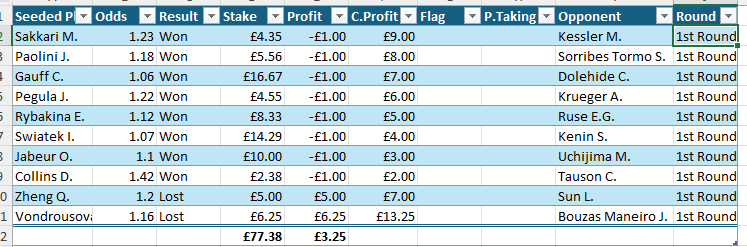
2024 Round 1 Matches

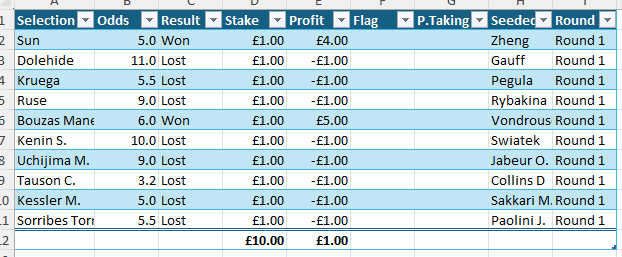
Wimbledon 1st round matches backing the underdog at £1.00 level stakes

The table above shows the results and profit had you backed the underdog with Bet365 sportsbook for a £1.00 level stake. As you can see your profit would have been £1.00

Wimbledon 1st round matches laying the top 10 seeded players.

This second table shows the results and profit achieved when laying the top 10 seeded players for a £1.00 liability at the exchange with a 0% commission If you factor in a 2% commission then the profit would be £3.02 instead of £3.25.

2024 2nd Round Matches

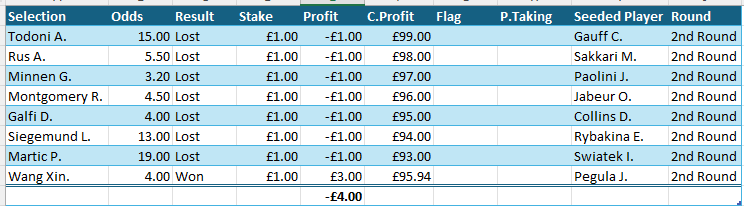
Wimbledon 2nd Round Backing the Underdog at £1.00 Level Stakes

In the 2nd round just 1 seeded player was knocked out and the “underdog” for the match was Wang Xin who was 3/1. Total stakes for round 2 was £8.00 producing, after Wangs’ win, a total loss of £4.00. This brings our total P/L for the tournament if we were backing the opponent of the top 10 seeded players to -£3.00.

Wimbledon 2nd round matches laying the remaining top 10 seeded players for a £1.00 liability

This table above shows the results if we had laid the remaining top 10 seed players. Our loss after 2% commission would be £3.74 giving a total loss of £3.72

2024 3rd Round Matches.

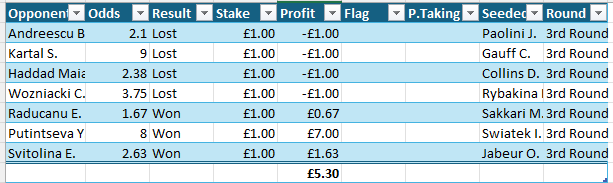
Wimbledon 3rd round matches Backing the underdog for a £1.00 level Stake

2024s’ 3rd round saw 3 of the top ten seeded players get knocked out including No 1 seed Swiatek which produced the highest individual profit of £7.00. The overall profit for round 3 backing the underdogs at Bet365 was £5.30 giving us an overall tournament profit of £2.30.

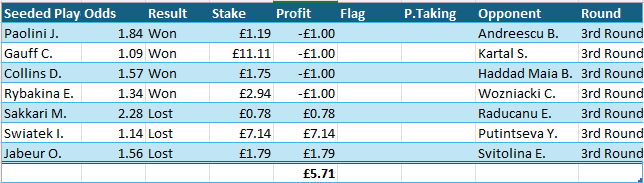
Wimbledon 3rd round matches laying the remaining top 10 seeded players to £1.00 liability

The dismissal of 3 of the remaining 7 top 10 seeded players has put our P/L back into the black with a 3rd round profit of £5.71 before commission deduction. With this factored in the 3rd round profit is £5.51 giving a tournament profit of £1.79

2024 4th Round Matches

Wimbledon 4th round matches backing the underdog at £1.00 level stakes

The dismissal of both Gauff and Collins in round 4 would have given us a level stake profit of £2.50 backing the underdog at Bet365 the retirement of both Keys and Kalinskaya ensured safe passage to the Quarter Finals of the remaining 2 top ten seeds Paolini and Rybakina. With these two wins in this round our total tournament profit for backing the underdog now stands at £4.80.

Wimbledon 4th round matches laying the remaining 4 top 10 seeds to a liability of £1.00.

Laying players at such short odds at the exchange has paid off in this round giving us an after commission profit of £3.10 adding to our tournament profit giving a total of £4.89

2024 Quarter Finals

Both of the remaining top 10 seeded players made it safely through to the semi finals reducing our Level stake profit when backing the underdog to £2.80. Laying the seeded players also had the same effect on our laying to a liability profit to £2.89 after commission.

2024 Semi Finals

Wimbledon 2024 Semi Final Matches showing the backing of the underdog at £1.00 level stakes

Paolini triumphed in her semi final match against unseeded Vekic but backing Krejcikova to win against Rybakina paid dividends producing an overall semi final profit to £1.00 level stakes at Bet365 of £2.0 giving us an overall tournament profit with just the final to play of £5.30.

Semi final matches involving the remaining 2 top ten seeded players when laying to a £1.00 liability.

Again laying the seeded player instead of backing the underdog produced a greater profit before 25 commission was deducted even with the commission subtracted the profit is £3.28 giving a total tournament profit with just the final to play of £6.17

2024 The Final.

The Final for Wimbledon 2024 where 31 seed Krejcikova beat 7th Seed Paolini 3/6 6/3 6/4

Backing the “Underdog” in the final at Bet365 produced a profit of 73p which when added to our tournament total for backing the underdog at £1.00 level stakes has given us a tournament grand total of £6.03

Laying the seeded player paid off again giving a small profit after commission of 78p

Laying the no 7 seed Paolini at odds of 2.25 has seemed the only sensible bet in the tournament given the odds of the eventual winner, Krejcikova, of 1.8 at the exchange. A profit of 78p was achieved after the reduction of 2% commission and when added to the tournament total for laying each and every one of the top ten seeded players produced an overall profit of £6.95. This is 92p more than backing the underdog at a sportsbook.

Analysis of the tournament.

Without doubt had we laid the top ten seeded players then our profit would have been more than backing the underdog at the bookmaker. However there is the fact that bookmakers need to create at least a 7% overound and we may well have benefited more by backing the underdog at an exchange especially if you have a promotional 0% commission. Without the top seeds falling by the wayside early on in the tournament the profit would have been less or even a loss might have occurred, certainly our profit was boosted by the single fact that Swiatek crashed out in the 3rd round!
Overall a success and in fact a low risk strategy. Laying to a liability of just £1.00 means that we can monitor and control any losses. We can make the lay bets in the knowledge that if we start with a small bank of just £10 and not let any emotion enter into our decisions we can keep this strategy fun.

How the seeded players faired in previous years.

2023

Top 10 Seeds

Swiatek – Lost in Round 4 (Odds 1.19)
Sabalenka – Lost in Semi Finals (Odds 1.7)
Rybakina – Lost in Quarter Finals (Odds 1.71)
Pegula – Lost in Quarter Finals (Odds 1.76)
Garcia – Lost in Round 3 (Odds 2.05)
Jabeur – Lost in The Final (Odds 1.5)
Gauff – Lost in round 1 (Odds 1.34)
Sakkari – Lost in round 1 (Odds 1.36)
Kvitova -Lost in Round 4 (Odds 1.8)
Krejcikova Lost in Round 2 (Odds 1.35)

Swiatek
Reached the 4th round where she lost to Svitolina After losing 3 lay bets at £1.00 each we would have won £5.26 giving a profit of £2.54
Sabalenka
Reached the Semifinals where she lost to Jabeur. After losing 5 lay bets at £1.00 each we would have won £1.43 giving a loss of £3.57
Rybakina
Reached the quarter finals were she lost to Jabeur. After 4 losing lay bets at £1.00 each we would have won £1.41 giving a loss of £2.59
Pegula
Reached the Quarter finals where she lost to Vondrousova. After losing 4 lay bets at £1.00 each we would have won £1.32 giving a loss of £2.68
Garcia
Reached the 3rd round where she lost to Bouzkova. After losing 2 lay bets at £1.00 each we would have won 96p giving a loss of £1.04
Jabeur
Reached the final where she lost to Vondrousova. After losing 6 lay bets at £1.00 each we would have won £2.00 giving a loss of £4.00
Gauff
Lost in the 1st round to Kenin. We would have won £2.94.
Sakkari
Lost in the 1st round to Kostyuk. We would have won £2.78
Kvitova
Reached the 4th Round where she lost to Jabeur. After losing 3 lay bets of £1.00 each we would have won £1.25 giving a loss of 1.75
Krejcikova
Reached the 2nd round where she lost to Andreeva. After just 1 losing lay bet of £1.00 we would have won £2.86 giving a profit of £1.86

Conclusion.


We would have lost £5.51 over the whole tournament this year if we had laid each of the top 10 seeds to the end.

2022

Top 10 seeds

Swiatek – Lost in Round 3 (Odds 1.2) – P/L £3.00
Kontaveit – Lost in Round 2 (Odds 1.50) – P/L £1.00
Jabeur – Reached the Final (Odds 1.83) – P/L -£4.80
Badosa – Reached the 4th Round (Odds 3.4) – P/L -£2.58
Sakkari – Reached the 3rd Round (Odds 1.20) – P/L £3.00
Pliskova – Reached the 2nd round (Odds 1.71) – P/L £0.41
Collins – Lost in the 1st Round (Odds 1.79) – P/L £1.27
Pegula – Reached the 3rd Round (Odds 1.57) – P/L -£0.25
Mugurusa – Lost in the 1st round (Odds 1.25) – P/L £4.00
Raducanu Reached the 2nd Round (Odds 1.70) – P/L £0.43

Conclusion

We would have Won £5.48 over the whole tournament this year if we had laid each of the top 10 seeds to the end.

Betting Insights: Analyzing Provisional Odds for Winners

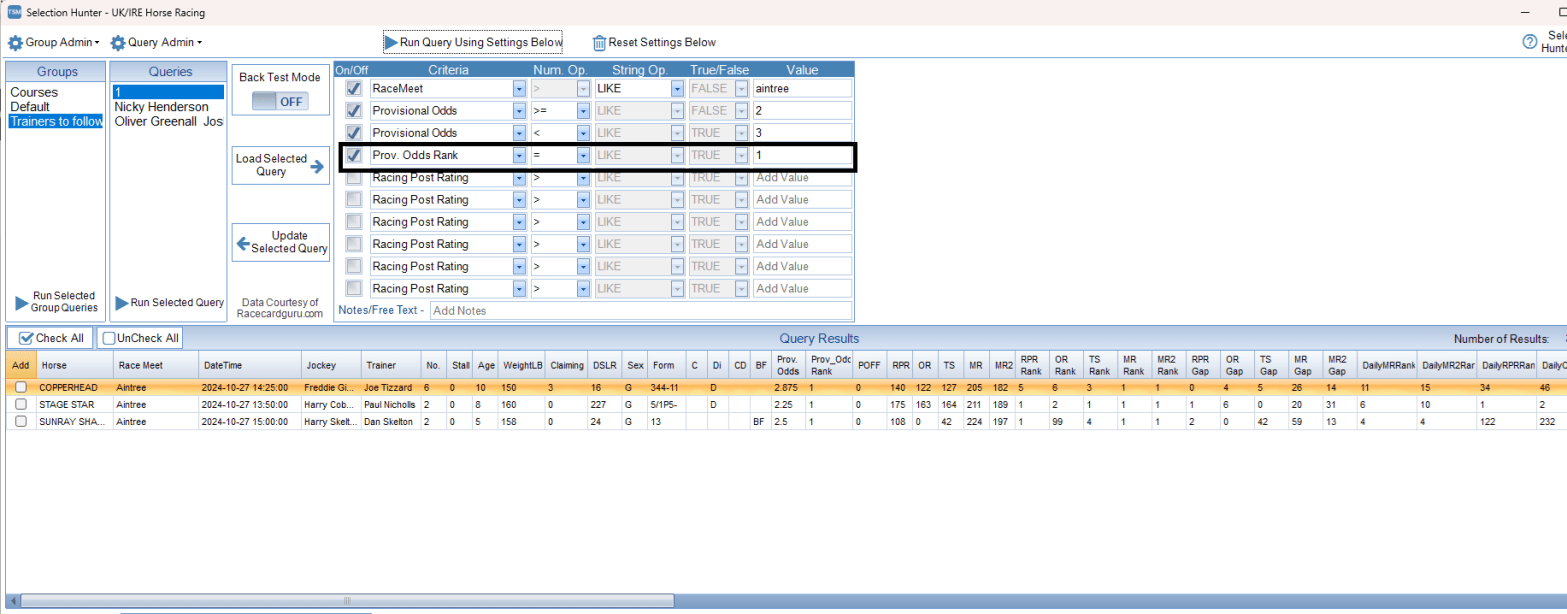
Yesterday I showed you how to create a basic query in TSMs’ Selection Hunter to find some likely winners using the back test mode to discover any trends and it came up with the following 3 horses
The selections are
13:50 Stage Star
14:25 Copperhead
15:00 Sunray Shadow.

If you missed it you can read the post here


13:50 Stage Star
Stage Star met the provisional odds criteria of between 2.00 and 2.99 but went off at a BSP of 3.21. Our conditions of placing a bet with betangel were that the BSP had to be between 2.00 and 2.99 for the software to trigger. 3.21 was out of our range at 3.21 so no bet was made.

Stage Star only managed 4th out of 5

14:25 Copperhead
Joe Tizzards’ Copperhead also qualified as the provisional odds were posted as 2.85 but again the BSP was outside of the criteria and went off at 3.5 giving us another miss fire from Betangel.
Copperhead Won by 14 lengths!!!

15:00 Sunray Shadow
The final selection was the Skelton trained and ridden Sunray Shadow who’s Provisional odds were posted at 2.5. Winning by a length and a 1/4 the BSP was well within the range at 2.23 and Betangel Fired the bet in 10 seconds before post time catching 2.25

Summary
2 of the 3 selections went off at odds outside the criteria one of them winning but alas one losing
2 of the 3 went off as favourites despite all 3 being ranked as provisional favourite.
Betangel fired just one bet and this returned 125% ROI
Given the strike rate of the criteria when back tested (68%) 2 actual winners from our query seemed to tentatively back this trend.

Cautionary note
While this was a completely genuine test run you should not go out and back every Aintree runner with a BSP of between 2.0 and 2.99 even though I back tested over a period of nearly 2 years results you should always do as much research as you can and start with stakes that you can afford to lose.

Build your bank steadily Racing is not going to finish tommorrow!!!

The staking Machine software has limited use for free but If you want to take advantage of the Selection Hunter you will need to pay – It only costs £24 for 1 year – Twenty Four!! this is not a typo and can be paid via paypal
That’s only 2 quid a month and if you had backed Sunray Shadow for a quid you would have made over 1/2 a months subscription already.

Discovering Profitable Staking Plans for Premiership Teams

There are many “get rich quick” schemes flying around and to many staking plans are typical of these and to others the holy grail of betting. In this feature I am going to look at and back test just some of the miriad of plans that are available, some you may have heard of and some you most definitely haven’t.
As with any thing that is potentially damaging to your bank balance rigorous testing should be undertaken before risking your money with the bookies. In this series of posts I will be using the “Staking Machine” website software to analyse the results from a set study of Premiership teams taken from last seasons finishing positions of top (Man City) 5th Place (Tottenham) and 10th Place (Crystal Palace)

What are staking plans? Essentially staking plans are a tool where you can use a pre determined equation to set your stake for the next bet in a sequence that you have chosen beforehand you would like to bet on. This could be following a racing tipster in your favourite newspaper to betting on a set trap number in greyhound racing. This post will focus on football and backing your favourite team through the season.

So which staking plan would you choose? The list is quite extensive and I will be analysing all of the plans that are on the staking machines website but to name just a few there is level, percentage, 1326, Fibonacci, Parley and the list goes on.
There are some basic things that you would need to input into the software for some of the plans and one of them is that it needs the average winning odds. This means the average of the odds where the selection won.
There is a section on the main software screen that shows strike rates, average winning odds average odds losing sequences and winning sequences a snap shot of which is shown below.

This is the quick stats snapshot from the data |I have entered for Crystal Palaces’ 23/24 season. Click to view a larger version in a new tab.


With last years football results this is easy as all the data can be downloaded from http://www.football-data.co.uk, which provides downloadable raw data from most leagues from around the world but in so much detail as regards to the domestic leagues you need to slim the excel sheets down a bit. What I will be using is the spreadsheet available below and filtering out the home and away results of the teams mentioned above to glean the average winning odds.

Man City’s Home odds when they won at home

The screenshot above shows Man City’s home wins and the average home win odds provided by http://www.football-data.co.uk
The screenshot below shows the matches where Man City were playing away from home and the average odds for an away win.

Man City’s away odds when they won when playing away

As you can see I have used the power of excel to determine the average of the average home win odds when they won and the average of the away odds when they won away from home and these are – Average winning Home odds 1.21 and the average winning away odds are 1.39 giving an over all average winning odds last season of 1.21 + 1.39 = 2.6
2.6/ 2 = 1.30

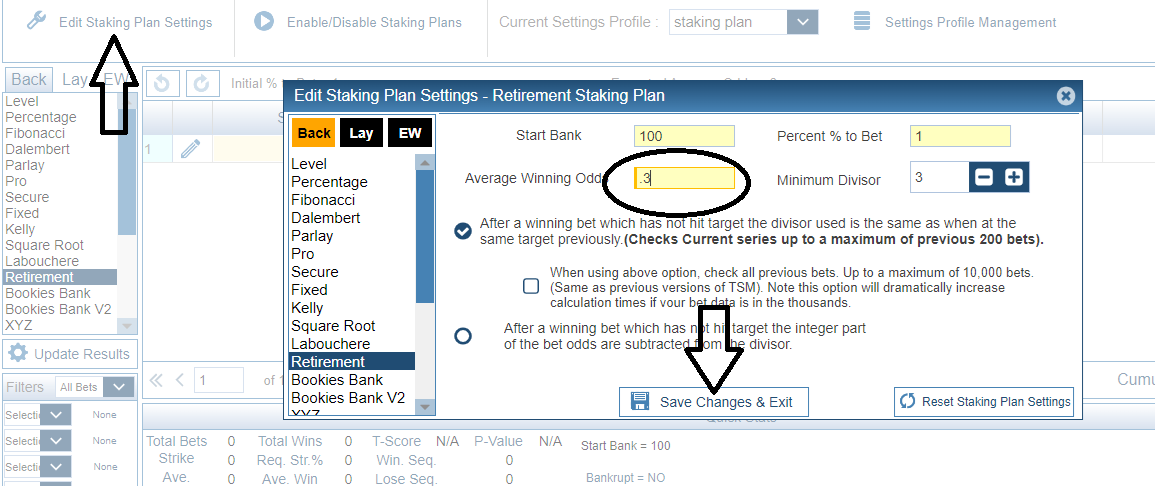
We can now enter this figure into the staking machine software. The rule for this is that you take the decimal odds of the average win odds and subtract 1 so the figure we enter into the winning odds box is 0.3

You can click the image above to open it in a new tab to make things clearer. Once this has been saved we can start entering the data from the spreadsheet. It should be noted at this point that the bank box is pre populated with £100 – you don’t physically need a £100 bank this is virtual all you need in your bookmaker account is the funds to make the next bet which is usually 1% of this i.e. £1.00. The demo mode of the software only allows you to input 10 results but I have subscribed so I can show you the full seasons bets.

Manchester city won 28 of their 38 league games last season (23/24) and subsequently finished league champions and everything that goes with this title but how did the devoted fan, who backs his team to win for £2.00 per week, fair? – Not too well to be honest. He would have lost £3.96 over the season. How can this be?

This graph shows the cumulative total using level stakes backing Manchester City to win throughout the season to a £1.00 level stake.


For a staking plan to work you need winners we all agree on that, but if the winners are at such a short price as Man City’s were then you need more winners. You may recall that the average “Winning Odds” for Man City last season was 1.3 this means that you would need a 76.8% strike rate to call a profit. Man City’s actual strike rate for last season was 73.7%. So Man City won the league and the bookies won the money- again!!!
This is just one instance where the advocates of level stake betting won’t turn a profit even though the strike rate is over 70%. There are however staking plans that will net you a profit but they are not life changing. I will explore these in more detail as time goes on but for now I will outline what would have happened if you had backed Tottenham throughout the season to win.
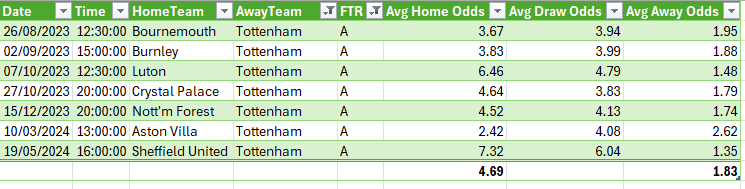
So again we first determine the winning odds for Tottenham by finding the average home winning odds and adding them to the away winning odds and dividing by 2. We can easily do this by filtering the data in excel as we did for Man City.

The average home winning odds are 1.79

Tottenham won 13 of their home games producing an average of 1.79 winning odds.

When playing away their strike rate was very much reduced and their winning odds averaged 1.83
If we add these together and divide by 2 we get : 1.79 +1.83 = 3.62 / 2 = 1.81

Plagued by bad luck or just better teams Tottenham achieved a winning strike rate of just 52.6% where in weeks 11 – 15 saw their longest losing streak. Average winning odds of 1.8 require a winning strike rate of 55.5%. So Again the bookies win and the fans wonder why when their team did so well in coming 5th in the table have, to a level stake of £2.00 on each game £5.00 less than when they started.

This graph shows the frequency of the odds grouped into values and how many matches they won at those ranged odds.

As you can see from the graph above when the odds were below 1.5 (7 in total) Tottenham won all of their games – as the odds suggest that they should have. the plan all starts to go pear shaped when the odds rise above 2.0 and more research might reveal that not backing Tottenham at these odds could improve the profit figure. The table below shows the ranges of odds and the profit/loss and a return on investment (ROI) had you just backed tottenham within these ranges. It should be noted that these figures are to a £1.00 level stake not £2.00

Click on the image to open in a new tab for a clearer look.

Finally on this post the results from 10th placed Crystal Palace. Crystal Palace had a total of 13 wins out of their 38 league matches giving a strike rate of 34.2%. Their average winning odds for these 13 games was 3.36 which required a strike rate of just 29.7% for all games over the season. This team would have made their fans a profit of £8.39 over the season if they had backed them to win with a level stake profit of £2.00

The following graphs and tables show in more detail the figures quoted above for Crystal Palace and the 23/24 season

Backing matches at “Bread and Butter” odds (1.5 – 3.0) would have shown a profit and 2 wins, one at odds between 5.5 and 6.0 and another at odds of above 10.0 and this can be better seen in the table below Again these figures show profit/loss to a £1.00 level stake.

Click to veiw in a new tab.


These are back tested results and show what would have happened if you had backed your team to level stakes and while not entirely picked at random for this study it does show that care needs to be taken when blindly backing at level stakes. Manchester city might have won nearly 3/4 of there league games but it was not enough to turn a profit
In the posts that follow I will be analysing the same 3 teams using a variety of staking plans to determine if there was a greater profit or a reduced loss to be made and still keep the betting enjoyable.

There is one more point I would like to make on the subject of strike rates and winning odds averages. The bookies know that if they are offering odds that are below the average winning odds then they are going to win. If you know about odds movement when a match is in play then you will realise that there are many times that you can back a team in play when the win odds of the team will rise above the average winning odds giving you the edge instead of them – There is of course the distinct possiblity that they may score early in the game!! These are all things that have to be considered and a risk assessment taken. Don’t be in such a hurry to lose your money!

The staking plans I will be using will be taken in the order listed on the staking machines software and after Level stakes the next plan is called “Percentage”. Below is a list of all the staking plans used which, when I have written the post will have a link attached so you can easily go straight to the post. Some of the plans I have never heard of and further reading on his site reveals that he himself has invented them.

Percentage
Fibonacci
Dalembert
Parlay
Pro
Secure
Fixed
Kelly
Square Root
Labouchere
Retirement
Bookies Bank
Bookies Bank v2
XYZ
Up X Down Y
LP 28
Recovery
Recovery Type 2
Recovery Type 3
SAW
Rolling Doubles
Coup Master
1 Point
i-TSM Plan

Greyhounds Backing The Favourite Day 1 (2nd March 2024)

For a while now I have been pondering the possibility of backing the favourite at the dogs to see if there is any money to be made. Even though the rumours that greyhound racing is not the most virtuous sport you can make a wager on it is certainly the most abundant sport with over 140 races each day and that is just the UK. According to the Oxford Stadium website 35% of all favourites win! This however is across all tracks, distances and, classes of race. To this end I decided that the only true way of sorting the wheat from the chaff is to back every single favourite in every single race and use the power of excel to weed out losing statistics from the more profitable. So without ado I will post day by day findings on this blog

My criteria is simple I will back each race favourite 20 seconds before the post time to a liability of just £1.00 so in effect my average stake should be kept to about 30p per race. This means that should the favourite win then the Profit will be £1.00 and if loses the stake determined by the odds that are available at that moment in time on the betfair exchange. There have been instances where the odds of two of the dogs have been exactly the same at the 20 second point and no bet was struck. This is unfortunate but one of those things. After testing that the software worked as required on March 1st testing began in earnest on March 2nd and showed an overall profit of £13.41 with profits showing from all meetings except Crayford and Hove.

Click to Enlarge

Starting with Central Park, there were a total of 6 winning favourites giving a small profit of £2.66 The rest I will put into a table for easy reference.

TrackWinning FavsAvg StakeP/L
Crayford145p-£3.85
Doncaster9 (2 Meetings)69p£4.73
Hove6£1.43 **-£0.51
Monmore10 (2 Meetings)57p£2.44
Newcastle648p£1.69
Oxford8 (2 Meetings63p£1.26
Perry Barr847p£1.48
Romford10 (2 Meetings)53p£3.03
Swindon449p£0.48
** Quite a few Odds On Favs Lost!!!

Crayford was quite obviously not a track to back the favourite on this day as just one favourite won, Hove had a few odds on favourites running hence the average stake of £1.43 with the shortest priced favourite of the day losing costing a massive £3.12 All in all not a bad day for the first day.
There were a total of 160 races of which 64 favourites won giving a 40% win rate.

Lets go on to look at the best performing meeting of the day which was Doncaster. Producing an overall profit of £4.73 with 9 winning favourites at the 2 meetings.
Of the 8 winning favourites 4 were in OR class races or Open Class and scored a 100% strike rate as did the OR3 class which accounted for 2 more winning favs.
The sheer volume of information I have collected just over the last 20 days is by no means enough and in subsequent posts I will delve a little deeper into which tracks are more profitable than others using this system and which Races should be avoided on all counts after looking at the stats.

Just as a Taster the best performing track using this system between 2 March and 22 march is Nottingham with a profit of £15.89
The worst Track for winning Favourites is Sunderland with a loss of £22.03

My total profit for this period backing every race is £38.28

Betfair Historical Data – Easy When You Know How

Betfair Historical Data has been, for some time now, openly available for free but it seems that no one is prepared to share just how you open the damned stuff!!!
There are plenty of sites out there willing to share their python knowledge but stop short of a full explanation – very frustrating.
At this point I have to give credit to “Trading The Market” guys who have finally given me the Eureka Moment!
If you follow the steps below you will soon have all the research information to back test your systems.
To begin with you do need to have a betfair account and to access which data you need you will need to be logged in and at the following page
https://historicdata.betfair.com/#/home

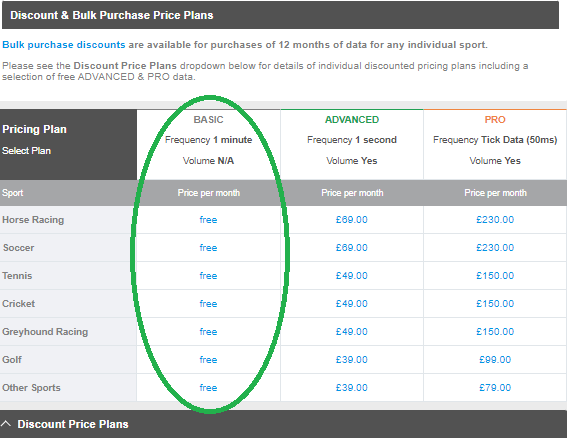
For the purposes of this post I will be using the basic plan which costs nothing and has a data frequency of 1 minute. If you need more frequent data logs then you will have to purchase your data by the month but there are free plans available for limited months mainly in 2020.
In this post I will be analysing the data from the North London Derby – Arsenal v Tottenham on the 1st October 2022
The easy way to handle this data is to “purchase” a month at a time so I will “Buy” the Soccer data from OCT 2022
To do this simply select the plan, sport, and month you need in the drop down boxes and click “Add to Purchases” and then the “purchase” as in the screen shot below

You will then be asked to confirm your purchase – Check that you haven’t included the wrong plan by mistake as the fee will be taken straight from your betfair balance. If everything is ok click confirm and you will see the following screen.

As you can see from the screen shot there are over 250000 markets! for our research we only need 3 or 4 of these so we need to find them.
I want to know how the under/over Markets behaved when each goal went in during the match. To do this click on the “My Data” Tab as shown below and you will see your most recent purchases as well as plans you have bought before.

We now need to populate the down load fields with the information that we need so if we look at the match stats we can see that there were 4 goals scored in total.

I want to see the following market odds
O/U 1.5
O/U 2.5
O/U 3.5
O/U 4.5
O/U 5.5
O/U 6.5
and the Match.
To do this we need to populate the download files panel as follows:

In the Plan Box (which is at the top but hidden in this screen shot) enter Basic
In the Sport Box enter Soccer
In the From and Upto Boxes enter 1 Oct 2022
Leave the event ID Blank
In the Event Name box enter Arsenal
In the Market Type box select the markets you need and in this case its Match_Odds
Over_Under_25
Over_Under_35
Over_Under_45
Over_Under_55
Over_Under_65
In the Country Box select GB (There is no UK)
and in the File Type Box select M
Click the Add to Downloads button
You now should have 12 files ready to down load.
Click the Yellow Download button

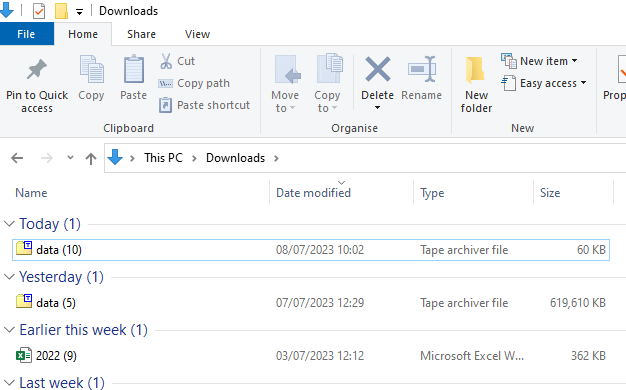
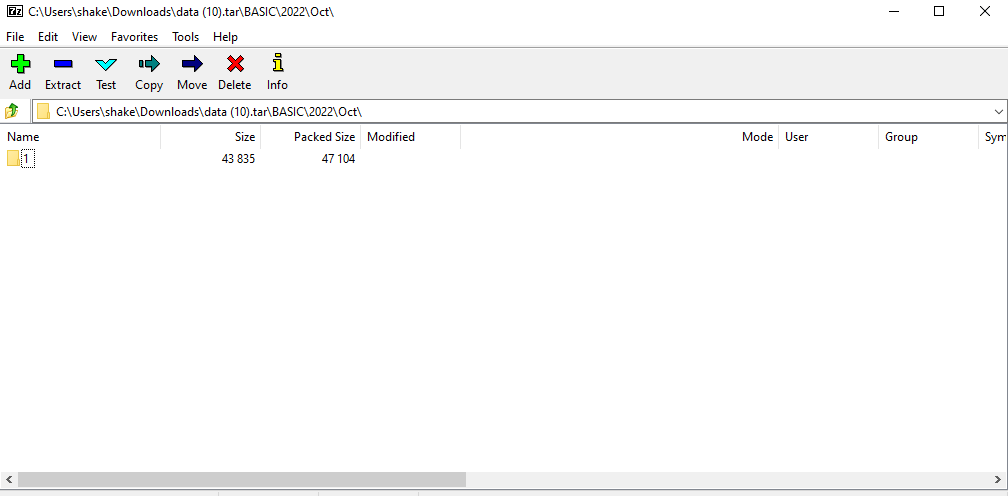
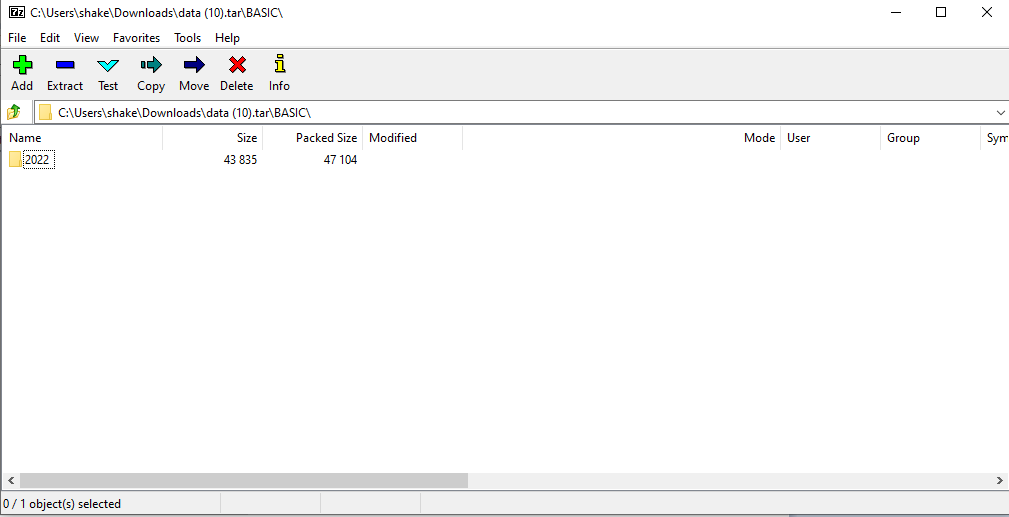
You will find this file in your downloads folder as a Data “tar” file

Double click the file to un pack it in your unzipping program

Keep double clicking until you get to the actual data files

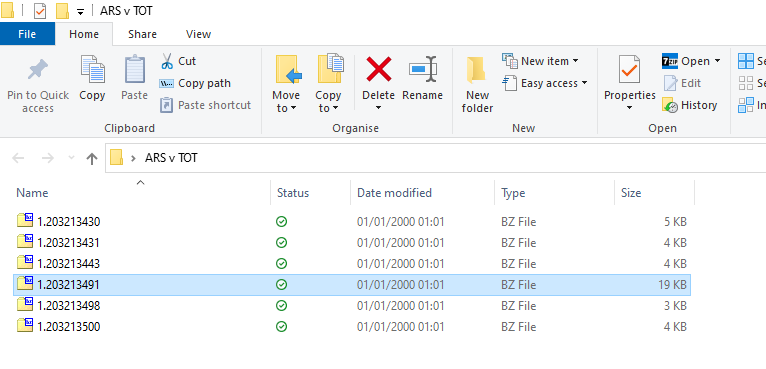
You should now see your 6 “bz2” files
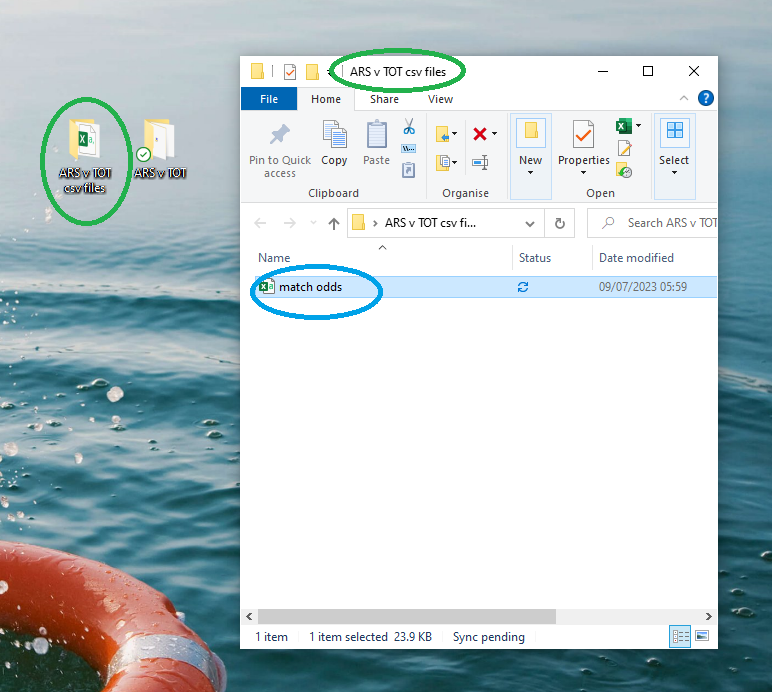
To make them easy to find Create a new folder on your desktop and name it ARS v TOT

You can now drag and drop the files into this folder from your unpacking software

We now need to convert these files into a readable format and Betfair provide one such program easily available from their website.

You will find this here

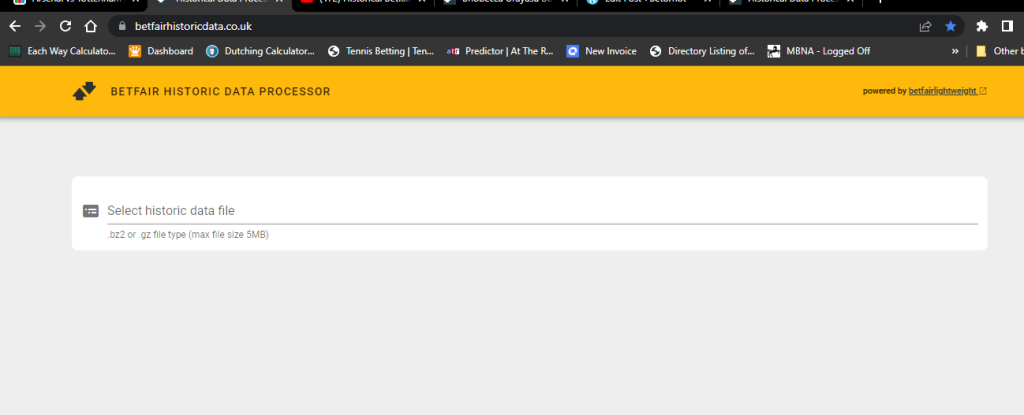
https://www.betfairhistoricdata.co.uk/

The first file we want to see is the Match Odds and this will usually be the largest file as most volume would have passed through that market. In this case we are looking at File 1.203213491

These are not very user friendly file names so I am going to rename them. to do this we simply select a file from the list using the betfair Historical Data Processor as below and note the file number and which market it contains. In this case File 1.203213498 is the O/U 6.5 goals Market. We dont want to do anything else yet. We are just identifying the files for our convenience

We can then repeat the process with all the files noting the file numbers to the markets and then rename all the files as below

We are now going to convert these files into meaningful excel ranges where we can look at them in more detail. To do this we again select a file from the folder using the Historical Data Processor and click the download settings button as shown in the screenshot below

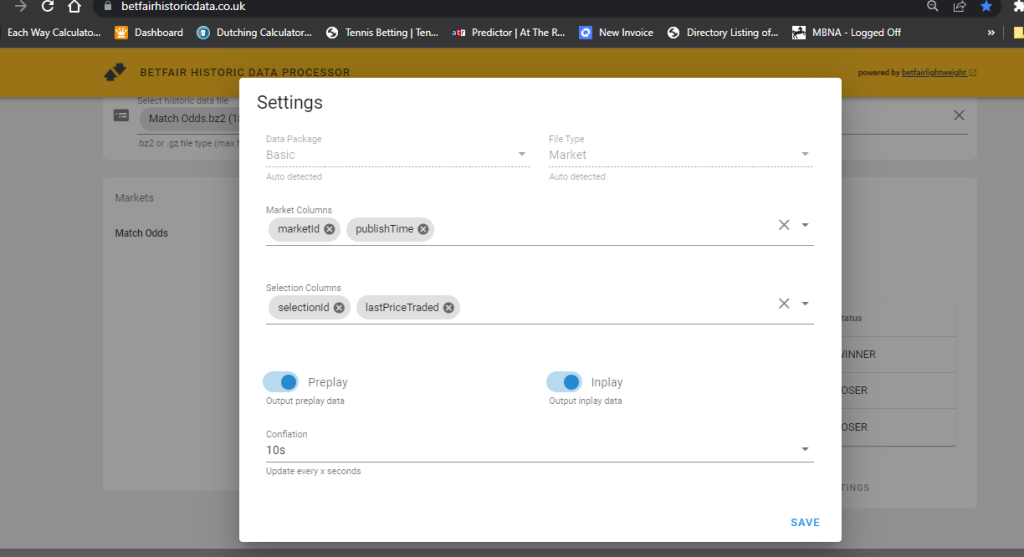
This will open the settings dialog box as shown below

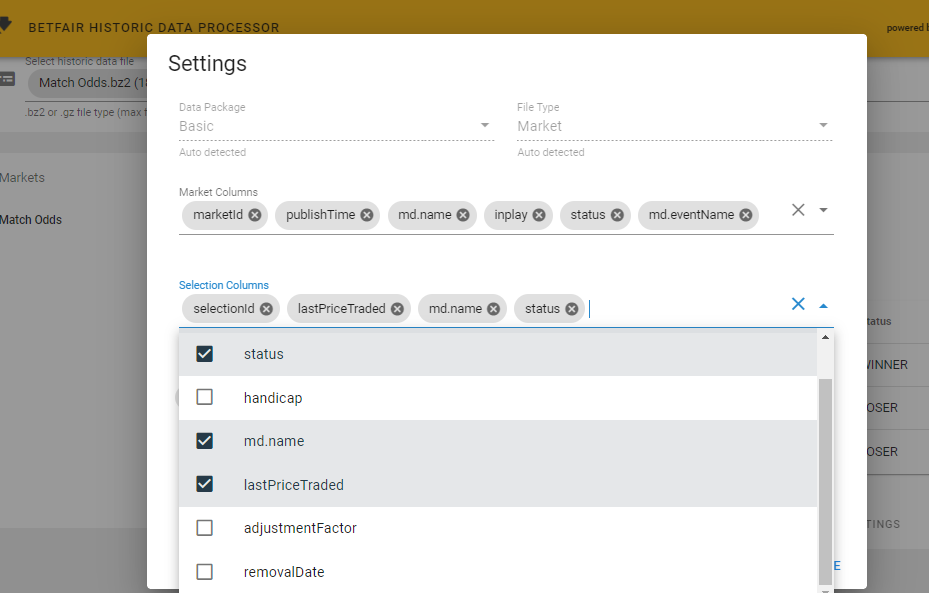
We now need to populate our spreadsheet with any relevant information we will need by clicking the drop down box arrow and selecting the fields by ticking the relevant tick boxes (dont worry if you put too much info into the spreadsheet as we can delete it later)

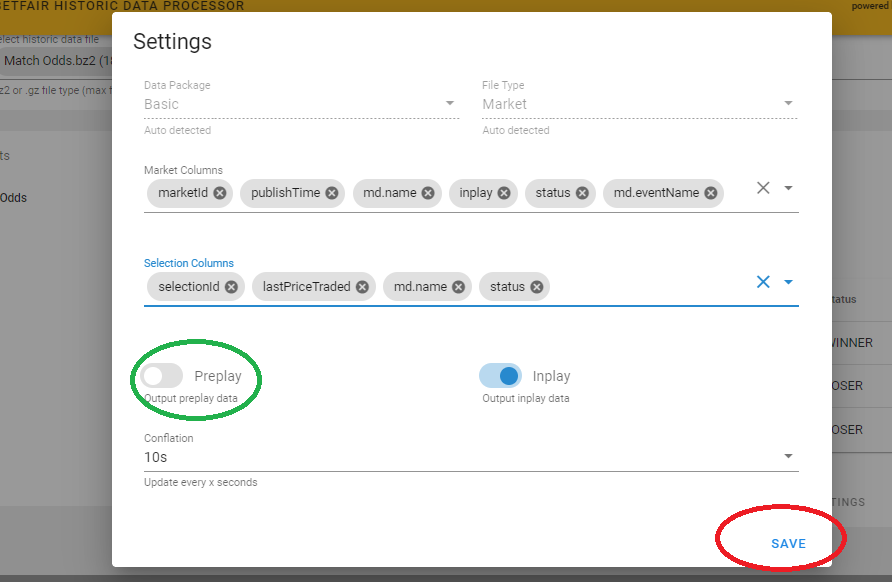
Once you have selected what you need close the drop down box by clicking the “up” arrow and because we are just interested in the in play data slide the “preplay” button to off as shown below and click save

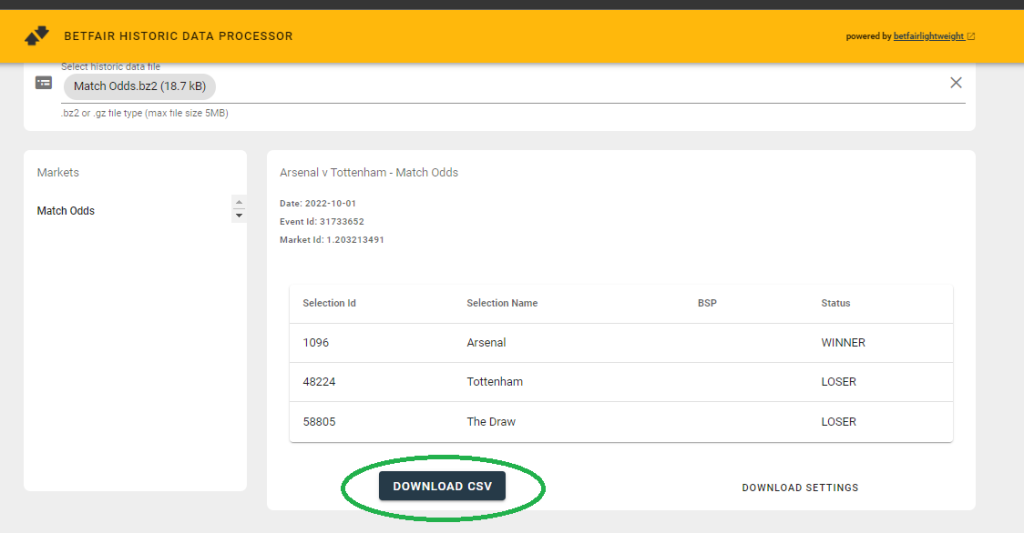
We are now ready to download the file as a CSV file into Excel we do this by simply clicking the “Download CSV” button as shown and let the wonders of better brains than our own do its stuff.

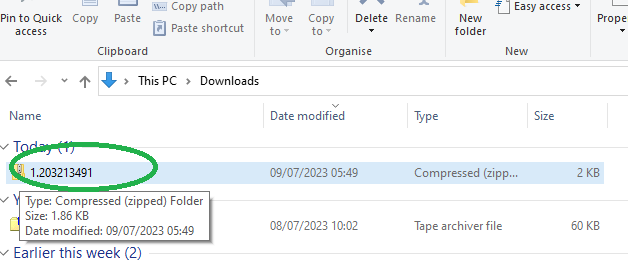
This will put a zipped file into your downloads folder with the original file number

If we double click this file it will unpack and be available as a csv file which we can open with excel.

It may be a good idea to move this file to a new folder on your desktop and rename it as I have done here

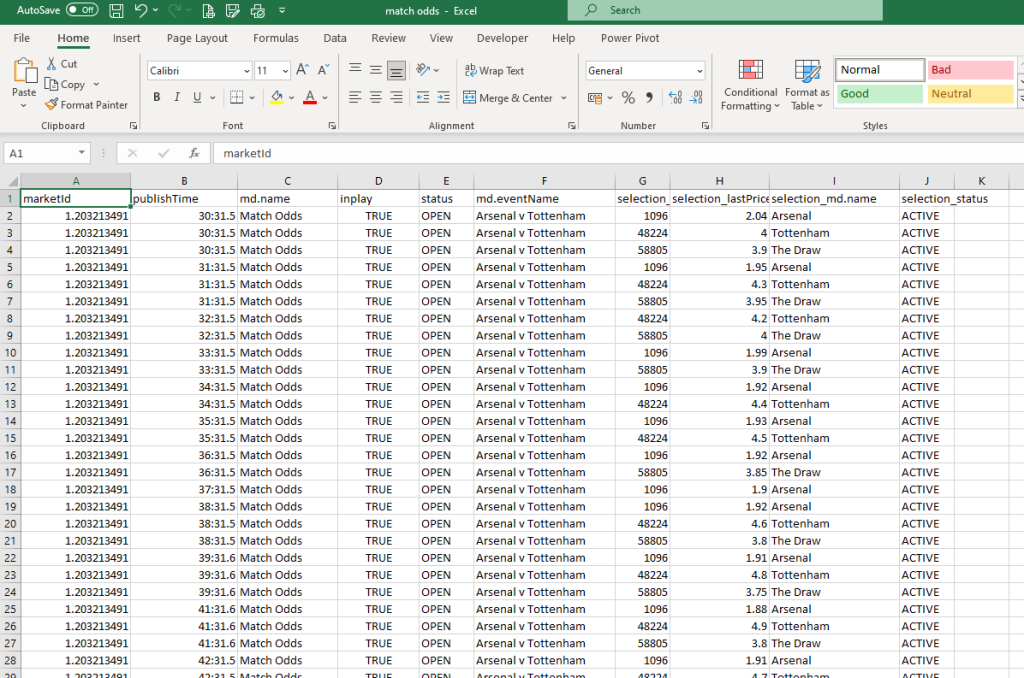
If we open this in excel this is what we get.

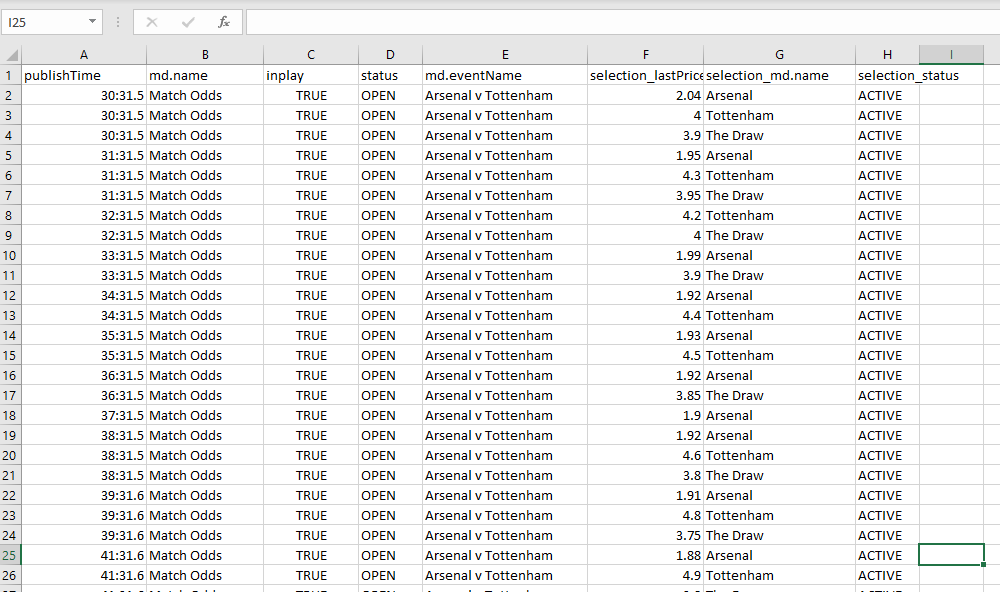
We can now start to manipulate the data to best suit our needs. We can start by removing some of the columns we dont need. I have removed the following columns to be left with the following spreadsheet.
Market ID
Selection ID

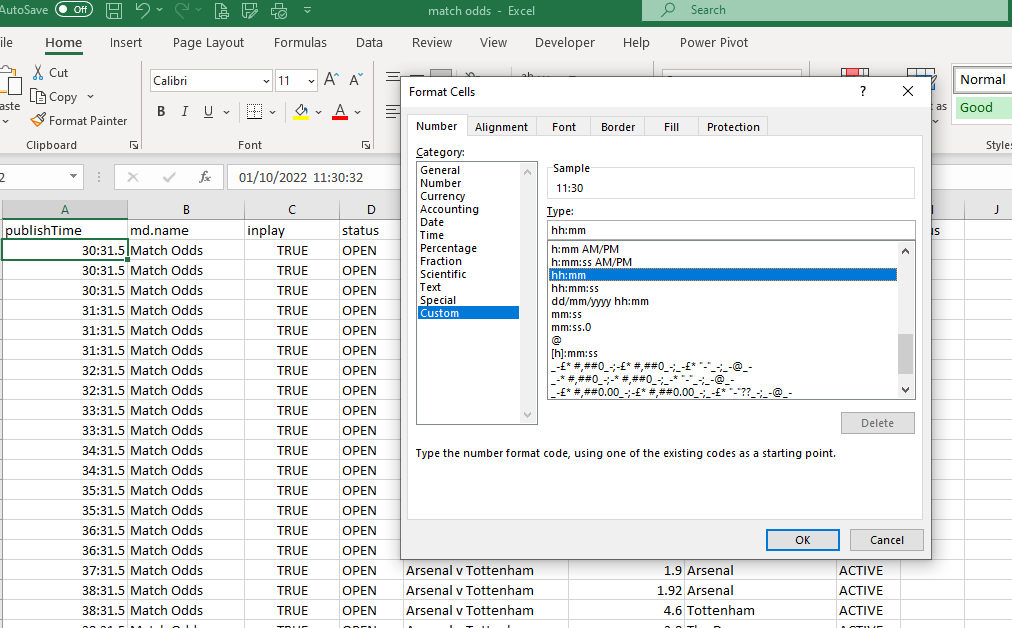
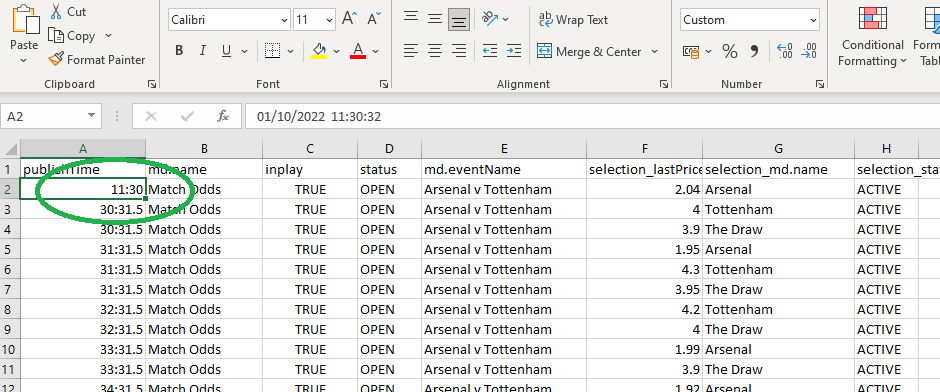
The next task is to make the published time more reader friendly. as you can see this is total jibberish, it means nothing. If you select cell A2, in the address window you will see that the full date and time is shown

So that column A shows the time in hrs and minutes we need to select hh:mm from the custom cell formats as shown below.

When we click ok then cell A2 will show the actual time of the published data for that row

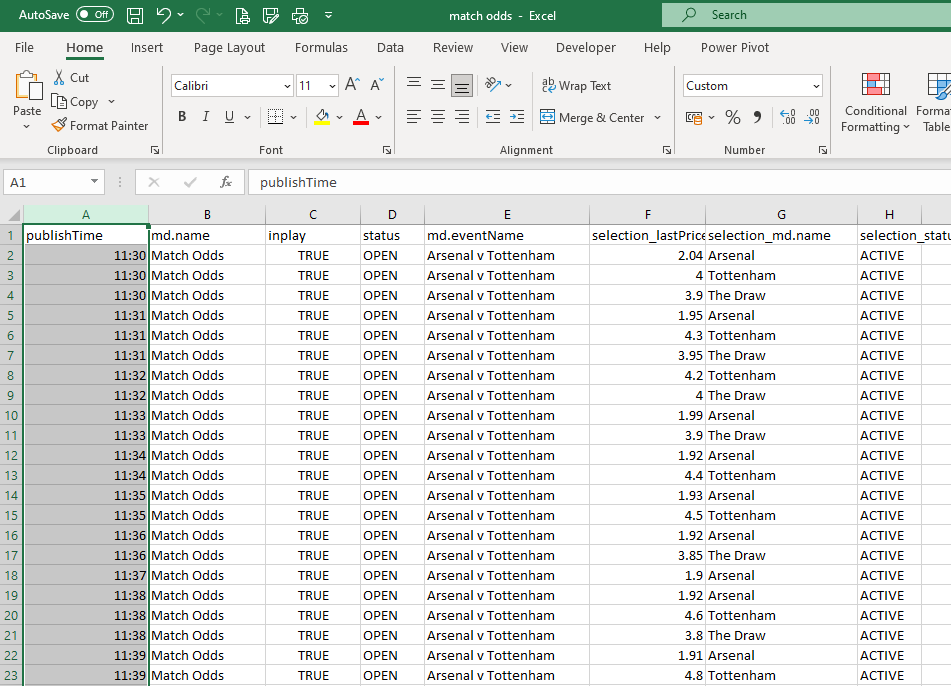
To convert all the row simply select Column A and repeat

When you click ok your spreadsheet should look like this

you will notice that the times are repeated 3 times this is because there are 3 separate outcomes within this betfair market – Arsenal to win The Draw and Tottenham to win.
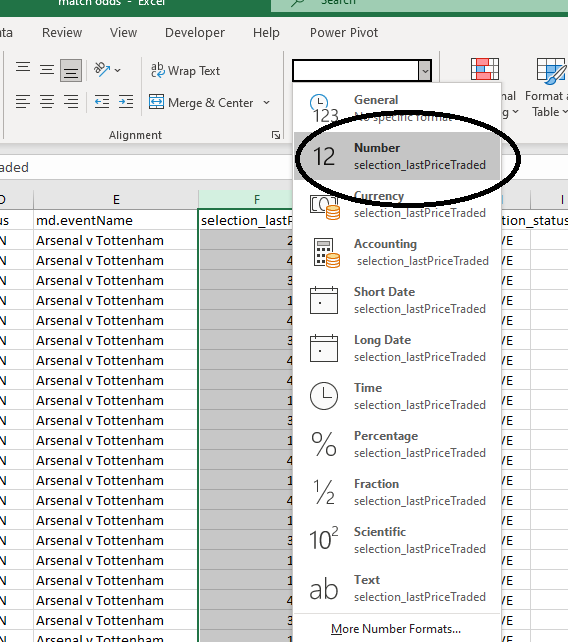
If we now draw our attention to Column F this is the last traded price column and we could do with tidying up this so that all the figures are shown to 2 decimal places. To do this simply select Column F and using the cell number format dropdown box, select “Number” as shown below.

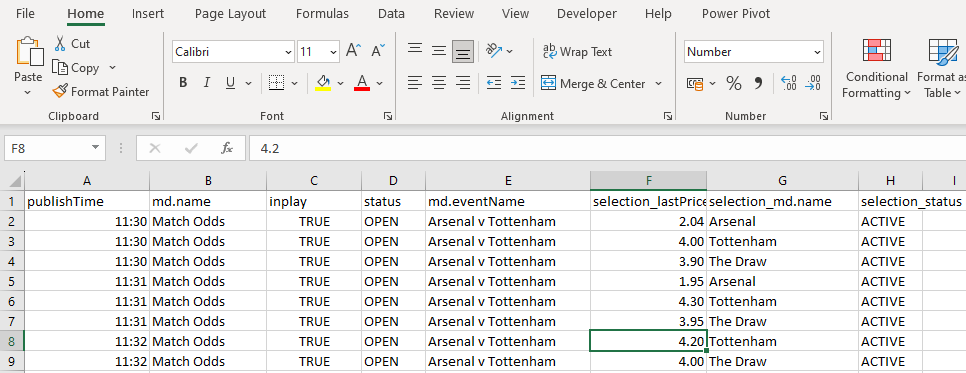
Your spreadsheet should now look something like this

A bit more tidying up by changing the column headers and this is what you should be looking at.

This is your basic data spreadsheet for the entire match for the Match Odds Market You can now save it into a folder and repeat the process with the other 5 markets

In my next post I will show you how to manipulate the data so that we can see what happened in each market as each goal went in

Please like and subscribe to my blog so that I can get a feel for what content can be most useful to you.