Master the “Back to Lay” Strategy in Tennis Trading

In our introductory post, Tennis Trading: The Different Trades You Can Make on a Tennis Match, we broke down the core pillars of operating on a betting exchange like Betfair.

Today, we are diving into item #2 on that list: The Back to Lay Strategy.

If you’ve ever watched a tennis match and known deep down that a player was about to mount a comeback, go on a hot streak, or break serve, Back to Lay is the execution tool you need. Unlike standard betting, where you need a player to win the entire match to collect a payout, Back to Lay allows you to lock in guaranteed profit before the final point is even played.

What is a “Back to Lay” Trade?

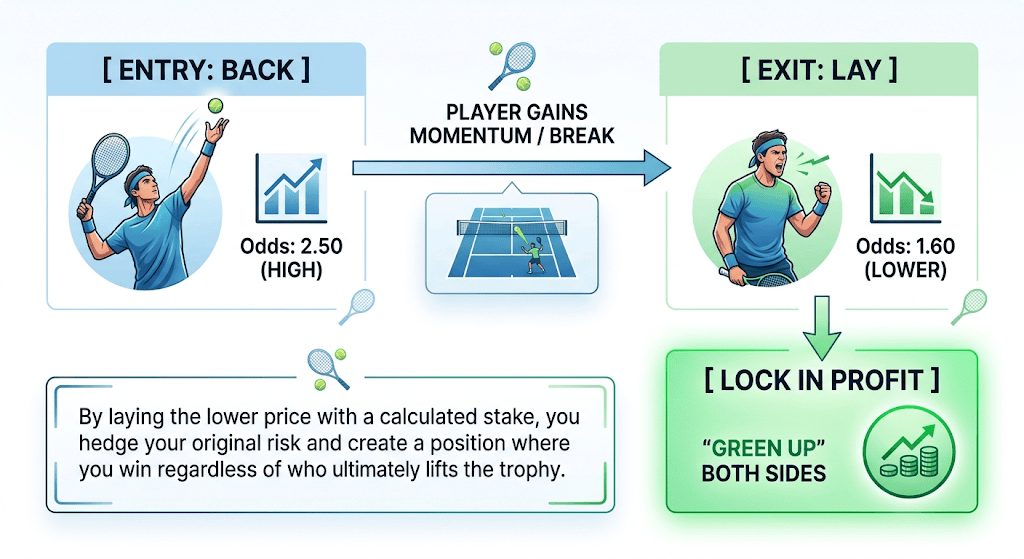
At its simplest, Back to Lay is the sports trading equivalent of buying low and selling high:

  1. BACK (Buy): You place a £10 bet on a player at high odds when the market understates their immediate chances.
  2. WAIT: The player gains momentum, scores key points, or wins a game/set, causing their decimal odds to shorten (drop).
  3. LAY (Sell): You bet against that same player using a £10 stake at lower odds to lock in a profit across all outcomes (“greening up”).

By placing a £10 Lay bet at lower odds, you hedge your original risk and create a position where you earn a profit regardless of who ultimately lifts the trophy.

Entry Points: When Should You Back to Lay?

Winning at Back to Lay comes down to spotting market overreactions or structural pivot points. Here are three prime entry triggers:

1. Fading the Cold Favorite

A strong pre-match favorite drops the first set or gets broken early. Their odds drift sharply higher due to panic selling in the market. If underlying match statistics (first-serve percentage, unforced errors) show they are simply cold rather than injured, backing them with a £10 stake at peak odds offers tremendous value before their inevitable response.

2. High-Stress Game Pivots (Scalping the Server)

When a dominant server drops to $0-30$ or $15-40$ in a service game, their match odds momentarily spike. If you place a £10 Back bet on them to fight back and hold serve, their odds will drop right back down after two or three big serves, giving you a quick exit window to Lay them for £10.

3. Surface & Matchup Advantage

Underdogs often start aggressively on fast surfaces (like grass or indoor hard courts). Backing a heavy-hitting underdog with a £10 stake pre-game or early in Set 1, then laying them off for £10 the moment they score an early break or force a tiebreak, yields quick tick profits.

Real Match Walkthroughs

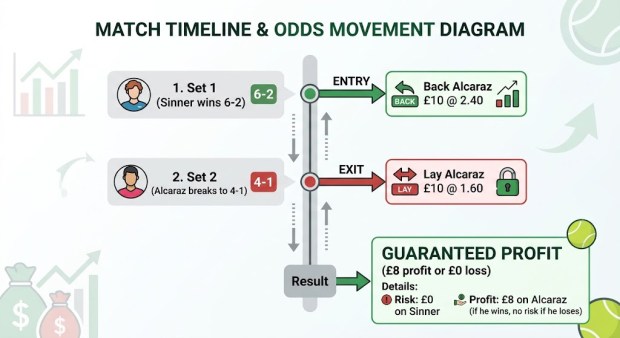
Example 1: The Favorite Recovery

  • Match: Carlos Alcaraz vs. Jannik Sinner
  • Situation: Pre-match, Alcaraz is trading at 1.50. Early in Set 1, Sinner plays lights-out tennis, breaks twice, and takes the set 6-2.
  • Market Shift: Alcaraz’s match odds drift up to 2.40.

Net Result:

  • If Alcaraz Wins: You win £14 from your Back bet and lose £6 on your Lay bet liability = +£8 Profit.
  • If Sinner Wins: You lose your £10 Back bet and win the £10 Lay stake = £0 (Break-even).

Example 2: Break-Point Scalp

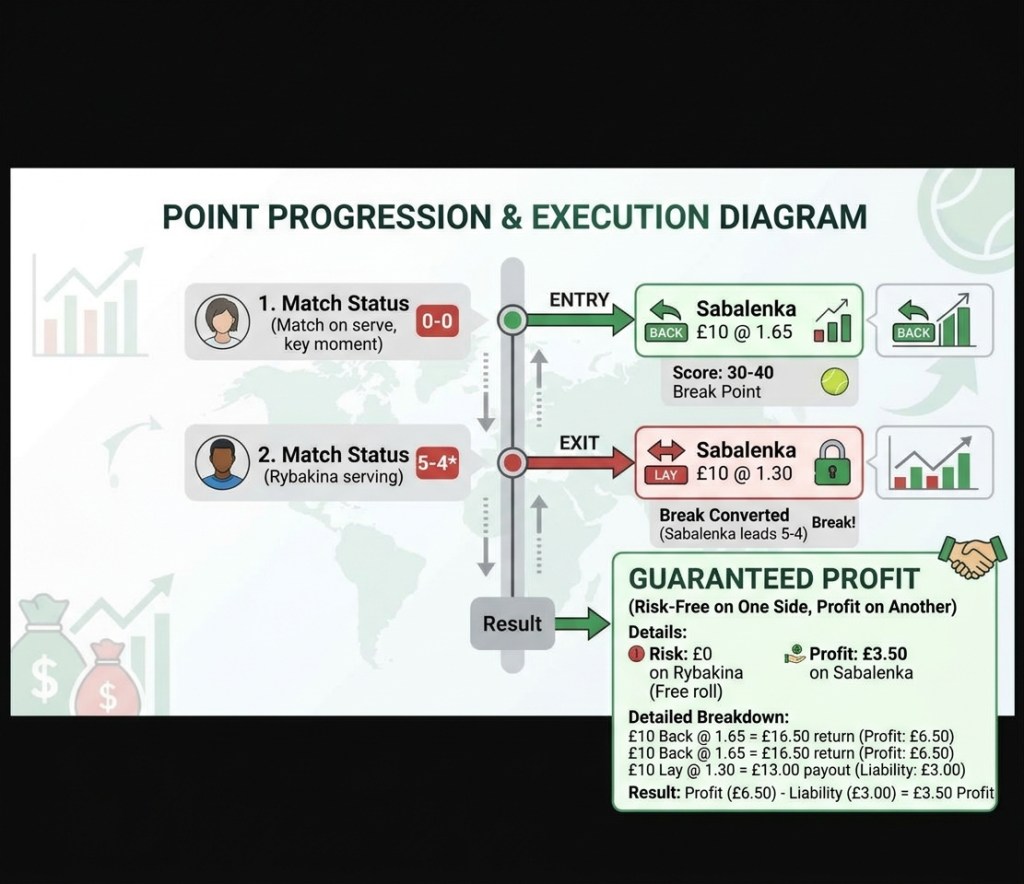
  • Match: Aryna Sabalenka vs. Elena Rybakina
  • Situation: Set 1 is tied at 4-4, 30-30 on Rybakina’s serve. Rybakina misses a first serve and commits an unforced error to bring up Break Point (30-40).
  • Market Shift: Sabalenka’s odds drop to 1.65 anticipating the break.
  1. Trade Entry: You Back Sabalenka at 1.65 for £10 (Potential profit: £6.50).
  2. Match Event: Sabalenka strikes a deep return-winner to convert the break and go up 5-4, serving for the set.
  3. Price Movement: Sabalenka’s odds instantly shorten to 1.30.
  4. Trade Exit: You Lay Sabalenka for £10 at 1.30 (Liability: £3.00).

Net Result:

  • If Sabalenka Wins: You win £6.50 on the Back bet minus the £3.00 Lay liability = +£3.50 Profit.
  • If Rybakina Wins: You lose the £10 Back bet and win the £10 Lay stake = £0 (No Loss).

3 Essential Rules for Back to Lay Trading

  1. Always Set a Stop-Loss Before Entering: If you Back a player with a £10 stake expecting a turnaround, but they get broken again, execute your £10 Lay trade at higher odds to cut losses quickly. Never convert a trade into a standard “hope” bet.
  2. Watch the Live Feed, Not Just the Scoreboard: Television and betting exchange streams often have a 3–7 second delay. Use courtside data or live video feeds where possible to avoid getting caught out by fast-moving points.
  3. Account for Serve Dynamics: WTA (women’s) matches statistically see a higher frequency of service breaks, leading to larger price swings than ATP (men’s) matches. Adjust your profit targets and volatility expectations accordingly.

For a visual breakdown of entry points and odds movement on betting exchanges, watch How to Trade Tennis on Betfair. This video walks through real-time exchange ladder movements and execution techniques.

Mastering the “Back the Favourite and Trade Out” Tennis Strategy

If you are entering the world of exchange trading on platforms like Smarkets or Betfair, “Back the Favourite and Trade Out” is one of the foundational position trades you need in your toolkit.

Unlike traditional sports betting, where you back a player and pray they win the entire match, tennis exchange trading focuses purely on price movement. You enter a position when you believe a price is overly generous, wait for the market to adjust in your favor, and lay off the position to lock in a profit before the final handshake at the net.

In this guide, we break down exactly how this strategy works, walk through step-by-step mathematical examples, explore when to deploy it, and examine how to manage your risk when things don’t go to plan.


What is “Back the Favourite and Trade Out”?

At its core, this strategy involves backing a player at a higher price (decimal odds) with the intention of laying that same player at a lower price later in the match.

  • Backing: Betting on an outcome to happen (acting like a traditional bettor).
  • Laying: Betting against an outcome happening (acting like the bookmaker).

When you back a player and their odds drop—for example, because they won the opening set or broke their opponent’s serve—you can lay them at the new, lower odds. This locks in an equal profit across all outcomes or completely eliminates your financial exposure.

The key takeaway? You are trading the movement in price, not necessarily predicting the eventual match winner.


Step-by-Step Example

Let’s look at a concrete breakdown to see how the numbers play out in real-time.

Phase 1: The Entry

Imagine a ATP/WTA match where Player A is expected to perform well, but due to market conditions, is trading at decimal odds of 2.50.

  • Action: You Back Player A for £10 at 2.50.
  • Your Exposure: £10 (if Player A loses, you lose £10).
  • Potential Return: £25 total (£15 profit) if Player A wins without trading out.

Phase 2: The In-Play Shift

Player A starts strong, holding serve comfortably and breaking their opponent early to take the first set 6–3.

Because Player A is now in a dominant position to win the match, the market reacts quickly. Their odds shorten significantly from 2.50 down to 1.70.

Phase 3: The Exit (Trading Out)

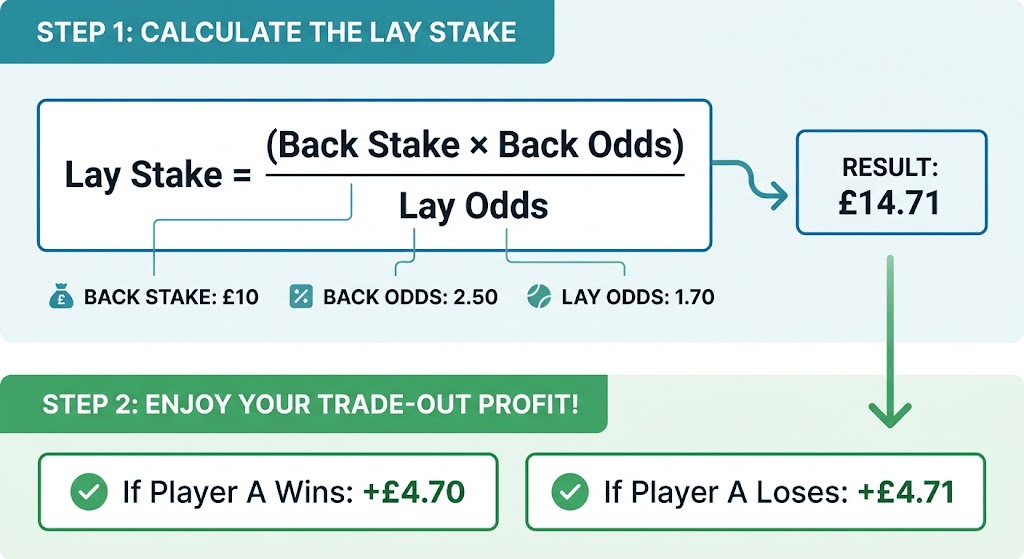
Instead of letting the match run and taking the risk of a comeback, you choose to trade out by laying Player A at 1.70.

To create an equal profit on both players (a “green screen”):

  • Action: Lay Player A for £14.71 at 1.70.

The Resulting Profit Matrix:

  • If Player A wins: You make £15 (from back) minus £10.30 (lay liability: $14.71 \times 0.70$) = +£4.70 profit
  • If Player A loses: You lose £10 (from back) plus £14.71 (from lay stake) = +£4.71 profit

(Note: Exact figures will vary slightly depending on exchange commission fees.)

Regardless of who goes on to win the match, you have successfully locked in roughly £4.70 profit.


When Does This Strategy Work Best?

This trade relies on predicting an early shift in momentum or market sentiment. Look for matches where:

  1. Strong Servers: Players with heavy first serves who rarely get broken early on. A simple hold-and-break pattern in the first set triggers quick price contractions.
  2. Fast Starters: Players who statistically perform best in first sets, even if their overall match endurance is questionable.
  3. Favourable Surface/Head-to-Head: A player whose game style specifically counters their opponent on a given surface (e.g., a clay court specialist against a flat-hitter).
  4. Underestimated Chances: Situations where pre-match odds feel inflated due to a minor recent loss, creating value at entry.

Risk Management & What to Avoid

The single biggest danger when backing a favourite to trade out is a price drift. If your player starts slowly, gets broken early, or drops the first set, their odds will drift outwards (e.g., from 2.50 to 3.50+).

To protect your bankroll, always establish a clear plan before placing your initial back bet:

  • Set a Target Exit: Know the price at which you will take your profit (e.g., exit when odds hit 1.70).
  • Set a Stop-Loss: Determine the maximum price drift or scoreline (e.g., if Player A gets broken in Set 1) where you will accept a minor loss and exit the trade rather than hoping for a Miracle comeback.
  • Avoid Holding to the End: Resist the temptation to convert a trade into a standard bet. The goal of tennis trading is consistency through active price management.

Final Thoughts

Backing the favourite and trading out is an ideal strategy for traders learning how to manage in-play odds movement. By focusing on early momentum and executing calculated exits, you turn unpredictable match outcomes into controlled, manageable trades.

Tennis Trading: The Different Trades You Can Make on a Tennis Match

Tennis is one of the most interesting sports for exchange trading.

Unlike traditional betting, tennis trading allows you to enter a position and then potentially close it before the match has finished. Prices can move dramatically after a single break of serve, a set win, an injury, or even a change in momentum.

That creates opportunities for traders who are prepared to manage both their entries and exits.

On an exchange such as Smarkets, there are several different ways to trade a tennis match. Some trades are relatively straightforward, while others require a much better understanding of tennis, momentum and probability.

This guide looks at the main tennis trades and explains how they work.


1. Back the Favourite and Trade Out

This is probably the simplest tennis position trade.

You back a player at relatively high odds and hope their price shortens as they move closer to winning.

Example

Player A is trading at:

2.50

You back them for £10.

If Player A wins the first set and their price subsequently falls to:

1.70

you can lay the same player to lock in a profit.

The important point is that you don’t necessarily need Player A to win the match.

You’re trading the movement in the price.

When can it work?

This type of trade can be particularly interesting when:

  • The player is expected to start strongly.
  • They are a strong server.
  • They have a favourable matchup.
  • Their opponent has poor recent form.
  • The market appears to have underestimated their chances.

However, the biggest danger is backing a player whose price continues to drift.


2. Back-to-Lay

The classic back-to-lay trade involves backing a player and then laying them at shorter odds.

For example:

Back £10 @ 3.00

If the price falls to:

Lay @ 2.00

you can trade out.

The amount you can win depends on the exact stake and exchange commission, so traders should calculate their green-up position before entering.

The advantage is that the trade can be closed before the final result.


3. Lay-to-Back

The opposite strategy is to lay a player at relatively short odds and hope their price drifts.

For example:

Lay Player A @ 1.50

Player A then loses the first set and their price moves to:

3.00

You can back Player A at the higher price to close the trade.

This is effectively betting that the market has overestimated a player’s chances at the original price.

It can be particularly interesting when a short-priced player is struggling despite being the pre-match favourite.


4. Lay the Favourite

One of the most popular tennis trading strategies is laying a strong favourite.

Suppose:

Player A — 1.20

Player B — 5.50

You believe Player A is vulnerable.

Instead of backing Player B, you can lay Player A.

If Player A gets into trouble, their price can increase rapidly.

For example:

1.20 → 1.50 → 2.00 → 3.00

The trader can then back Player A at the higher price and potentially lock in a profit.

The attraction of this strategy is that tennis prices can move extremely quickly after a break of serve.


5. Trade a Player After They Lose Their Serve

A break of serve can produce a significant price movement.

Imagine Player A is trading at:

1.40

They are broken early in the second set.

Their price might move to:

1.80

or higher.

A trader could consider backing them after the price drift if they believe the break is likely to be recovered.

This is essentially trading a potential break-back.

However, this is not simply a case of “a player has been broken, therefore back them.”

You need to consider:

  • Who is serving?
  • How strong is the server?
  • What is the score?
  • How has the match been played?
  • Has the player been creating break opportunities?
  • Is the player physically struggling?

6. Trade the Break Back

The opposite situation can also create an opportunity.

Suppose Player A is serving for the set but is broken.

The market reacts quickly and their price drifts.

If you believe Player A can immediately break back, you could back them at the bigger price.

A successful break back can produce a rapid price contraction.

For example:

1.30 → 1.75 → 1.35

That can create a trading opportunity without requiring the player to win the match.


7. Set Betting Trades

You don’t have to trade the match-winner market.

Set markets can also provide opportunities.

For example:

Player A to win Set 1

You might back them before the match or early in the set.

If they move into a strong position, you can potentially trade out.

Set markets can sometimes react more dramatically than match markets because there is less time remaining for the outcome to change.

The downside is that liquidity can be lower.


8. Correct Score Trading

Correct-score markets can also be traded.

Examples include:

  • 2–0
  • 2–1
  • 0–2
  • 1–2

At the beginning of a match, a 2–0 correct score might be trading at a relatively high price.

If the favourite wins the first set, the 2–0 price can shorten considerably.

A trader can then close the position.

This is a much more aggressive form of trading because there are fewer ways for the trade to succeed.


9. Total Games Trading

Another interesting tennis market is total games.

Examples:

Over 22.5 games

or

Under 22.5 games

You can trade the total number of games in the match.

This can be particularly interesting when the match is expected to be close.

For example, a first set finishing:

7–6

can cause the Over price to shorten dramatically.

A trader who backed Over before the match may then have an opportunity to close the position.


10. Over/Under Games in a Set

The same principle can be applied to individual sets.

For example:

Over 9.5 games — Set 1

If the first set reaches 5–4, the market may react strongly.

Likewise, if a player races into a 5–1 lead, the Under price can shorten considerably.

These markets require traders to understand the relationship between the current score and the remaining games required.


11. Trading the First Set

The first set provides some particularly interesting trading opportunities.

Suppose Player A is priced at:

1.80

They start well and move to:

4–2

Their price might shorten substantially.

Rather than holding the position until the end of the match, a trader can potentially take the profit at that point.

The advantage is that you are reducing your exposure to what happens later in the match.


12. Trading Momentum

Momentum is one of the most discussed subjects in tennis trading.

Imagine:

Player A wins the first set.

Then Player B immediately goes a break ahead in the second.

The market may move rapidly.

A trader might believe the match has swung too far towards Player B and look for a position on Player A.

However, momentum should never be treated as a guarantee.

A player may have genuinely lost control of the match.

The key is determining whether the price movement is justified or excessive.


13. Trading the Server

Because tennis is based around service games, the current server can be extremely important.

Consider a player trading at:

1.50

They are serving at 5–4 for the set.

If they hold serve, they win the set and their price could shorten significantly.

If they are broken, however, the price can move sharply in the opposite direction.

This creates a potential short-term trading opportunity around important service games.


14. Trading Tie-Breaks

Tie-breaks can produce some of the fastest price movements in tennis.

At 6–6, the next few points can dramatically change the match price.

A player might move from:

1.70

to:

1.25

after gaining a significant lead.

But the reverse can happen just as quickly.

Tie-break trading therefore carries considerable risk.

A small number of points can completely change the position.


15. Trading a Favourite Who Starts Slowly

Sometimes a pre-match favourite starts badly.

For example:

Player A starts at:

1.30

They lose the first set and drift to:

2.80

A trader who believes the pre-match assessment remains valid may consider backing them at the larger price.

This is sometimes referred to as backing the favourite after a price drift.

But there is an important distinction between a player simply having a bad set and a player having a genuine problem.

Look for information such as:

  • Break-point opportunities
  • First-serve percentage
  • Unforced errors
  • Winners
  • Rally performance
  • Physical condition
  • Movement
  • Previous head-to-head results
  • Surface suitability

16. Trading an Underdog Who Starts Well

The opposite strategy is to back an underdog before the match and trade after they make a strong start.

For example:

Player B @ 4.50

Player B then takes the first set.

Their price might fall substantially.

Rather than continuing to hold the position, the trader can take the profit.

This can be attractive because the original objective was the price movement, not necessarily predicting the eventual winner.


17. Trading Around Match Points

Match points create enormous price movements.

If a player reaches match point, their price can collapse.

If they save match point, the price can immediately rebound.

This creates opportunities, but it is also one of the most dangerous areas of tennis trading.

A single point can turn a profitable position into a losing one.

Traders should be particularly careful with unmatched orders and fast-moving markets.


18. Trading an Injury or Medical Timeout

An injury can completely transform a tennis market.

A player who is struggling physically may suddenly drift dramatically.

However, attempting to anticipate an injury is extremely risky.

Instead, traders should react to observable information.

If a player takes a medical timeout and subsequently shows obvious physical problems, the market may reassess their chances.

This can create large price movements in both directions.


19. Trading Retirement Markets

Some exchanges provide markets relating to whether a player will retire.

These are specialist markets and require considerably more understanding of the rules and settlement conditions.

The key lesson is simple:

Always understand the market’s settlement rules before trading it.

Different markets can have different rules concerning retirements, walkovers and abandoned matches.


20. Trading the Match Handicap

Handicap markets can also be traded.

For example:

Player A -3.5 games

or

Player B +3.5 games

The price can move as the match develops.

These markets are particularly interesting when the match is expected to be relatively one-sided but the exact winner’s price is too short for a trader’s strategy.


21. Combining Pre-Match and In-Play Information

One of the most useful approaches is to combine pre-match analysis with what is actually happening on court.

Before entering a trade, consider:

Pre-match

  • Ranking
  • Recent form
  • Surface
  • Head-to-head
  • Serve statistics
  • Return statistics
  • Recent opponents
  • Injury history
  • Tournament conditions

In-play

  • Current score
  • Service performance
  • Break points
  • First-serve percentage
  • Unforced errors
  • Winners
  • Physical condition
  • Momentum
  • Body language
  • Quality of rallies

The market price should then be compared with your assessment.


22. Don’t Confuse Trading With Predicting

This is perhaps the most important concept.

A tennis trader does not necessarily need to predict the winner.

Instead, the trader is trying to identify when the market price is likely to move.

For example:

You might back Player A at 3.00 and lay at 2.20.

Player A could subsequently lose the match.

That doesn’t necessarily mean the trade was unsuccessful.

The trade was based on the price moving from 3.00 to 2.20.


A Simple Tennis Trading Framework

Before entering a position, ask five questions:

1. Why am I entering?

What do I believe the market has got wrong?

2. What price am I entering at?

Never enter simply because you “like” a player.

3. What is my target exit?

Know your target before placing the trade.

4. Where will I take a loss?

Every trade needs a point at which you accept that your original idea was wrong.

5. What could happen next?

Consider the next service game, break point, set point or tie-break.


The Golden Rule of Tennis Trading

The biggest mistake new traders make is waiting for the trade to become a winning bet.

A position trade should have an entry, a target and an exit plan.

For example:

Back Player A @ 2.50
Target exit @ 2.00
Maximum acceptable loss @ 3.20

The exact prices will depend on the match and the trader’s analysis.

The important thing is having the plan before emotions take over.


Final Thoughts

Tennis offers an unusually wide range of trading opportunities because the market is constantly responding to points, games, sets and changes in momentum.

The major strategies include:

  • Back-to-lay
  • Lay-to-back
  • Laying favourites
  • Backing drifting favourites
  • Trading underdogs
  • Trading breaks of serve
  • Trading break-backs
  • Set trading
  • Correct-score trading
  • Total-games trading
  • Set totals
  • Tie-break trading
  • Momentum trading
  • Service-game trading
  • Handicap trading
  • Injury-related trading

No strategy is guaranteed to make money.

The strongest approach is to treat every trade as a price-management exercise, rather than simply trying to pick the winner.

The objective isn’t necessarily to predict what happens at the end of the match.

It is to identify a price you believe is wrong, enter the market, manage the position and get out when the market moves in your favour.

That’s tennis trading.

Tennis Trading No 5 Dutching the Set Betting Market

With Wimbledon just around the corner I thought it might be interesting to explore the possibility of dutching the set betting market for the WTA as there is only 4 possible outcomes and using betangel’s dutching tool I can place orders into the market to ensure a 20% or better return on a £10 total stake.
The french Open is currently at the 4th round stage in the WTA competition and there are just 4 matches today (Sunday 4th June 2023)
The risk to reward on this is quite high depending on the odds offered. anything from a 50% risk up to a mighty 80% risk.
In this exercise I will be placing the margin stake onto the favourites 2-0 score
Match 1 Pavlyuchenkova v Mertens
This is an evenly matched match where both players are at around even money to win the match.
The screen shot below shows the bets placed

As you can see I have put the margin stake onto Mertens 2-0 scoreline at odds of 11
This is a massive risk to reward scenario as I am risking nearly 89% of my £10.00 stake for a 25% return. One of the factors that has helped me make this decision is that I have downloaded all the results from the previous 3 WTA French Opens into a spreadsheet and filtered the results into following criteria.
1. Winners price at the start of the match is between 1.90 and 2.10
2. 2-0 set result
3. 4th round matches only
Having filtered these factors the resulting percentage of matches that ended 2-0 are just 3 from a total of 24 4th round matches – just 12.5%
If we drill this down even further to include ALL matches that ended 2-0 where the winners odds were between 1.9 and 2.1 we find that from 381 WTA French Open matches that have been played in the previous 3 years there was just 20 that is just over 5%
What we also have to remember is that we are only interested in the odds selected for movement only need to move so far in order to be matched. In close matches such as this a first set score of 5-5 could be enough to convince the market that the match could go to 3 sets.

As I said there are four 4th round matches today and the next one is between Muchiva and El Avanesyan
Muchova is odds on favourite to win at odds of 1.27

In this dutching trade I am risking 53% of my stake for a 25% return
While the risk to reward is much less than the previous match if we look at the spreadsheet and input the same figures in relation to this match ie where the Winning favourite was between 1.25 and 1.3 there was just 1 (one) match in the fourth round that ended 2-0 and just 21 out of all 381 French Open Matches from the previous 3 years.

The 3rd match of the day is between Svitolina and Kasatkina. Kasatkina is favourite at odds of 1.66 to win the match

The final match today is Stephens v Sabalenka where Sabalenka is 1.25 to win the match

With all dutch trades in place I will post the logs and final tally tomorrow
My Maximum loss for these four trades should they all lose is £27.39 out of £40.00
My Maximum Profit is £10.17
This signifies a 37% reward to risk factor but considering the very basic research I explored I am hopeful for a 75% strike rate

Trading a Tennis Match

With the Madrid open starting this weekend I watched a couple of YouTube videos on trading tennis and was astonished to learn that Betfairs’ tennis markets regularly trade in 5 or 6 figure turnovers. One of the contributing factors of this is the fact that because the game can swing dramatically from one player to the other the odds swing with the markets can move considerately. For instance a lay bet of £20.00 on the favourite who’s odds are perhaps 1.35 at the start of the set will only have a liability of £7.00. If the other player then serves first and wins the first game then the odds of the favourite could well swing up to 1.5 and a back bet of £18.00 at those odds would see you making a profit of around £2.00 – a better than 25% return on your investment. If on the other hand the game goes the other way and the favourite wins the first game then the odds might swing down to perhaps 1.25. A back bet of £17.00 at 1.25 would only leave you with a loss of £2.95 if the favourite went on to win but a £2.94 profit if he/she was to go on to lose.
With this in mind I placed a lay bet of £20.00 this morning on Aslan Karatsev at odds of 1.36 giving me a liability of £7.20.

With an hour to go before the first serve I can already trade out for 14p

20 minutes later the odds have reverted back to 1.36 and £20,000 more have been matched. I feel that I have perhaps jumped into this too soon as I dont know who will serve first So will cash out for no loss or profit and wait until they come out on court.

I have to admit to knowing absolutley nothing about tennis and even less about these two players but just some prelimianary research shows that Ugo Humbert is ranked 32nd in the ATP singles rankings and Aslan Karatsev 27th. The void in-between these two players odds, considering their closeness in the rankings suggests that Karatsev is on fire at the present time and a look at his form shows that he won 3 of his last 4 games in Belgrade kncking out Djokovic 2 sets to one.
The match is now underway and Humbert served first winning the first game to 15 giving me a cashout of about 90p