

In our introductory post, Tennis Trading: The Different Trades You Can Make on a Tennis Match, we broke down the core pillars of operating on a betting exchange like Betfair.
Today, we are diving into item #2 on that list: The Back to Lay Strategy.
If you’ve ever watched a tennis match and known deep down that a player was about to mount a comeback, go on a hot streak, or break serve, Back to Lay is the execution tool you need. Unlike standard betting, where you need a player to win the entire match to collect a payout, Back to Lay allows you to lock in guaranteed profit before the final point is even played.
What is a “Back to Lay” Trade?
At its simplest, Back to Lay is the sports trading equivalent of buying low and selling high:
- BACK (Buy): You place a £10 bet on a player at high odds when the market understates their immediate chances.
- WAIT: The player gains momentum, scores key points, or wins a game/set, causing their decimal odds to shorten (drop).
- LAY (Sell): You bet against that same player using a £10 stake at lower odds to lock in a profit across all outcomes (“greening up”).
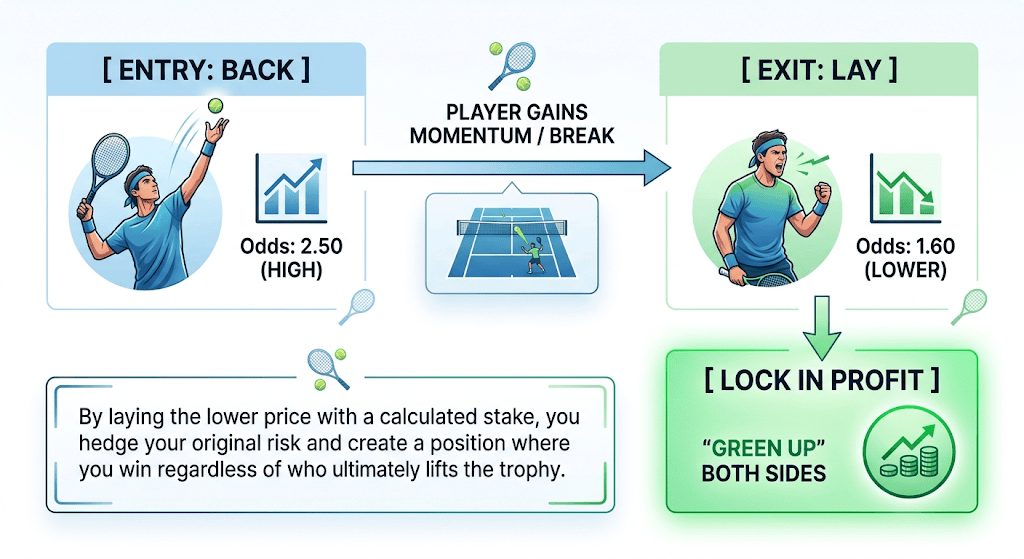
By placing a £10 Lay bet at lower odds, you hedge your original risk and create a position where you earn a profit regardless of who ultimately lifts the trophy.
Entry Points: When Should You Back to Lay?
Winning at Back to Lay comes down to spotting market overreactions or structural pivot points. Here are three prime entry triggers:
1. Fading the Cold Favorite
A strong pre-match favorite drops the first set or gets broken early. Their odds drift sharply higher due to panic selling in the market. If underlying match statistics (first-serve percentage, unforced errors) show they are simply cold rather than injured, backing them with a £10 stake at peak odds offers tremendous value before their inevitable response.
2. High-Stress Game Pivots (Scalping the Server)
When a dominant server drops to $0-30$ or $15-40$ in a service game, their match odds momentarily spike. If you place a £10 Back bet on them to fight back and hold serve, their odds will drop right back down after two or three big serves, giving you a quick exit window to Lay them for £10.
3. Surface & Matchup Advantage
Underdogs often start aggressively on fast surfaces (like grass or indoor hard courts). Backing a heavy-hitting underdog with a £10 stake pre-game or early in Set 1, then laying them off for £10 the moment they score an early break or force a tiebreak, yields quick tick profits.
Real Match Walkthroughs
Example 1: The Favorite Recovery
- Match: Carlos Alcaraz vs. Jannik Sinner
- Situation: Pre-match, Alcaraz is trading at 1.50. Early in Set 1, Sinner plays lights-out tennis, breaks twice, and takes the set 6-2.
- Market Shift: Alcaraz’s match odds drift up to 2.40.
Net Result:
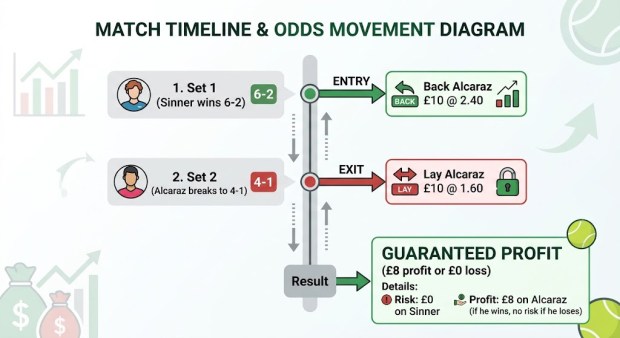
- If Alcaraz Wins: You win £14 from your Back bet and lose £6 on your Lay bet liability = +£8 Profit.
- If Sinner Wins: You lose your £10 Back bet and win the £10 Lay stake = £0 (Break-even).
Example 2: Break-Point Scalp
- Match: Aryna Sabalenka vs. Elena Rybakina
- Situation: Set 1 is tied at 4-4, 30-30 on Rybakina’s serve. Rybakina misses a first serve and commits an unforced error to bring up Break Point (30-40).
- Market Shift: Sabalenka’s odds drop to 1.65 anticipating the break.
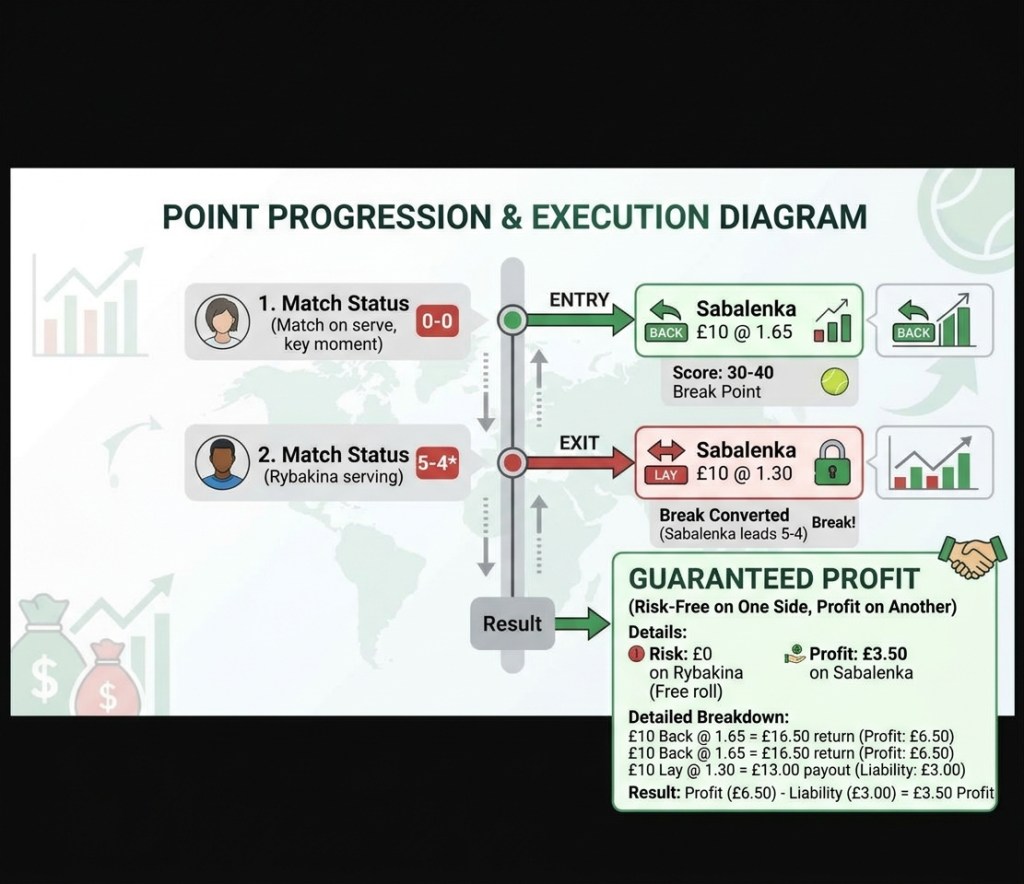
- Trade Entry: You Back Sabalenka at 1.65 for £10 (Potential profit: £6.50).
- Match Event: Sabalenka strikes a deep return-winner to convert the break and go up 5-4, serving for the set.
- Price Movement: Sabalenka’s odds instantly shorten to 1.30.
- Trade Exit: You Lay Sabalenka for £10 at 1.30 (Liability: £3.00).
Net Result:
- If Sabalenka Wins: You win £6.50 on the Back bet minus the £3.00 Lay liability = +£3.50 Profit.
- If Rybakina Wins: You lose the £10 Back bet and win the £10 Lay stake = £0 (No Loss).
3 Essential Rules for Back to Lay Trading
- Always Set a Stop-Loss Before Entering: If you Back a player with a £10 stake expecting a turnaround, but they get broken again, execute your £10 Lay trade at higher odds to cut losses quickly. Never convert a trade into a standard “hope” bet.
- Watch the Live Feed, Not Just the Scoreboard: Television and betting exchange streams often have a 3–7 second delay. Use courtside data or live video feeds where possible to avoid getting caught out by fast-moving points.
- Account for Serve Dynamics: WTA (women’s) matches statistically see a higher frequency of service breaks, leading to larger price swings than ATP (men’s) matches. Adjust your profit targets and volatility expectations accordingly.
For a visual breakdown of entry points and odds movement on betting exchanges, watch How to Trade Tennis on Betfair. This video walks through real-time exchange ladder movements and execution techniques.

