

Master the “Back to Lay” Strategy in Tennis Trading

In our introductory post, Tennis Trading: The Different Trades You Can Make on a Tennis Match, we broke down the core pillars of operating on a betting exchange like Betfair.

Today, we are diving into item #2 on that list: The Back to Lay Strategy.

If you’ve ever watched a tennis match and known deep down that a player was about to mount a comeback, go on a hot streak, or break serve, Back to Lay is the execution tool you need. Unlike standard betting, where you need a player to win the entire match to collect a payout, Back to Lay allows you to lock in guaranteed profit before the final point is even played.

What is a “Back to Lay” Trade?

At its simplest, Back to Lay is the sports trading equivalent of buying low and selling high:

  1. BACK (Buy): You place a £10 bet on a player at high odds when the market understates their immediate chances.
  2. WAIT: The player gains momentum, scores key points, or wins a game/set, causing their decimal odds to shorten (drop).
  3. LAY (Sell): You bet against that same player using a £10 stake at lower odds to lock in a profit across all outcomes (“greening up”).
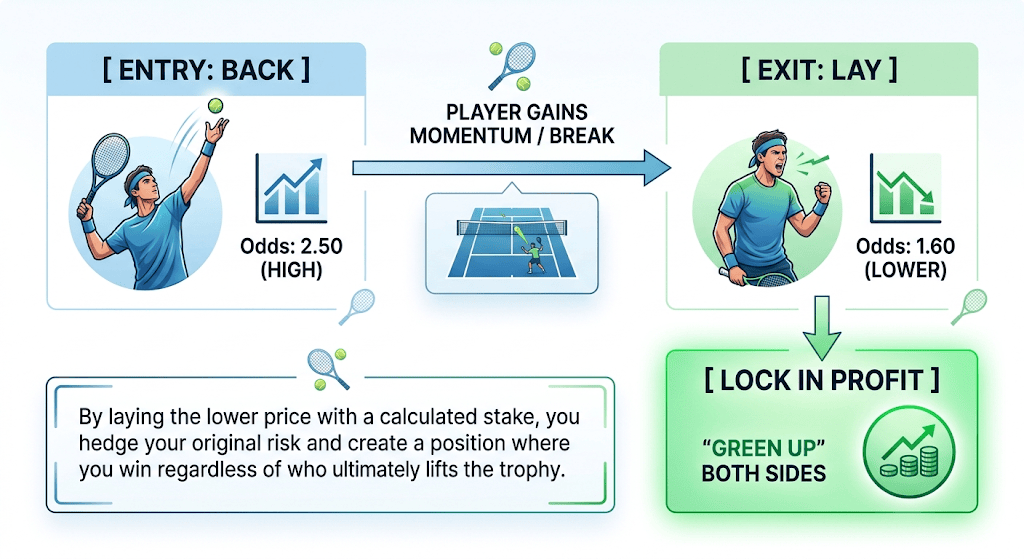
By placing a £10 Lay bet at lower odds, you hedge your original risk and create a position where you earn a profit regardless of who ultimately lifts the trophy.

Entry Points: When Should You Back to Lay?

Winning at Back to Lay comes down to spotting market overreactions or structural pivot points. Here are three prime entry triggers:

1. Fading the Cold Favorite

A strong pre-match favorite drops the first set or gets broken early. Their odds drift sharply higher due to panic selling in the market. If underlying match statistics (first-serve percentage, unforced errors) show they are simply cold rather than injured, backing them with a £10 stake at peak odds offers tremendous value before their inevitable response.

2. High-Stress Game Pivots (Scalping the Server)

When a dominant server drops to $0-30$ or $15-40$ in a service game, their match odds momentarily spike. If you place a £10 Back bet on them to fight back and hold serve, their odds will drop right back down after two or three big serves, giving you a quick exit window to Lay them for £10.

3. Surface & Matchup Advantage

Underdogs often start aggressively on fast surfaces (like grass or indoor hard courts). Backing a heavy-hitting underdog with a £10 stake pre-game or early in Set 1, then laying them off for £10 the moment they score an early break or force a tiebreak, yields quick tick profits.

Real Match Walkthroughs

Example 1: The Favorite Recovery

  • Match: Carlos Alcaraz vs. Jannik Sinner
  • Situation: Pre-match, Alcaraz is trading at 1.50. Early in Set 1, Sinner plays lights-out tennis, breaks twice, and takes the set 6-2.
  • Market Shift: Alcaraz’s match odds drift up to 2.40.

Net Result:
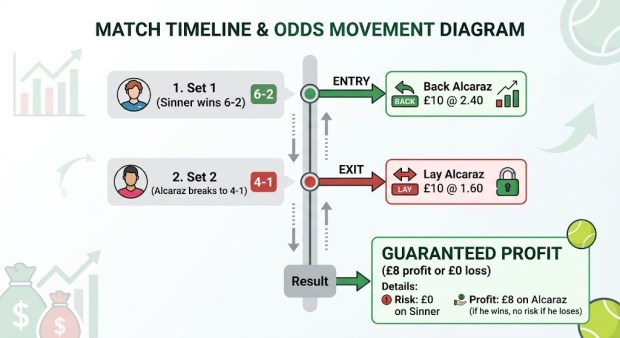
  • If Alcaraz Wins: You win £14 from your Back bet and lose £6 on your Lay bet liability = +£8 Profit.
  • If Sinner Wins: You lose your £10 Back bet and win the £10 Lay stake = £0 (Break-even).

Example 2: Break-Point Scalp

  • Match: Aryna Sabalenka vs. Elena Rybakina
  • Situation: Set 1 is tied at 4-4, 30-30 on Rybakina’s serve. Rybakina misses a first serve and commits an unforced error to bring up Break Point (30-40).
  • Market Shift: Sabalenka’s odds drop to 1.65 anticipating the break.
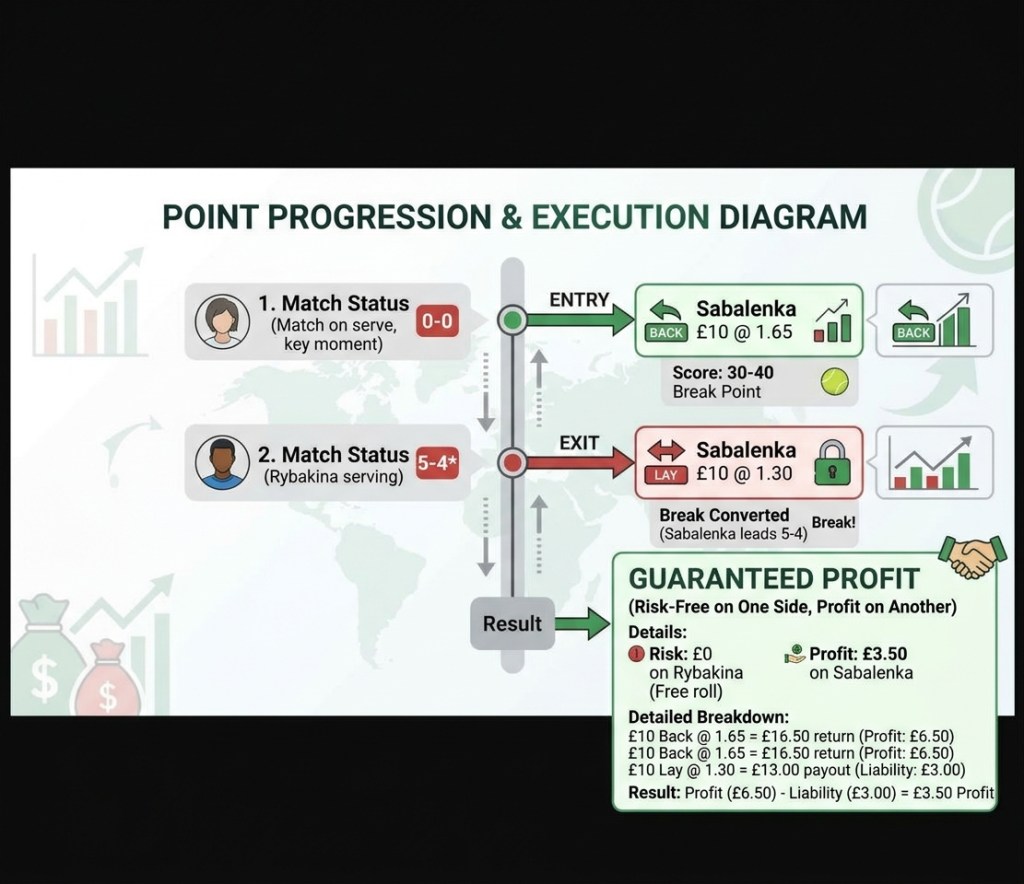
  1. Trade Entry: You Back Sabalenka at 1.65 for £10 (Potential profit: £6.50).
  2. Match Event: Sabalenka strikes a deep return-winner to convert the break and go up 5-4, serving for the set.
  3. Price Movement: Sabalenka’s odds instantly shorten to 1.30.
  4. Trade Exit: You Lay Sabalenka for £10 at 1.30 (Liability: £3.00).

Net Result:

  • If Sabalenka Wins: You win £6.50 on the Back bet minus the £3.00 Lay liability = +£3.50 Profit.
  • If Rybakina Wins: You lose the £10 Back bet and win the £10 Lay stake = £0 (No Loss).

3 Essential Rules for Back to Lay Trading

  1. Always Set a Stop-Loss Before Entering: If you Back a player with a £10 stake expecting a turnaround, but they get broken again, execute your £10 Lay trade at higher odds to cut losses quickly. Never convert a trade into a standard “hope” bet.
  2. Watch the Live Feed, Not Just the Scoreboard: Television and betting exchange streams often have a 3–7 second delay. Use courtside data or live video feeds where possible to avoid getting caught out by fast-moving points.
  3. Account for Serve Dynamics: WTA (women’s) matches statistically see a higher frequency of service breaks, leading to larger price swings than ATP (men’s) matches. Adjust your profit targets and volatility expectations accordingly.

For a visual breakdown of entry points and odds movement on betting exchanges, watch How to Trade Tennis on Betfair. This video walks through real-time exchange ladder movements and execution techniques.

Mastering the “Back the Favourite and Trade Out” Tennis Strategy

If you are entering the world of exchange trading on platforms like Smarkets or Betfair, “Back the Favourite and Trade Out” is one of the foundational position trades you need in your toolkit.

Unlike traditional sports betting, where you back a player and pray they win the entire match, tennis exchange trading focuses purely on price movement. You enter a position when you believe a price is overly generous, wait for the market to adjust in your favor, and lay off the position to lock in a profit before the final handshake at the net.

In this guide, we break down exactly how this strategy works, walk through step-by-step mathematical examples, explore when to deploy it, and examine how to manage your risk when things don’t go to plan.


What is “Back the Favourite and Trade Out”?

At its core, this strategy involves backing a player at a higher price (decimal odds) with the intention of laying that same player at a lower price later in the match.

  • Backing: Betting on an outcome to happen (acting like a traditional bettor).
  • Laying: Betting against an outcome happening (acting like the bookmaker).

When you back a player and their odds drop—for example, because they won the opening set or broke their opponent’s serve—you can lay them at the new, lower odds. This locks in an equal profit across all outcomes or completely eliminates your financial exposure.

The key takeaway? You are trading the movement in price, not necessarily predicting the eventual match winner.


Step-by-Step Example

Let’s look at a concrete breakdown to see how the numbers play out in real-time.

Phase 1: The Entry

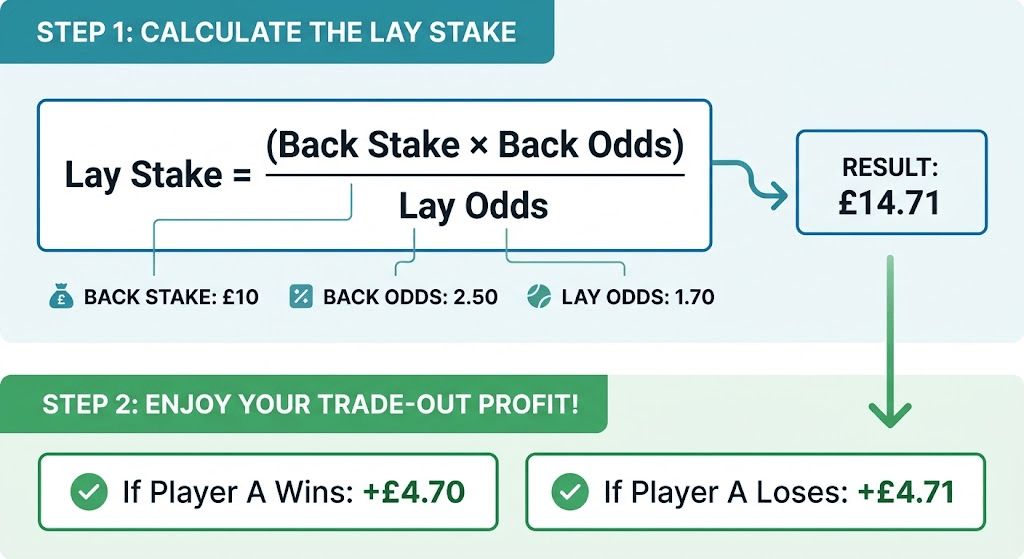
Imagine a ATP/WTA match where Player A is expected to perform well, but due to market conditions, is trading at decimal odds of 2.50.

  • Action: You Back Player A for £10 at 2.50.
  • Your Exposure: £10 (if Player A loses, you lose £10).
  • Potential Return: £25 total (£15 profit) if Player A wins without trading out.

Phase 2: The In-Play Shift

Player A starts strong, holding serve comfortably and breaking their opponent early to take the first set 6–3.

Because Player A is now in a dominant position to win the match, the market reacts quickly. Their odds shorten significantly from 2.50 down to 1.70.

Phase 3: The Exit (Trading Out)

Instead of letting the match run and taking the risk of a comeback, you choose to trade out by laying Player A at 1.70.

To create an equal profit on both players (a “green screen”):

  • Action: Lay Player A for £14.71 at 1.70.

The Resulting Profit Matrix:

  • If Player A wins: You make £15 (from back) minus £10.30 (lay liability: $14.71 \times 0.70$) = +£4.70 profit
  • If Player A loses: You lose £10 (from back) plus £14.71 (from lay stake) = +£4.71 profit

(Note: Exact figures will vary slightly depending on exchange commission fees.)

Regardless of who goes on to win the match, you have successfully locked in roughly £4.70 profit.


When Does This Strategy Work Best?

This trade relies on predicting an early shift in momentum or market sentiment. Look for matches where:

  1. Strong Servers: Players with heavy first serves who rarely get broken early on. A simple hold-and-break pattern in the first set triggers quick price contractions.
  2. Fast Starters: Players who statistically perform best in first sets, even if their overall match endurance is questionable.
  3. Favourable Surface/Head-to-Head: A player whose game style specifically counters their opponent on a given surface (e.g., a clay court specialist against a flat-hitter).
  4. Underestimated Chances: Situations where pre-match odds feel inflated due to a minor recent loss, creating value at entry.

Risk Management & What to Avoid

The single biggest danger when backing a favourite to trade out is a price drift. If your player starts slowly, gets broken early, or drops the first set, their odds will drift outwards (e.g., from 2.50 to 3.50+).

To protect your bankroll, always establish a clear plan before placing your initial back bet:

  • Set a Target Exit: Know the price at which you will take your profit (e.g., exit when odds hit 1.70).
  • Set a Stop-Loss: Determine the maximum price drift or scoreline (e.g., if Player A gets broken in Set 1) where you will accept a minor loss and exit the trade rather than hoping for a Miracle comeback.
  • Avoid Holding to the End: Resist the temptation to convert a trade into a standard bet. The goal of tennis trading is consistency through active price management.

Final Thoughts

Backing the favourite and trading out is an ideal strategy for traders learning how to manage in-play odds movement. By focusing on early momentum and executing calculated exits, you turn unpredictable match outcomes into controlled, manageable trades.