Tennis is one of the most interesting sports for exchange trading.
Unlike traditional betting, tennis trading allows you to enter a position and then potentially close it before the match has finished. Prices can move dramatically after a single break of serve, a set win, an injury, or even a change in momentum.
That creates opportunities for traders who are prepared to manage both their entries and exits.
On an exchange such as Smarkets, there are several different ways to trade a tennis match. Some trades are relatively straightforward, while others require a much better understanding of tennis, momentum and probability.
This guide looks at the main tennis trades and explains how they work.
This is probably the simplest tennis position trade.
You back a player at relatively high odds and hope their price shortens as they move closer to winning.
Example
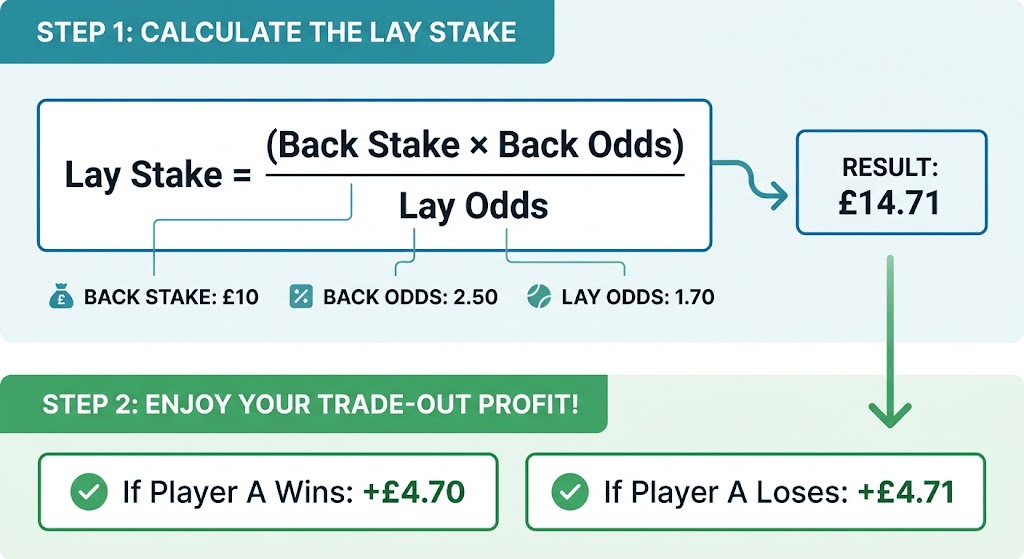
Player A is trading at:
2.50
You back them for £10.
If Player A wins the first set and their price subsequently falls to:
1.70
you can lay the same player to lock in a profit.
The important point is that you don’t necessarily need Player A to win the match.
You’re trading the movement in the price.
When can it work?
This type of trade can be particularly interesting when:
- The player is expected to start strongly.
- They are a strong server.
- They have a favourable matchup.
- Their opponent has poor recent form.
- The market appears to have underestimated their chances.
However, the biggest danger is backing a player whose price continues to drift.
2. Back-to-Lay
The classic back-to-lay trade involves backing a player and then laying them at shorter odds.
For example:
Back £10 @ 3.00
If the price falls to:
Lay @ 2.00
you can trade out.
The amount you can win depends on the exact stake and exchange commission, so traders should calculate their green-up position before entering.
The advantage is that the trade can be closed before the final result.
3. Lay-to-Back
The opposite strategy is to lay a player at relatively short odds and hope their price drifts.
For example:
Lay Player A @ 1.50
Player A then loses the first set and their price moves to:
3.00
You can back Player A at the higher price to close the trade.
This is effectively betting that the market has overestimated a player’s chances at the original price.
It can be particularly interesting when a short-priced player is struggling despite being the pre-match favourite.
4. Lay the Favourite
One of the most popular tennis trading strategies is laying a strong favourite.
Suppose:
Player A — 1.20
Player B — 5.50
You believe Player A is vulnerable.
Instead of backing Player B, you can lay Player A.
If Player A gets into trouble, their price can increase rapidly.
For example:
1.20 → 1.50 → 2.00 → 3.00
The trader can then back Player A at the higher price and potentially lock in a profit.
The attraction of this strategy is that tennis prices can move extremely quickly after a break of serve.
5. Trade a Player After They Lose Their Serve
A break of serve can produce a significant price movement.
Imagine Player A is trading at:
1.40
They are broken early in the second set.
Their price might move to:
1.80
or higher.
A trader could consider backing them after the price drift if they believe the break is likely to be recovered.
This is essentially trading a potential break-back.
However, this is not simply a case of “a player has been broken, therefore back them.”
You need to consider:
- Who is serving?
- How strong is the server?
- What is the score?
- How has the match been played?
- Has the player been creating break opportunities?
- Is the player physically struggling?
6. Trade the Break Back
The opposite situation can also create an opportunity.
Suppose Player A is serving for the set but is broken.
The market reacts quickly and their price drifts.
If you believe Player A can immediately break back, you could back them at the bigger price.
A successful break back can produce a rapid price contraction.
For example:
1.30 → 1.75 → 1.35
That can create a trading opportunity without requiring the player to win the match.
7. Set Betting Trades
You don’t have to trade the match-winner market.
Set markets can also provide opportunities.
For example:
Player A to win Set 1
You might back them before the match or early in the set.
If they move into a strong position, you can potentially trade out.
Set markets can sometimes react more dramatically than match markets because there is less time remaining for the outcome to change.
The downside is that liquidity can be lower.
8. Correct Score Trading
Correct-score markets can also be traded.
Examples include:
At the beginning of a match, a 2–0 correct score might be trading at a relatively high price.
If the favourite wins the first set, the 2–0 price can shorten considerably.
A trader can then close the position.
This is a much more aggressive form of trading because there are fewer ways for the trade to succeed.
9. Total Games Trading
Another interesting tennis market is total games.
Examples:
Over 22.5 games
or
Under 22.5 games
You can trade the total number of games in the match.
This can be particularly interesting when the match is expected to be close.
For example, a first set finishing:
7–6
can cause the Over price to shorten dramatically.
A trader who backed Over before the match may then have an opportunity to close the position.
10. Over/Under Games in a Set
The same principle can be applied to individual sets.
For example:
Over 9.5 games — Set 1
If the first set reaches 5–4, the market may react strongly.
Likewise, if a player races into a 5–1 lead, the Under price can shorten considerably.
These markets require traders to understand the relationship between the current score and the remaining games required.
11. Trading the First Set
The first set provides some particularly interesting trading opportunities.
Suppose Player A is priced at:
1.80
They start well and move to:
4–2
Their price might shorten substantially.
Rather than holding the position until the end of the match, a trader can potentially take the profit at that point.
The advantage is that you are reducing your exposure to what happens later in the match.
12. Trading Momentum
Momentum is one of the most discussed subjects in tennis trading.
Imagine:
Player A wins the first set.
Then Player B immediately goes a break ahead in the second.
The market may move rapidly.
A trader might believe the match has swung too far towards Player B and look for a position on Player A.
However, momentum should never be treated as a guarantee.
A player may have genuinely lost control of the match.
The key is determining whether the price movement is justified or excessive.
13. Trading the Server
Because tennis is based around service games, the current server can be extremely important.
Consider a player trading at:
1.50
They are serving at 5–4 for the set.
If they hold serve, they win the set and their price could shorten significantly.
If they are broken, however, the price can move sharply in the opposite direction.
This creates a potential short-term trading opportunity around important service games.
14. Trading Tie-Breaks
Tie-breaks can produce some of the fastest price movements in tennis.
At 6–6, the next few points can dramatically change the match price.
A player might move from:
1.70
to:
1.25
after gaining a significant lead.
But the reverse can happen just as quickly.
Tie-break trading therefore carries considerable risk.
A small number of points can completely change the position.
15. Trading a Favourite Who Starts Slowly
Sometimes a pre-match favourite starts badly.
For example:
Player A starts at:
1.30
They lose the first set and drift to:
2.80
A trader who believes the pre-match assessment remains valid may consider backing them at the larger price.
This is sometimes referred to as backing the favourite after a price drift.
But there is an important distinction between a player simply having a bad set and a player having a genuine problem.
Look for information such as:
- Break-point opportunities
- First-serve percentage
- Unforced errors
- Winners
- Rally performance
- Physical condition
- Movement
- Previous head-to-head results
- Surface suitability
16. Trading an Underdog Who Starts Well
The opposite strategy is to back an underdog before the match and trade after they make a strong start.
For example:
Player B @ 4.50
Player B then takes the first set.
Their price might fall substantially.
Rather than continuing to hold the position, the trader can take the profit.
This can be attractive because the original objective was the price movement, not necessarily predicting the eventual winner.
17. Trading Around Match Points
Match points create enormous price movements.
If a player reaches match point, their price can collapse.
If they save match point, the price can immediately rebound.
This creates opportunities, but it is also one of the most dangerous areas of tennis trading.
A single point can turn a profitable position into a losing one.
Traders should be particularly careful with unmatched orders and fast-moving markets.
18. Trading an Injury or Medical Timeout
An injury can completely transform a tennis market.
A player who is struggling physically may suddenly drift dramatically.
However, attempting to anticipate an injury is extremely risky.
Instead, traders should react to observable information.
If a player takes a medical timeout and subsequently shows obvious physical problems, the market may reassess their chances.
This can create large price movements in both directions.
19. Trading Retirement Markets
Some exchanges provide markets relating to whether a player will retire.
These are specialist markets and require considerably more understanding of the rules and settlement conditions.
The key lesson is simple:
Always understand the market’s settlement rules before trading it.
Different markets can have different rules concerning retirements, walkovers and abandoned matches.
20. Trading the Match Handicap
Handicap markets can also be traded.
For example:
Player A -3.5 games
or
Player B +3.5 games
The price can move as the match develops.
These markets are particularly interesting when the match is expected to be relatively one-sided but the exact winner’s price is too short for a trader’s strategy.
21. Combining Pre-Match and In-Play Information
One of the most useful approaches is to combine pre-match analysis with what is actually happening on court.
Before entering a trade, consider:
Pre-match
- Ranking
- Recent form
- Surface
- Head-to-head
- Serve statistics
- Return statistics
- Recent opponents
- Injury history
- Tournament conditions
In-play
- Current score
- Service performance
- Break points
- First-serve percentage
- Unforced errors
- Winners
- Physical condition
- Momentum
- Body language
- Quality of rallies
The market price should then be compared with your assessment.
22. Don’t Confuse Trading With Predicting
This is perhaps the most important concept.
A tennis trader does not necessarily need to predict the winner.
Instead, the trader is trying to identify when the market price is likely to move.
For example:
You might back Player A at 3.00 and lay at 2.20.
Player A could subsequently lose the match.
That doesn’t necessarily mean the trade was unsuccessful.
The trade was based on the price moving from 3.00 to 2.20.
A Simple Tennis Trading Framework
Before entering a position, ask five questions:
1. Why am I entering?
What do I believe the market has got wrong?
2. What price am I entering at?
Never enter simply because you “like” a player.
3. What is my target exit?
Know your target before placing the trade.
4. Where will I take a loss?
Every trade needs a point at which you accept that your original idea was wrong.
5. What could happen next?
Consider the next service game, break point, set point or tie-break.
The Golden Rule of Tennis Trading
The biggest mistake new traders make is waiting for the trade to become a winning bet.
A position trade should have an entry, a target and an exit plan.
For example:
Back Player A @ 2.50
Target exit @ 2.00
Maximum acceptable loss @ 3.20
The exact prices will depend on the match and the trader’s analysis.
The important thing is having the plan before emotions take over.
Final Thoughts
Tennis offers an unusually wide range of trading opportunities because the market is constantly responding to points, games, sets and changes in momentum.
The major strategies include:
- Back-to-lay
- Lay-to-back
- Laying favourites
- Backing drifting favourites
- Trading underdogs
- Trading breaks of serve
- Trading break-backs
- Set trading
- Correct-score trading
- Total-games trading
- Set totals
- Tie-break trading
- Momentum trading
- Service-game trading
- Handicap trading
- Injury-related trading
No strategy is guaranteed to make money.
The strongest approach is to treat every trade as a price-management exercise, rather than simply trying to pick the winner.
The objective isn’t necessarily to predict what happens at the end of the match.
It is to identify a price you believe is wrong, enter the market, manage the position and get out when the market moves in your favour.
That’s tennis trading.