
Mastering Strategy #5: Trade a Player After They Lose Their Serve

In our overview post on Tennis Trading: The Different Trades You Can Make on a Tennis Match, we introduced the concept of backing a strong player after they drop a service game.

When a favourite gets broken, the market often overreacts, causing their back odds to drift significantly higher. This creates a prime value entry for traders anticipating an immediate bounce-back or a break-back in the following games. However, simply buying every broken favourite blindly is a fast track to draining your bankroll. Success requires precise entry criteria, clear profit targets, and disciplined stop-loss management.

Here is a deep dive into how to trade this setup, complete with real-world profitable and losing trade examples using a standard base stake of £10.

The Core Concept & Entry Checklist

When a player loses serve, their odds instantly jump (for example, moving from 1.40 up to 1.80 or higher). This strategy aims to back the broken player at inflated odds and exit the market once momentum stabilizes or a break-back occurs.

Before entering a position, run through this checklist:

  • Return Profile: Is the broken player a strong returner (high break-back percentage)?
  • Server Vulnerability: Is the opponent’s serve historically weak or unreliable under pressure?
  • Body Language/Stats: Is the favourite creating break points despite losing serve, or are they struggling physically/mentally?

Example 1: The Profitable Trade (Successful Break-Back)

Scenario Setup

  • Pre-match Favourite: Player A (Trading pre-match at 1.40)
  • Match Situation: Player A wins Set 1 easily (6–3). In Set 2, at 1–1, Player A plays a sloppy game and gets broken to go 1–2 down.

Trade Execution

  1. Entry Point: Following the break at 1–2, Player A’s odds drift from 1.42 up to 1.85. Seeing that Player A generated three break points in their previous return game, you back Player A for £10 at 1.85.
    • Outlay / Risk: £10 stake to return £18.50 (£8.50 potential profit).
  2. In-Play Dynamics: In the very next game (1–2), Player A applies heavy pressure on the return, forcing errors and successfully securing the break-back to level the set at 2–2.
  3. Exit Point: Immediately following the break-back, the market re-adjusts. Player A’s odds contract rapidly back down to 1.48. You lay Player A for £12.50 at 1.48 to trade out and green up across all outcomes.

Outcome & Profit

  • Back Stake: £10 @ 1.85
  • Lay Stake: £12.50 @ 1.48 (Liability = £6.00)
  • Result: Guaranteed profit of approximately £2.50 regardless of who goes on to win the match (before exchange commission), completely risk-free for the rest of the game.

Example 2: The Losing Trade (Disciplined Stop-Loss)

Not every broken favourite bounces back immediately. Having a hard stop-loss strategy is crucial to prevent a minor setback from turning into a devastating loss.

Scenario Setup

  • Pre-match Favourite: Player B (Trading pre-match at 1.35)
  • Match Situation: Set 1 is tied at 3–3. Player B serves poorly and suffers a break, putting them 3–4 down.

Trade Execution

  1. Entry Point: Player B’s odds drift from 1.40 to 1.75. You enter the market by backing Player B for £10 at 1.75, anticipating a swift response.
  2. Stop-Loss Strategy: Define a strict exit rule prior to entry: If Player B fails to break back on the next game AND faces serious pressure on their subsequent service game (or if their odds cross 2.25), close the position immediately.
  3. In-Play Dynamics:
    • Game 8 (3–4): Player B fails to convert break points; the opponent holds serve (3–5). Odds move to 1.95.
    • Game 9 (3–5): Player B drops to 0–40 on their own serve due to consecutive unforced errors.
  4. Exit Point (Stop-Loss Trigger): Rather than hoping for a miracle save from 0–40 down, execute your stop-loss and lay Player B for £10 at 2.25 to cap your loss.

Outcome & Loss Management

  • Back Stake: £10 @ 1.75
  • Lay Stake: £10 @ 2.25
  • Result: Total loss limited to £5.00 (or ~£2.22 if hedged equally across both outcomes).

By executing your stop-loss at 2.25, you prevented a potential £10.00 total loss had Player B gone on to lose the set 3–6 and drifted past 3.50.

Key Takeaways for Execution

  1. Pre-define Your Exit: Never enter a position without knowing the exact score line or odds trigger where you will cut your losses.
  2. Avoid “Hope Trading”: If a player drops serve because of double faults, sluggish movement, or visible physical pain, skip the trade—the price drift is justified.
  3. Lock in Green: When the break-back occurs, trade out immediately to secure your profit rather than holding out for a full match victory.


Master the “Lay to Back” Tennis Trading Strategy: Optimum Odds Groups & Data Insights

In tennis sports trading, Lay to Back (L2B) is one of the most structured, high-probability trading methodologies available. Rather than backing a player and hoping they win the entire match, laying a player (selling their probability) allows traders to capitalize on market overreactions, momentum swings, and in-play score volatility before backing them back at higher odds to lock in a guaranteed profit.

Analyzing 2026 ATP tour match data reveals how performance dynamics, set-loss recovery rates, and odds movement vary across pre-match price ranges. Choosing the correct Odds Group is essential for determining liability risk, entry triggers, and trade execution.

Data Insights: Player Behavior Across Odds Groups

Using full ATP match data across Grand Slams, Masters, ATP 500, and ATP 250 events, pre-match favorites can be grouped by average implied probability to observe set-loss frequency and match stretch rates:

Odds GroupFavorite Price RangeFavorite Win RateLoser Wins Set 1 Rate3+ Set Match RatePrimary Risk Profile
Group A: Heavy Favorites1.01 – 1.2086.2%17.4%56.4%Low liability / High swing threshold
Group B: Moderate Favorites1.21 – 1.4074.0%19.3%48.9%Optimum L2B Sweet Spot
Group C: Lean Favorites1.41 – 1.6063.3%22.2%49.8%Medium risk / High in-play volatility
Group D: Coin-Flip Matches1.61 – 2.0056.6%21.7%47.4%High liability / High match turnover

The Optimum Odds Groups for Lay to Back Trades

1. Group B: 1.21 – 1.40 (The Optimum Sweet Spot)

  • Why it works: Short favorites in this band win 74.0% of their matches overall, but fail to win straight sets in over 48.9% of matches.
  • The Opportunity: When a 1.25–1.35 favorite loses the opening service game or drops the first set, their odds typically float up into the 1.70–2.20 range. Because their baseline quality remains superior, their recovery rate is exceptionally strong.
  • Trade Mechanics: Lay the favorite early when they face break points or drop behind, then Back to hedge once they steady their service game or reclaim the break.

2. Group C: 1.41 – 1.60 (The Volatility Trader’s Choice)

  • Why it works: Favorites in this category lose Set 1 in 22.2% of matches. When a 1.50 favorite goes down a set, their price often drifts to 2.80–3.20.
  • The Opportunity: This price drift offers significant tick movement for Lay to Back entries on the favorite before or during set 2, as market resistance creates price elasticity.

3. Group A: 1.01 – 1.20 (The Recovery Trade)

  • Why it works: Heavy favorites rarely lose outright (86.2% win rate), but they go to 3 or more sets in 56.4% of matches (including Grand Slams).
  • The Opportunity: Laying a 1.10 favorite at start-of-match carries minimal liability. If they lose an early service game, the price inflates sharply (e.g., from 1.10 to 1.35+), yielding an immediate hedge window.

Step-by-Step L2B Execution Workflow

[ Pre-Match Identification ]
│
▼
[ Filter: Fav Odds Range 1.21 - 1.50 ]
│
▼
[ In-Play Trigger: Fav drops early serve or drops Set 1 ]
│
▼
[ ACTION: LAY the Favorite at inflated low price ]
│
▼
[ Price Movement: Favorite breaks back or stabilizes ]
│
▼
[ ACTION: BACK the Favorite at higher odds to hedge profit ]

Execution Rules & Risk Management

  1. Strict Stop-Loss Discipline: If laying a favorite after they drop Set 1, set a clear stop-loss trigger if they fall behind an additional double-break in Set 2.
  2. Beware of Surface Variations: Clay court matches feature higher break rates and wider price swings compared to Fast Hard or Grass courts. Factor surface speed into tick targets.
  3. Green-Up Equally: Always use exchange auto-hedging (“Cash Out” / “Green Up”) to spread profit evenly across both outcomes regardless of who completes the match victory.

Disclaimer:

The information, data, and strategies shared in this post are for educational and informational purposes only and do not constitute financial or betting advice. Sports trading carries inherent risks, and past performance or statistical insights do not guarantee future outcomes. Always manage your risk responsibly, bet only what you can afford to lose, and adhere to local gambling regulations.

Mastering the “Back the Favourite and Trade Out” Tennis Strategy

If you are entering the world of exchange trading on platforms like Smarkets or Betfair, “Back the Favourite and Trade Out” is one of the foundational position trades you need in your toolkit.

Unlike traditional sports betting, where you back a player and pray they win the entire match, tennis exchange trading focuses purely on price movement. You enter a position when you believe a price is overly generous, wait for the market to adjust in your favor, and lay off the position to lock in a profit before the final handshake at the net.

In this guide, we break down exactly how this strategy works, walk through step-by-step mathematical examples, explore when to deploy it, and examine how to manage your risk when things don’t go to plan.


What is “Back the Favourite and Trade Out”?

At its core, this strategy involves backing a player at a higher price (decimal odds) with the intention of laying that same player at a lower price later in the match.

  • Backing: Betting on an outcome to happen (acting like a traditional bettor).
  • Laying: Betting against an outcome happening (acting like the bookmaker).

When you back a player and their odds drop—for example, because they won the opening set or broke their opponent’s serve—you can lay them at the new, lower odds. This locks in an equal profit across all outcomes or completely eliminates your financial exposure.

The key takeaway? You are trading the movement in price, not necessarily predicting the eventual match winner.


Step-by-Step Example

Let’s look at a concrete breakdown to see how the numbers play out in real-time.

Phase 1: The Entry

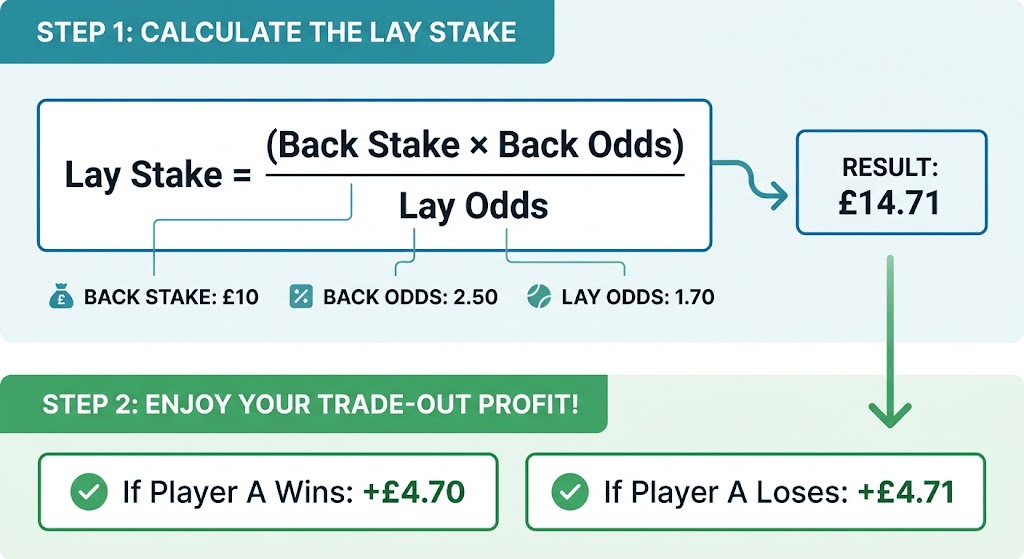
Imagine a ATP/WTA match where Player A is expected to perform well, but due to market conditions, is trading at decimal odds of 2.50.

  • Action: You Back Player A for £10 at 2.50.
  • Your Exposure: £10 (if Player A loses, you lose £10).
  • Potential Return: £25 total (£15 profit) if Player A wins without trading out.

Phase 2: The In-Play Shift

Player A starts strong, holding serve comfortably and breaking their opponent early to take the first set 6–3.

Because Player A is now in a dominant position to win the match, the market reacts quickly. Their odds shorten significantly from 2.50 down to 1.70.

Phase 3: The Exit (Trading Out)

Instead of letting the match run and taking the risk of a comeback, you choose to trade out by laying Player A at 1.70.

To create an equal profit on both players (a “green screen”):

  • Action: Lay Player A for £14.71 at 1.70.

The Resulting Profit Matrix:

  • If Player A wins: You make £15 (from back) minus £10.30 (lay liability: $14.71 \times 0.70$) = +£4.70 profit
  • If Player A loses: You lose £10 (from back) plus £14.71 (from lay stake) = +£4.71 profit

(Note: Exact figures will vary slightly depending on exchange commission fees.)

Regardless of who goes on to win the match, you have successfully locked in roughly £4.70 profit.


When Does This Strategy Work Best?

This trade relies on predicting an early shift in momentum or market sentiment. Look for matches where:

  1. Strong Servers: Players with heavy first serves who rarely get broken early on. A simple hold-and-break pattern in the first set triggers quick price contractions.
  2. Fast Starters: Players who statistically perform best in first sets, even if their overall match endurance is questionable.
  3. Favourable Surface/Head-to-Head: A player whose game style specifically counters their opponent on a given surface (e.g., a clay court specialist against a flat-hitter).
  4. Underestimated Chances: Situations where pre-match odds feel inflated due to a minor recent loss, creating value at entry.

Risk Management & What to Avoid

The single biggest danger when backing a favourite to trade out is a price drift. If your player starts slowly, gets broken early, or drops the first set, their odds will drift outwards (e.g., from 2.50 to 3.50+).

To protect your bankroll, always establish a clear plan before placing your initial back bet:

  • Set a Target Exit: Know the price at which you will take your profit (e.g., exit when odds hit 1.70).
  • Set a Stop-Loss: Determine the maximum price drift or scoreline (e.g., if Player A gets broken in Set 1) where you will accept a minor loss and exit the trade rather than hoping for a Miracle comeback.
  • Avoid Holding to the End: Resist the temptation to convert a trade into a standard bet. The goal of tennis trading is consistency through active price management.

Final Thoughts

Backing the favourite and trading out is an ideal strategy for traders learning how to manage in-play odds movement. By focusing on early momentum and executing calculated exits, you turn unpredictable match outcomes into controlled, manageable trades.

ASB Classic 2025 Tournament Results and Insights

The ASB Classic is the first WTA 250 tournament of the year on the WTA 250 Tour. Comprising of 32 players competing for tour points and prize money that will advance their world standings as the points accumulate. As with other posts in this series I will be looking at the fate of the top eight seeded players for each tournament furthering my own research into making small profits by laying these players to a fixed liability of £1.00 (which is 10% of a starting bank of £10.00) at the Betdaq exchange, where at present I enjoy a 0% commission rate.
The top 8 seedes in order of rank were for this tournament as follows
1. Keys. M
2. Mertens. E
3. Anismova. A
4. Sun. L
5. Tauson. C
6. Raducanu. E
7. Osaka. N
8. Volynets. K

Both Mertens and Raducanu withdrew from the tournament before the start due to injury.

Round 1

With just 6 of the top 8 seeds starting the maximum loss if all seeded players won in the 1st round would be £6.00. Both the 3rd and 4th seed lost their first round matches. Sun (4) losing 6-3/3-6/6-3 and Anisimova (3) losing 2-6/6-2/6-3. The table below shows the P/L of the first round matches where each of the seeded players were laid to a £1.00 liability.

Round 1 resulted in a small loss of 34p and 4 players advancing into the 2nd round.

Round 2

With 4 of the top 8 seeds progressing into the second round and a 34p loss from the 1st round our maximum loss if all players won the second round would be £4.34. Unfortunately for our laying strategy this is exactly what happened. The table below shows just this.

A total loss of £4.34 after round 2 still leaves us £5.66 of our £10.00 bank intact and is ample to now see us through to the end of the tournament.

Quarter Finals.

The quarter finals have eventually seen the match up of 2 of our seeded players, Touson and Keys so we now know that our Maximum loss for the Quarter finals is not £4.00 as in the second round but £2.00 plus whatever the outcome of the matched up seeded players returns. This could be a profit if the favourite has short enough odds and loses or a small offset loss if she wins
In the event of it No 8 seed Volynet loses to Parks and in the Match up match between Touson and Keys, Keys was the odds on favourite to win the match but Touson won it in straight sets 6-4/7-6. This produced an overall profit of £1.95 for the Quarter Finals round as shown in the table below.

If we add this profit to our previous losses in the 1st and second rounds we still have a loss of £2.39.

Semi- Finals

With just 2 of the seeded players in the semi finals and each playing another player our maximum loss for the semis is just £2.00 if both players advance to the final. And this is exactly what happened unfortunately. Both players won in straight sets Tauson winning 6-4/6-3 and Osaka 6-4/6-2. This brought our total tournament loss to £4.39 with a similar situation as in the quarter finals where two of the seeded players play each other. The table below shows the semi final results

The Final.

The tournament organisers must have been very pleased with themselves as the seeding worked and 2 of the seeded players meet in the final but depending on which one wins will either increase our tournament loss or decrease it depending on the odds. Osaka was the odds on favourite at 1.53 and if she wins then our tournament loss would be increased. If however she were to lose to the “underdog” Tauson who had lay odds of 2.79 then we would win more from Osaka’s loss than from Tauson’s Win and it would decrease our overall tournament loss. The table below shows just what happened.

As you can see in the table we lost £1.00 with Tauson winning but we won £1.89 with Osaka becoming runner up. This gave us a 89p profit to add to our tournament loss of 34.39 giving a total of £3.50 loss. The table below shows all the lay bets made and odds with stakes for each match.

Summary

Over the whole of the tournament we would have made a total of 18 bets at £1.00 liability. The early exit of Anisimova and Sun helped preserve the bank to a certain extent and from this point a total loss whilst possible proved unfounded and left us with a workable bank of £6.50 of which we can take into the second WTA 250 tournament using liability bets of 65p.

Disclaimer

If you liked this content please “like” so I can get some feel for the effort I am putting into this being beneficial to others who are looking to make a couple of quid but no fortunes.

Please gamble responsibly and dont bet more than you can afford. The content of this post is historical fact and in no way guarantees the out come of future tournaments.