Master the “Lay to Back” Tennis Trading Strategy: Optimum Odds Groups & Data Insights

In tennis sports trading, Lay to Back (L2B) is one of the most structured, high-probability trading methodologies available. Rather than backing a player and hoping they win the entire match, laying a player (selling their probability) allows traders to capitalize on market overreactions, momentum swings, and in-play score volatility before backing them back at higher odds to lock in a guaranteed profit.

Analyzing 2026 ATP tour match data reveals how performance dynamics, set-loss recovery rates, and odds movement vary across pre-match price ranges. Choosing the correct Odds Group is essential for determining liability risk, entry triggers, and trade execution.

Data Insights: Player Behavior Across Odds Groups

Using full ATP match data across Grand Slams, Masters, ATP 500, and ATP 250 events, pre-match favorites can be grouped by average implied probability to observe set-loss frequency and match stretch rates:

Odds GroupFavorite Price RangeFavorite Win RateLoser Wins Set 1 Rate3+ Set Match RatePrimary Risk Profile
Group A: Heavy Favorites1.01 – 1.2086.2%17.4%56.4%Low liability / High swing threshold
Group B: Moderate Favorites1.21 – 1.4074.0%19.3%48.9%Optimum L2B Sweet Spot
Group C: Lean Favorites1.41 – 1.6063.3%22.2%49.8%Medium risk / High in-play volatility
Group D: Coin-Flip Matches1.61 – 2.0056.6%21.7%47.4%High liability / High match turnover

The Optimum Odds Groups for Lay to Back Trades

1. Group B: 1.21 – 1.40 (The Optimum Sweet Spot)

  • Why it works: Short favorites in this band win 74.0% of their matches overall, but fail to win straight sets in over 48.9% of matches.
  • The Opportunity: When a 1.25–1.35 favorite loses the opening service game or drops the first set, their odds typically float up into the 1.70–2.20 range. Because their baseline quality remains superior, their recovery rate is exceptionally strong.
  • Trade Mechanics: Lay the favorite early when they face break points or drop behind, then Back to hedge once they steady their service game or reclaim the break.

2. Group C: 1.41 – 1.60 (The Volatility Trader’s Choice)

  • Why it works: Favorites in this category lose Set 1 in 22.2% of matches. When a 1.50 favorite goes down a set, their price often drifts to 2.80–3.20.
  • The Opportunity: This price drift offers significant tick movement for Lay to Back entries on the favorite before or during set 2, as market resistance creates price elasticity.

3. Group A: 1.01 – 1.20 (The Recovery Trade)

  • Why it works: Heavy favorites rarely lose outright (86.2% win rate), but they go to 3 or more sets in 56.4% of matches (including Grand Slams).
  • The Opportunity: Laying a 1.10 favorite at start-of-match carries minimal liability. If they lose an early service game, the price inflates sharply (e.g., from 1.10 to 1.35+), yielding an immediate hedge window.

Step-by-Step L2B Execution Workflow

[ Pre-Match Identification ]
│
▼
[ Filter: Fav Odds Range 1.21 - 1.50 ]
│
▼
[ In-Play Trigger: Fav drops early serve or drops Set 1 ]
│
▼
[ ACTION: LAY the Favorite at inflated low price ]
│
▼
[ Price Movement: Favorite breaks back or stabilizes ]
│
▼
[ ACTION: BACK the Favorite at higher odds to hedge profit ]

Execution Rules & Risk Management

  1. Strict Stop-Loss Discipline: If laying a favorite after they drop Set 1, set a clear stop-loss trigger if they fall behind an additional double-break in Set 2.
  2. Beware of Surface Variations: Clay court matches feature higher break rates and wider price swings compared to Fast Hard or Grass courts. Factor surface speed into tick targets.
  3. Green-Up Equally: Always use exchange auto-hedging (“Cash Out” / “Green Up”) to spread profit evenly across both outcomes regardless of who completes the match victory.

Disclaimer:

The information, data, and strategies shared in this post are for educational and informational purposes only and do not constitute financial or betting advice. Sports trading carries inherent risks, and past performance or statistical insights do not guarantee future outcomes. Always manage your risk responsibly, bet only what you can afford to lose, and adhere to local gambling regulations.

Mastering the Lay-to-Back Tennis Trading Strategy

In tennis exchange trading, success isn’t about predicting who will hold the trophy at the end of the match—it’s about capitalizing on market overreactions and price swings.

While backing a favorite is intuitive, one of the most effective strategies for value-focused traders is the Lay-to-Back trade. This strategy flips traditional betting on its head: you start by betting against a player at short odds and exit by betting for them once their odds rise.

What is a Lay-to-Back Trade?

A Lay-to-Back trade is a two-step position:

  1. The Entry (Lay): You lay a player at relatively low odds (e.g., 1.50), betting that they will struggle or that the market has overvalued their immediate probability of winning.
  2. The Exit (Back): If the player loses a set, gets broken on serve, or drifts in price due to visible fatigue or momentum shifts, you back that same player at higher odds (e.g., 3.00).

By doing this, you lock in a profit or hedge your exposure before the final match result is ever decided.

Visualizing the Strategy: The Odds Movement

Here is a simple flow showing how a Lay-to-Back trade unfolds over the course of a match:

[ ENTRY: PRE-MATCH / EARLY GAME ]
│
▼
Lay Player A @ 1.50
(Risking liability on a low-odds favorite)
│
▼
[ IN-PLAY EVENT ]
Player A loses Set 1 or gets broken on serve
│
▼
[ EXIT: TRADE OUT ]
Back Player A @ 3.00
│
▼
[ RESULT ]
Profit locked in across all outcomes (Green-up)

Worked Example: Laying a Vulnerable Favorite

Let’s walk through a concrete scenario on a betting exchange like Smarkets or Betfair.

Scenario

  • Match: Player A vs. Player B
  • Pre-Match Odds: Player A is trading at 1.50.
  • Assessment: Player A historically starts slowly or struggles on their second serve, making 1.50 too short of a price.

Step-by-Step Execution

1. Initial Lay Bet

You lay Player A for £20 at odds of 1.50.

  • Liability (Risk):Stake x (Odds} – 1) = £20 x (1.50 – 1) = £10.00
  • Potential Gain: £20 (if Player A loses or drifts)

2. Match Progression

Player A drops serve early in the first set and ultimately loses Set 1 6–4. The exchange market reacts immediately to the setback, and Player A’s odds drift from 1.50 up to 3.00.

3. Exit Back Bet

With Player A now at 3.00, you back Player A for £10 to close your liability and hedge your position.

Outcome Breakdown

Player A WinsPlayer B Wins
Lay Outcome: -£10.00 (lost liability)Lay Outcome: +£20.00 (kept lay stake)
Back Outcome: +£20.00 ({Profit} = £10 \times (3.00 – 1))Back Outcome: -£10.00 (lost back stake)
Net Profit: +£10.00Net Profit: +£10.00

By spreading your stakes, you secure a £10 profit regardless of who goes on to win the match.

Key Triggers for a Lay-to-Back Trade

Knowing when to execute a Lay-to-Back trade is crucial. Look out for these high-probability setups:

  • Slow Starters: Players who take time to adjust to match conditions or opponent rhythms.
  • Weak Second Serves: Favorites whose second-serve win percentage is low, making them prone to early breaks.
  • Underdog Momentum: An opponent who returns aggressively and puts early pressure on the favorite’s service games.
  • Physical Flips: Signs of minor injury, lethargy, or frustration during warm-ups or early games.

Summary Checklist

  • Entry: Lay short odds (1.20 – 1.60) when a favorite is overpriced.
  • Target Exit: Back the player at double their original odds or higher after a set loss or serve break.
  • Risk Management: Always pre-determine a stop-loss point (e.g., if the favorite dominates early and drops to 1.20, take a small controlled loss).

Disclaimer: The content provided in this post is for educational and informational purposes only and does not constitute financial or sports betting advice. Sports trading and betting on exchanges carry inherent financial risks, and past market performance or specific trading strategies do not guarantee future results. Never stake more than you can afford to lose. Please gamble responsibly.

Tennis Trading: The Different Trades You Can Make on a Tennis Match

Tennis is one of the most interesting sports for exchange trading.

Unlike traditional betting, tennis trading allows you to enter a position and then potentially close it before the match has finished. Prices can move dramatically after a single break of serve, a set win, an injury, or even a change in momentum.

That creates opportunities for traders who are prepared to manage both their entries and exits.

On an exchange such as Smarkets, there are several different ways to trade a tennis match. Some trades are relatively straightforward, while others require a much better understanding of tennis, momentum and probability.

This guide looks at the main tennis trades and explains how they work.


1. Back the Favourite and Trade Out

This is probably the simplest tennis position trade.

You back a player at relatively high odds and hope their price shortens as they move closer to winning.

Example

Player A is trading at:

2.50

You back them for £10.

If Player A wins the first set and their price subsequently falls to:

1.70

you can lay the same player to lock in a profit.

The important point is that you don’t necessarily need Player A to win the match.

You’re trading the movement in the price.

When can it work?

This type of trade can be particularly interesting when:

  • The player is expected to start strongly.
  • They are a strong server.
  • They have a favourable matchup.
  • Their opponent has poor recent form.
  • The market appears to have underestimated their chances.

However, the biggest danger is backing a player whose price continues to drift.


2. Back-to-Lay

The classic back-to-lay trade involves backing a player and then laying them at shorter odds.

For example:

Back £10 @ 3.00

If the price falls to:

Lay @ 2.00

you can trade out.

The amount you can win depends on the exact stake and exchange commission, so traders should calculate their green-up position before entering.

The advantage is that the trade can be closed before the final result.


3. Lay-to-Back

The opposite strategy is to lay a player at relatively short odds and hope their price drifts.

For example:

Lay Player A @ 1.50

Player A then loses the first set and their price moves to:

3.00

You can back Player A at the higher price to close the trade.

This is effectively betting that the market has overestimated a player’s chances at the original price.

It can be particularly interesting when a short-priced player is struggling despite being the pre-match favourite.


4. Lay the Favourite

One of the most popular tennis trading strategies is laying a strong favourite.

Suppose:

Player A — 1.20

Player B — 5.50

You believe Player A is vulnerable.

Instead of backing Player B, you can lay Player A.

If Player A gets into trouble, their price can increase rapidly.

For example:

1.20 → 1.50 → 2.00 → 3.00

The trader can then back Player A at the higher price and potentially lock in a profit.

The attraction of this strategy is that tennis prices can move extremely quickly after a break of serve.


5. Trade a Player After They Lose Their Serve

A break of serve can produce a significant price movement.

Imagine Player A is trading at:

1.40

They are broken early in the second set.

Their price might move to:

1.80

or higher.

A trader could consider backing them after the price drift if they believe the break is likely to be recovered.

This is essentially trading a potential break-back.

However, this is not simply a case of “a player has been broken, therefore back them.”

You need to consider:

  • Who is serving?
  • How strong is the server?
  • What is the score?
  • How has the match been played?
  • Has the player been creating break opportunities?
  • Is the player physically struggling?

6. Trade the Break Back

The opposite situation can also create an opportunity.

Suppose Player A is serving for the set but is broken.

The market reacts quickly and their price drifts.

If you believe Player A can immediately break back, you could back them at the bigger price.

A successful break back can produce a rapid price contraction.

For example:

1.30 → 1.75 → 1.35

That can create a trading opportunity without requiring the player to win the match.


7. Set Betting Trades

You don’t have to trade the match-winner market.

Set markets can also provide opportunities.

For example:

Player A to win Set 1

You might back them before the match or early in the set.

If they move into a strong position, you can potentially trade out.

Set markets can sometimes react more dramatically than match markets because there is less time remaining for the outcome to change.

The downside is that liquidity can be lower.


8. Correct Score Trading

Correct-score markets can also be traded.

Examples include:

  • 2–0
  • 2–1
  • 0–2
  • 1–2

At the beginning of a match, a 2–0 correct score might be trading at a relatively high price.

If the favourite wins the first set, the 2–0 price can shorten considerably.

A trader can then close the position.

This is a much more aggressive form of trading because there are fewer ways for the trade to succeed.


9. Total Games Trading

Another interesting tennis market is total games.

Examples:

Over 22.5 games

or

Under 22.5 games

You can trade the total number of games in the match.

This can be particularly interesting when the match is expected to be close.

For example, a first set finishing:

7–6

can cause the Over price to shorten dramatically.

A trader who backed Over before the match may then have an opportunity to close the position.


10. Over/Under Games in a Set

The same principle can be applied to individual sets.

For example:

Over 9.5 games — Set 1

If the first set reaches 5–4, the market may react strongly.

Likewise, if a player races into a 5–1 lead, the Under price can shorten considerably.

These markets require traders to understand the relationship between the current score and the remaining games required.


11. Trading the First Set

The first set provides some particularly interesting trading opportunities.

Suppose Player A is priced at:

1.80

They start well and move to:

4–2

Their price might shorten substantially.

Rather than holding the position until the end of the match, a trader can potentially take the profit at that point.

The advantage is that you are reducing your exposure to what happens later in the match.


12. Trading Momentum

Momentum is one of the most discussed subjects in tennis trading.

Imagine:

Player A wins the first set.

Then Player B immediately goes a break ahead in the second.

The market may move rapidly.

A trader might believe the match has swung too far towards Player B and look for a position on Player A.

However, momentum should never be treated as a guarantee.

A player may have genuinely lost control of the match.

The key is determining whether the price movement is justified or excessive.


13. Trading the Server

Because tennis is based around service games, the current server can be extremely important.

Consider a player trading at:

1.50

They are serving at 5–4 for the set.

If they hold serve, they win the set and their price could shorten significantly.

If they are broken, however, the price can move sharply in the opposite direction.

This creates a potential short-term trading opportunity around important service games.


14. Trading Tie-Breaks

Tie-breaks can produce some of the fastest price movements in tennis.

At 6–6, the next few points can dramatically change the match price.

A player might move from:

1.70

to:

1.25

after gaining a significant lead.

But the reverse can happen just as quickly.

Tie-break trading therefore carries considerable risk.

A small number of points can completely change the position.


15. Trading a Favourite Who Starts Slowly

Sometimes a pre-match favourite starts badly.

For example:

Player A starts at:

1.30

They lose the first set and drift to:

2.80

A trader who believes the pre-match assessment remains valid may consider backing them at the larger price.

This is sometimes referred to as backing the favourite after a price drift.

But there is an important distinction between a player simply having a bad set and a player having a genuine problem.

Look for information such as:

  • Break-point opportunities
  • First-serve percentage
  • Unforced errors
  • Winners
  • Rally performance
  • Physical condition
  • Movement
  • Previous head-to-head results
  • Surface suitability

16. Trading an Underdog Who Starts Well

The opposite strategy is to back an underdog before the match and trade after they make a strong start.

For example:

Player B @ 4.50

Player B then takes the first set.

Their price might fall substantially.

Rather than continuing to hold the position, the trader can take the profit.

This can be attractive because the original objective was the price movement, not necessarily predicting the eventual winner.


17. Trading Around Match Points

Match points create enormous price movements.

If a player reaches match point, their price can collapse.

If they save match point, the price can immediately rebound.

This creates opportunities, but it is also one of the most dangerous areas of tennis trading.

A single point can turn a profitable position into a losing one.

Traders should be particularly careful with unmatched orders and fast-moving markets.


18. Trading an Injury or Medical Timeout

An injury can completely transform a tennis market.

A player who is struggling physically may suddenly drift dramatically.

However, attempting to anticipate an injury is extremely risky.

Instead, traders should react to observable information.

If a player takes a medical timeout and subsequently shows obvious physical problems, the market may reassess their chances.

This can create large price movements in both directions.


19. Trading Retirement Markets

Some exchanges provide markets relating to whether a player will retire.

These are specialist markets and require considerably more understanding of the rules and settlement conditions.

The key lesson is simple:

Always understand the market’s settlement rules before trading it.

Different markets can have different rules concerning retirements, walkovers and abandoned matches.


20. Trading the Match Handicap

Handicap markets can also be traded.

For example:

Player A -3.5 games

or

Player B +3.5 games

The price can move as the match develops.

These markets are particularly interesting when the match is expected to be relatively one-sided but the exact winner’s price is too short for a trader’s strategy.


21. Combining Pre-Match and In-Play Information

One of the most useful approaches is to combine pre-match analysis with what is actually happening on court.

Before entering a trade, consider:

Pre-match

  • Ranking
  • Recent form
  • Surface
  • Head-to-head
  • Serve statistics
  • Return statistics
  • Recent opponents
  • Injury history
  • Tournament conditions

In-play

  • Current score
  • Service performance
  • Break points
  • First-serve percentage
  • Unforced errors
  • Winners
  • Physical condition
  • Momentum
  • Body language
  • Quality of rallies

The market price should then be compared with your assessment.


22. Don’t Confuse Trading With Predicting

This is perhaps the most important concept.

A tennis trader does not necessarily need to predict the winner.

Instead, the trader is trying to identify when the market price is likely to move.

For example:

You might back Player A at 3.00 and lay at 2.20.

Player A could subsequently lose the match.

That doesn’t necessarily mean the trade was unsuccessful.

The trade was based on the price moving from 3.00 to 2.20.


A Simple Tennis Trading Framework

Before entering a position, ask five questions:

1. Why am I entering?

What do I believe the market has got wrong?

2. What price am I entering at?

Never enter simply because you “like” a player.

3. What is my target exit?

Know your target before placing the trade.

4. Where will I take a loss?

Every trade needs a point at which you accept that your original idea was wrong.

5. What could happen next?

Consider the next service game, break point, set point or tie-break.


The Golden Rule of Tennis Trading

The biggest mistake new traders make is waiting for the trade to become a winning bet.

A position trade should have an entry, a target and an exit plan.

For example:

Back Player A @ 2.50
Target exit @ 2.00
Maximum acceptable loss @ 3.20

The exact prices will depend on the match and the trader’s analysis.

The important thing is having the plan before emotions take over.


Final Thoughts

Tennis offers an unusually wide range of trading opportunities because the market is constantly responding to points, games, sets and changes in momentum.

The major strategies include:

  • Back-to-lay
  • Lay-to-back
  • Laying favourites
  • Backing drifting favourites
  • Trading underdogs
  • Trading breaks of serve
  • Trading break-backs
  • Set trading
  • Correct-score trading
  • Total-games trading
  • Set totals
  • Tie-break trading
  • Momentum trading
  • Service-game trading
  • Handicap trading
  • Injury-related trading

No strategy is guaranteed to make money.

The strongest approach is to treat every trade as a price-management exercise, rather than simply trying to pick the winner.

The objective isn’t necessarily to predict what happens at the end of the match.

It is to identify a price you believe is wrong, enter the market, manage the position and get out when the market moves in your favour.

That’s tennis trading.

Betting Insights: Analyzing Provisional Odds for Winners

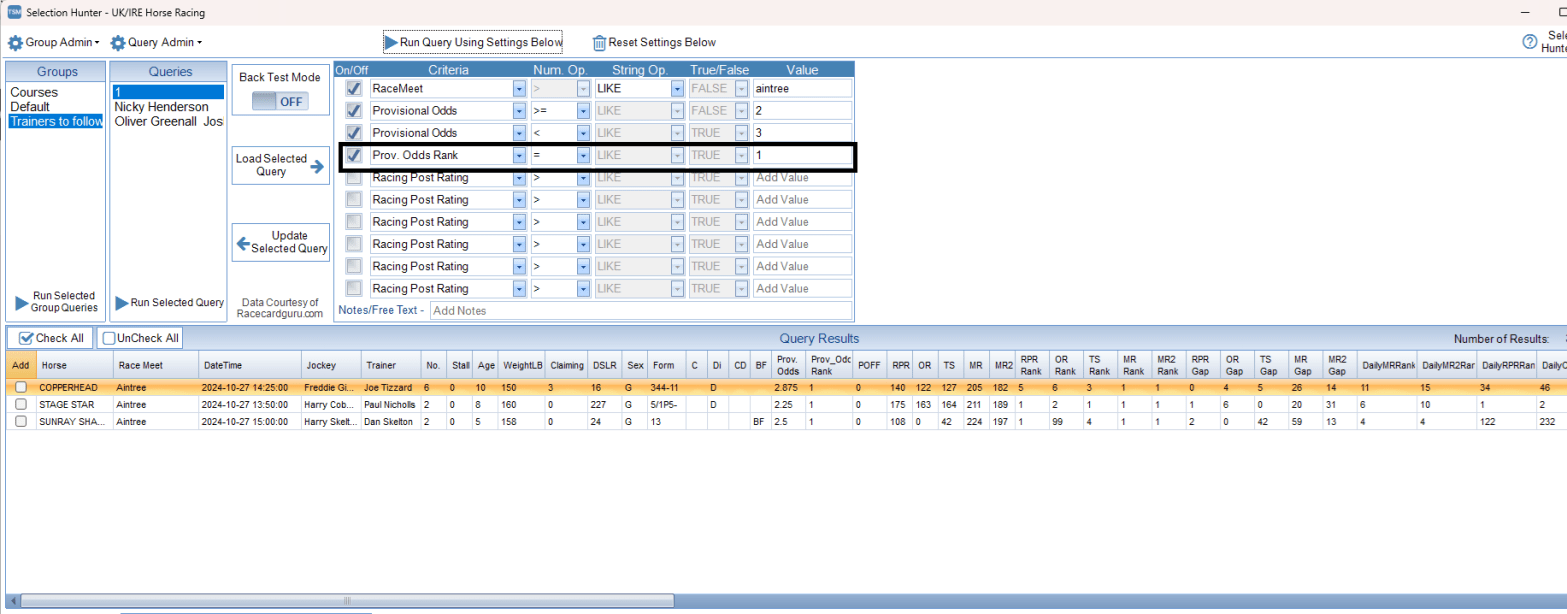
Yesterday I showed you how to create a basic query in TSMs’ Selection Hunter to find some likely winners using the back test mode to discover any trends and it came up with the following 3 horses
The selections are
13:50 Stage Star
14:25 Copperhead
15:00 Sunray Shadow.

If you missed it you can read the post here


13:50 Stage Star
Stage Star met the provisional odds criteria of between 2.00 and 2.99 but went off at a BSP of 3.21. Our conditions of placing a bet with betangel were that the BSP had to be between 2.00 and 2.99 for the software to trigger. 3.21 was out of our range at 3.21 so no bet was made.

Stage Star only managed 4th out of 5

14:25 Copperhead
Joe Tizzards’ Copperhead also qualified as the provisional odds were posted as 2.85 but again the BSP was outside of the criteria and went off at 3.5 giving us another miss fire from Betangel.
Copperhead Won by 14 lengths!!!

15:00 Sunray Shadow
The final selection was the Skelton trained and ridden Sunray Shadow who’s Provisional odds were posted at 2.5. Winning by a length and a 1/4 the BSP was well within the range at 2.23 and Betangel Fired the bet in 10 seconds before post time catching 2.25

Summary
2 of the 3 selections went off at odds outside the criteria one of them winning but alas one losing
2 of the 3 went off as favourites despite all 3 being ranked as provisional favourite.
Betangel fired just one bet and this returned 125% ROI
Given the strike rate of the criteria when back tested (68%) 2 actual winners from our query seemed to tentatively back this trend.

Cautionary note
While this was a completely genuine test run you should not go out and back every Aintree runner with a BSP of between 2.0 and 2.99 even though I back tested over a period of nearly 2 years results you should always do as much research as you can and start with stakes that you can afford to lose.

Build your bank steadily Racing is not going to finish tommorrow!!!

The staking Machine software has limited use for free but If you want to take advantage of the Selection Hunter you will need to pay – It only costs £24 for 1 year – Twenty Four!! this is not a typo and can be paid via paypal
That’s only 2 quid a month and if you had backed Sunray Shadow for a quid you would have made over 1/2 a months subscription already.

Timeform 5* selections for 8th June 2024

Timeform is a respected and well followed source of racing form and they rate each horse for each race by using a star rating. You may have read my post on using this rating system to pick your horses for the ITV 7 well what if you were to back each 5 star rated horse in every race for a day.
Below is a PDF of the 5 star Runners for 8th June 2024 and how they faired. The figures are based upon the ISP (Industry Starting Price) and the stakes reflect a £5.00 profit should the horse win. It is worth noting that at least one of these selections (Billyb) was available at odds greater than the starting price as I actually backed it at odds of 4.50 at 11am that morning.

If you had backed each 5 star rated horse that ran on this day to a £1.00 level stake you would have got a profit of £3.87 which is a 10.18% ROI (Return on Investment)
If you had backed them as I do to a £5.00 target profit then you would have a £24.93 profit but the stakes involved are greater! My total stakes for all races would have been £117.94 for that £24.93 profit but it is still a 21% ROI
After a quick analysis of the results there were a total of 38 runners of which 15 won which is a 39.5% strike rate.
More interestingly is the fact that if you had backed the horses which ran in just the handicap races then of the 31 handicap races run 27 actuall ran of which 12 won.
This gave a profit of £12.41 to level £1.00 stakes giving a 46% ROI. Staking the horses to a £5.00 target profit gave a profit of £32.52 for a total of £58.79 stake money yielding a 55.3% ROI.
This is just 1 days analysis but it seems that it may be worth pursuing further.

The above file can be downloaded so you can do your own analysis

More on this to come
Follow me to stay in the loop.

My ITV 7 8th June 2024 – The Results

7 races – 7 winners how hard can it be?
The criteria for this exercise in losing money is that I selected Timeforms 5 star runners and where these were non runners as in race 3 and 7 the next best 4 star runner with the lowest odds.

Race 1:
14:05 Beverley
Maw Lam backed at 3/1 for a stake of £1.67
Lost

Running P/L -£1.67

Race 2
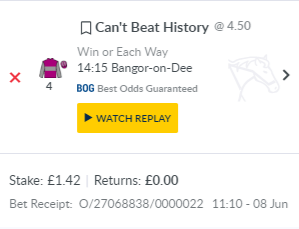
14:15 Bangor on Dee
Can’t beat history backed at 4.5 for £1.42
Lost

Running P/L -£3.09

Race 3
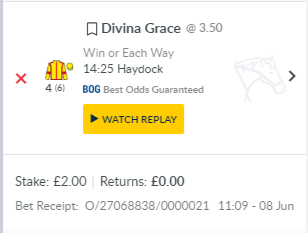
14:25 Haydock
Divina Grace backed at 3.5 or £2.00
Lost

Running P/L -£5.09

Race 4
14:40 Beverley
Moving Force backed at 2.75 for £2.86
Lost

Odds moved slightly in my favour but still no return
Running P/L -£7.95

Race 5
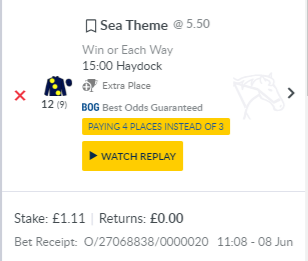
15:00 Haydock
Sea Theme backed at 5.50 for a stake of £1.11
Lost

Running P/L -£9.06

Race 6
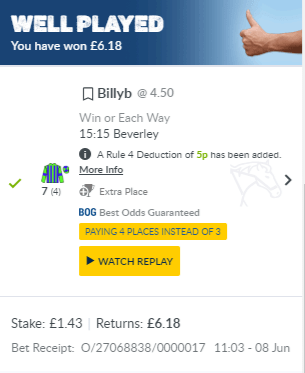
15:15 Beverley
Billyb backed at 4.5 for a stake of £1.43
Won 🤑

A rule 4 deduction reduced my profit from £5.00 to £4.75
Running P/L -£4.31

Race 7
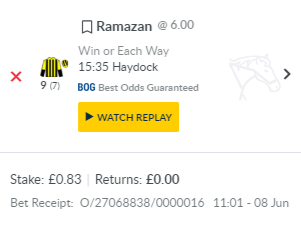
15:35 Haydock
Ramazan backed at odds of 6.00 for a stake of £1.00
Lost

Total Loss for todays ITV 7 is £5.31

ITV 7 and Timeform’s 5 Star Ratings

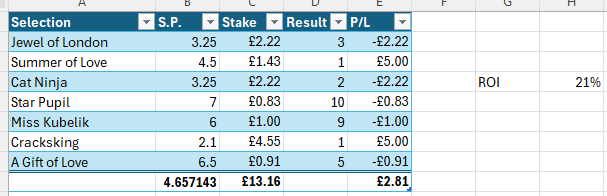
While sat waiting for yet another customer to come and unload their meat I quickly did the ITV 7 on Wednesday 5th of June.
My criteria was simple – I just selected the 7 horses that Timeform rated with 5 stars. Not rocket science but nothing to lose.
I had 2 winners from the 7 – this equates to a 28.5% strike rate.
I then got to thinking what if I had backed these 7 selections individually for a target profit of £5.00 so I did the maths
If I had backed these at S.P. my total stake would have been £13.16. With 2 winners both yielding £5.00 each in profit (not returns) I would have come out with a £2.81 overall profit

OLBG Accas Are they Profitable? Day 1 (01/01/23)

OLBG (Online Bookmaker Guide) produce on a daily basis the accumulated tips from the best performing tipsters on the site and publish them as viable accumulator bets. This post will list and and publish the profits or losses of these bets over the Month

First up is the “Earlybird Multisport Acca” which is available from 7am onwards
Jan 1st 2023

Result
Earlybird Multisport Acca
Lost14:00Tottenham Tottenham v Aston Villa👎1.67
Won15:50Wrappedupinmay 3:50 Exeter👍1.33
Lost18:00PHI Eagles -5.50 NO Saints @ PHI Eagles👎1.91
Won18:00DET Lions CHI Bears @ DET Lions👍1.42
Lost08:15Sydney Sixers Brisbane Heat vs Sydney Sixers👎1.67
Won09:00Magda Linette to win 2 – 0 Magda Linette vs Zhibek Kulambayeva👍1.20
 Available: 07:00 daily
This ACCA lost

 Advised at 07:00 at odds of 12.02

Next Acca of the day is the Racing Each Way Lucky 15 which is available from 10am each day

ResultEach Way Lucky 15
Lost14:16Recorwoman 2:16 Southwell👎12.00
Lost15:00Maid Of Houxty 3:00 Catterick👎7.00
Lost15:45Thunder 3:45 Fairyhouse👎34.00
Lost17:26Brandy Station 5:26 Southwell👎12.00
 Available: 10:00 daily
Lost

 Advised at 10:00 at odds of 37128.00

A cheeky little racing Double is the next acca to be published and is supposed to be available to view from 11 am but today (1st Jan 2023) it appeared at 10:30 and was as follows

ResultRacing Double
Lost13:20Thunder Rock 1:20 Cheltenham👎2.75
Lost15:00Tom Creen 3:00 Catterick👎2.50
 Available: 11:00 daily
Lost

 Advised at 10:30 at odds of 6.86

The racing four fold is usually available at 12:00 so it could be a bit frantic to get the bets on if the first race is close to midday. OLBG comensate for this by publishing the acca early so its best to have notifications set to on and have the app downloaded to your phone. More on this at the end of todays post.

ResultRacing 4-Fold
Won12:10Weveallbeencaught 12:10 Cheltenham👍2.00
Lost12:55Annie Magic 12:55 Exeter👎2.20
Lost13:20Thunder Rock 1:20 Cheltenham👎2.75
Lost15:00Tom Creen 3:00 Catterick👎2.50
 Available: 12:00 daily
Lost

 Advised at 11:00 at odds of 28.89

13:00 brings us the daily Multisport Acca which is similar to the EarlyBird Multi Sport Acca

ResultDaily Multisport Acca
Won15:56Manaafith 3:56 Southwell1.50
Lost18:00WAS Commanders CLE Browns @ WAS Commanders1.75
Lost18:00PHI Eagles -5.50 NO Saints @ PHI Eagles1.95
Won14:00Monaco Monaco v Brest1.45
Lost14:00Tottenham Tottenham v Aston Villa1.67
Lost15:00Tom Creen 3:00 Catterick2.75
 Available: 13:00 daily
Lost

 Advised at 13:00 at odds of 37.87

The popular Football four Fold is published at 13:30 at weekends and 17:00 on weekdays – here is todays

ResultFootball 4-Fold
Lost16:00Lyon Lyon v Clermont Foot1.53
Lost16:30Chelsea Nottm Forest v Chelsea1.60
Won15:00Plymouth Plymouth v Milton Keynes Dons1.70
Won15:00Millwall Millwall v Rotherham1.50
 Available: 17:00 weekdays | 13:30 weekend
Lost

 Advised at 13:30 at odds of 6.20

ResultUS Sports Acca
Lost21:05SF 49ers -9.50 SF 49ers @ LV Raiders1.91
Lost18:00WAS Commanders CLE Browns @ WAS Commanders1.80
Lost18:00PHI Eagles -5.50 NO Saints @ PHI Eagles1.95
Won18:00MIA Dolphins +2.50 MIA Dolphins @ NE Patriots2.05
Won18:00DET Lions CHI Bears @ DET Lions1.44
Won18:00NY Giants IND Colts @ NY Giants1.44
 Available: 16:30 daily
Lost

 Advised at 16:30 at odds of 28.50

ResultEvening Multisport Acca
Lost21:05SF 49ers -9.50 SF 49ers @ LV Raiders1.91
Won21:25GB Packers MIN Vikings @ GB Packers1.60
Lost01:10MIL Bucks WAS Wizards @ MIL Bucks1.55
Won01:10MEM Grizzlies SAC Kings @ MEM Grizzlies1.59
Lost19:45Draw or PSG Lens v PSG1.33
Lost19:45Gerwyn Price Gerwyn Price vs Gabriel Clemens1.80
 Available: 18:00 daily
Lost

 Advised at 18:00 at odds of 15.67

The outcome for the first day of the study is not a good one! None of the straight Accas came anywhere near and the lucky 15 did not even have a place

If we set our stake at £1.00 for accas and 10p e/w lucky 15 then we would be £10 down so far

Using a Flow Chart to make unemotional decisions when making a bet

Emotional gambling, hunch betting and chasing losses are just 3 reasons why punters lose and bookies win. How then can we take some of this uncertainty out of the equation and put some solid research together in an ordered and unbiased way that will enable us to make a more informed and unemotional decision of where to risk our money?
Creating a flow chart that defines definite criteria for us to follow is certainly one way and with excel this task can be done with relative ease.

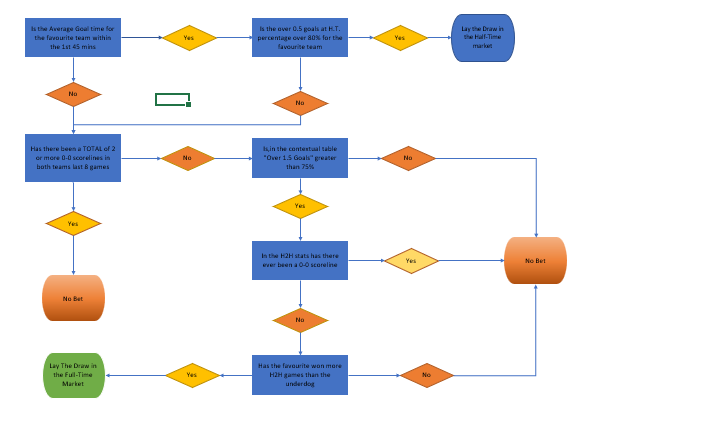
Flow chart for Laying the Draw

The screenshot above is an example of a flowchart I have been working on to help me identify football games where I can trade laying the draw in either the half time or full time markets using set criteria to avoid making uninformed decisions.
While this is still in its development stage I hope you can see the advantages of using a tool such as this may help you in the quest for making a bit of money from the bookies instead of handing good money after bad to them.

You can download this file by clicking the link above

Creating your own Horses to Follow list

Having just belatedly received my Jumpers to follow list for the 2021/22 season (I got it at half price) I thought that following horses halfway through the season might not be an altogether bad thing as you can see how they have done so far in the season. I then got to thinking why not make my own list but not of good prospects this season which are usually aimed at big races but day to day runners which I can back to lay in-running.
The sheer volume of horses racing each day could make this a task of monumental proportions so I started to whittle down the most prevalent horses each day, concentrating on predominately front running horses. As I subscribe to The In-Running Trading Tool I can see at a glance horses that prefer to lead races and provide a good opportunity to make small but regular profits win or lose. This, however is not foolproof, and just because it ran well and the traders backed it down to odds on in-running the last two runs doesn’t mean it will do the same this time. There are many factors that will and do change how a horse will run a race such as going, distance, a jockey change or even a stable change. This latter factor may not be as prevalent as the late great Dick Francis portrays in his most excellent novels but it does happen.
Once I have a couple of good prospects for the day I can then switch over to the Timeform website and check any pace hints that they provide for the race and if the horse is mentioned I then go to the sporting Life website where I can usually watch the horses previous races to get a feel for how it ran. Having satisfied myself that I can risk a bet I will then look at the exchange – usually betfair – and look at the price changes via the provided chart to determine whether the odds are steadily drifting out or static or starting to come in and try and judge the best time to place a small bet. Once the bet is on then I continue to monitor the odds to note any changes.
Once the bet is on I will then place a lay bet at the closest “cross-over” point (Exchange cross-over points are points in the exchange range of odds where the range of odds change and betfair describe them as follows)

“There are points in the Betfair odds system that we call “crossover points”. These are around odds such as 4.0 where the tick below is 3.95 (0.05 away) and the tick above is 4.1 (0.10 away). It often makes sense to lay at odds of 4.0 as your risk is lower than your reward over the short-term.

Because of this, you often see the market pause at price changes. Support and resistance can become imbalanced too, as lots of people are keen place their lay bets. You might also see the market spike downwards if it breaks through a crossover point, as all of the layers scurry to close out of their positions.”

I place this below the backed odds and ensure that I change the Lay from “cancel” at in-play to “keep” This will ensure that my bet lay bet will still be available once the race is off.
If the back to lay trade is successful after the race has finished or in some cases before the race is actually at post time then the horse can be added to the “Follow” spreadsheet. To make things easy and to get an alert when the horse is next running I also add it to my Timeform Tracker list which I have set up to send me a “push” notification the evening before the race as well as an email.

The information that is available for your chosen horses is vast so choosing what Information to record can be overwhelming however Excel is a truly outstanding piece of software which can be utilised for as much or as little as you think is relevant.
I have provided a workbook for anyone to download and use. It is populated with 1 horse (Best Trition) and a template sheet for you.
The front page is an index page which is handy for you to summarise and quickly access the runners record as well as

Having done all this I can now wait patiently for emails to arrive and determine the probability of a successful back to lay bet without trawling through reams of information which might sway me into a bad decision.
When you have established your “Stable” and have grown some confidence in your selections you can start to determine how far your lay bet you are willing to make away from your back bet. To help you in this I have also provided a “tick-drop” calculator. This simple spreadsheet will enable you to instantly work out the odds needed for a 10, 20 or 30 tick drop from the actual back odds taken.

For more information on back to laying horses please read my post below