

Master the “Lay to Back” Tennis Trading Strategy: Optimum Odds Groups & Data Insights

In tennis sports trading, Lay to Back (L2B) is one of the most structured, high-probability trading methodologies available. Rather than backing a player and hoping they win the entire match, laying a player (selling their probability) allows traders to capitalize on market overreactions, momentum swings, and in-play score volatility before backing them back at higher odds to lock in a guaranteed profit.

Analyzing 2026 ATP tour match data reveals how performance dynamics, set-loss recovery rates, and odds movement vary across pre-match price ranges. Choosing the correct Odds Group is essential for determining liability risk, entry triggers, and trade execution.

Data Insights: Player Behavior Across Odds Groups

Using full ATP match data across Grand Slams, Masters, ATP 500, and ATP 250 events, pre-match favorites can be grouped by average implied probability to observe set-loss frequency and match stretch rates:

Odds GroupFavorite Price RangeFavorite Win RateLoser Wins Set 1 Rate3+ Set Match RatePrimary Risk Profile
Group A: Heavy Favorites1.01 – 1.2086.2%17.4%56.4%Low liability / High swing threshold
Group B: Moderate Favorites1.21 – 1.4074.0%19.3%48.9%Optimum L2B Sweet Spot
Group C: Lean Favorites1.41 – 1.6063.3%22.2%49.8%Medium risk / High in-play volatility
Group D: Coin-Flip Matches1.61 – 2.0056.6%21.7%47.4%High liability / High match turnover

The Optimum Odds Groups for Lay to Back Trades

1. Group B: 1.21 – 1.40 (The Optimum Sweet Spot)

  • Why it works: Short favorites in this band win 74.0% of their matches overall, but fail to win straight sets in over 48.9% of matches.
  • The Opportunity: When a 1.25–1.35 favorite loses the opening service game or drops the first set, their odds typically float up into the 1.70–2.20 range. Because their baseline quality remains superior, their recovery rate is exceptionally strong.
  • Trade Mechanics: Lay the favorite early when they face break points or drop behind, then Back to hedge once they steady their service game or reclaim the break.

2. Group C: 1.41 – 1.60 (The Volatility Trader’s Choice)

  • Why it works: Favorites in this category lose Set 1 in 22.2% of matches. When a 1.50 favorite goes down a set, their price often drifts to 2.80–3.20.
  • The Opportunity: This price drift offers significant tick movement for Lay to Back entries on the favorite before or during set 2, as market resistance creates price elasticity.

3. Group A: 1.01 – 1.20 (The Recovery Trade)

  • Why it works: Heavy favorites rarely lose outright (86.2% win rate), but they go to 3 or more sets in 56.4% of matches (including Grand Slams).
  • The Opportunity: Laying a 1.10 favorite at start-of-match carries minimal liability. If they lose an early service game, the price inflates sharply (e.g., from 1.10 to 1.35+), yielding an immediate hedge window.

Step-by-Step L2B Execution Workflow

[ Pre-Match Identification ]
│
▼
[ Filter: Fav Odds Range 1.21 - 1.50 ]
│
▼
[ In-Play Trigger: Fav drops early serve or drops Set 1 ]
│
▼
[ ACTION: LAY the Favorite at inflated low price ]
│
▼
[ Price Movement: Favorite breaks back or stabilizes ]
│
▼
[ ACTION: BACK the Favorite at higher odds to hedge profit ]

Execution Rules & Risk Management

  1. Strict Stop-Loss Discipline: If laying a favorite after they drop Set 1, set a clear stop-loss trigger if they fall behind an additional double-break in Set 2.
  2. Beware of Surface Variations: Clay court matches feature higher break rates and wider price swings compared to Fast Hard or Grass courts. Factor surface speed into tick targets.
  3. Green-Up Equally: Always use exchange auto-hedging (“Cash Out” / “Green Up”) to spread profit evenly across both outcomes regardless of who completes the match victory.

Disclaimer:

The information, data, and strategies shared in this post are for educational and informational purposes only and do not constitute financial or betting advice. Sports trading carries inherent risks, and past performance or statistical insights do not guarantee future outcomes. Always manage your risk responsibly, bet only what you can afford to lose, and adhere to local gambling regulations.

How I Turned £10 into Profit: A Betting Journey Through Wimbledon 2025

Putting my research into practice I set aside a £10.00 “Bank” and at the start of the tournament started laying the top 10 seeded players for a liability of £1.00.
These were in order of seeding:
1. Sabalenka
2. Gauff
3. Pegula
4. Paolini
5. Zheng
6. Keys
7. Andreeva
8. Swiatek
9. Badosa
10. Navarro

Round 1

The 1st round saw 4 of the top 10 seeds lose, namely Gauff, Pegula, Zheng, and Badosa.
Gauff, the No 2 Seed lost in straight sets to Yastremska and I laid her at 1.20 for a stake of £5.00.
Pegula, the No 3 seed, lost to Cocciaretto, again in straight sets, 6-2/6-3 and managed to lay her at odds of 1.13 for a stake of £7.69
Zheng, The No 5 seed, lost to Siniakova 7-5/4-6/6-1 Laying her at odds of 1.60 netting me £1.67
Badosa, the No 9 seed was the final casualty of the 1st round losing to Boulter 6-2/3-6/6-4. She was the biggest odds at 1.70 and with a stake of £1.43
The other 6 top 10 seeded players all made it through to the second round which meant that these 6 cost me a total of £6.00 in liability stakes but with the afore mentioned players falling I had a profit of £15.79 from these matches which gave me a £9.79 net profit from the 1st round matches.

Round 2

6 of the top 10 seeded players were now safely through to the second round and this posed a possible £6.00 loss if all 6 won their matches. Paolini, the No 4 seed, who I had laid at odds of 1.19 for a stake of £5.26 lost to unseeded Rakhimova 4-6/6-4/4-6. Losing £5.00 on the other 5 top 10 seeded players this shock exit of the No 4 seed netted me a small profit of 26p to add to my £9.79 profit from round 1.
Total net profit from the 1st 2 rounds now stood at £10.05 and only 5 of the top 10 players left in the tournament.

Round 3

The sixth casualty was Madison Keys, the No 6 seed lost to Siegemund in straight sets 6-3/6-3. Having laid keys at odds of 1.19 for a stake of £5.25 this netted me £1.25 for the round and a total profit for the tournament so far of £11.30 as the other 4 seeds made it safely through to round 4

Round 4

This round saw the match up of No 7 seed Andreeva and No 10 seed Navarro which meant that my total possible loss from round 4 would be reduced from a highest of £4.00 if all 4 won their matches to £2.00 if Sabalenka and Swiatek both won plus, either a net profit if Navarro (Odds 2.60) won, or a net loss if Andreeva (Odds 1.62) won. In the event Both Sabalenka and Swiatek did indeed win their matches and Andreeva dismissed Navarro in straight sets 6-2/6-3 this gave me a net loss of 37p on this match plus £2.00 loss on the other 2 players making the 4th round my first loss of the tournament of £2.37 making this a total tournament profit so far of £8.93. This also left 3 players in the Quarter Finals and a potential loss in that round of £3.00

Quarter Finals.

The quarter finals saw Sabalenka safely through to the semi finals as did Swiatek giving a loss of £2.00 but Andreeva lost to Bencic which won me £2.05 after laying Andreeva at odds of 1.49. This gave me a round profit of 5p and even though small is still a profit and my tournament total going into the Semi Finals stood at a healthy £8.98

Semi Finals

Sabalenka played Anisimova and at last the No 1 seed fell! Laying her at odds of 1.4 for a stake of £2.50 this gave me a round profit of £1.50 to add to my total as Swiatek dismissed Bencic in straight sets 6-2/6-0
Total profit going into the final now stood at £10.48.

The Final

The odds for Swiatek to win the final were 1.42 which I laid for a stake of £2.38 this meant that if she did win my Tournament profit would be £9.48 or if Anisimova won my profit for the tournament would finish up at £12.86.
Swiatek demolished Anisimova 6-0/6-0 to become the first Polish lady to win the Ladies Title and reduce my profit for the tournament to £9.48.

Summary

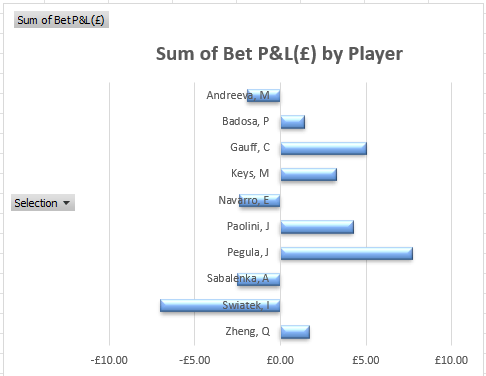
I made the rules at the beginning of the tournament and kept my liability to £1.00 per player and not by market which would have made things complicated in “Match-Up” matches. The chart above shows P/L in £ of each player. It is not actually necessary to have an exchange account as a similar result can be obtained by backing the opponents of the seeded players for your desired stake. As a quick comparison in the Match between Coco Gauff and Yastremska in the 1st round. I laid Gauff at odds of 1.2 giving me a profit of £5.00 but the best odds available to back Yastremska at the bookies was 4/1 (5.0), if you had backed her at these odds your profit would have been £4.00 instead of £5.00

Had I have lost my £10.00 bank halfway through the tournament then I would have stopped and that would have been that, but having researched this, the trends suggested that the Ladies tournament provided the better chance of profit than the Gentleman’s tournament using this strategy. I am sure that many of you reading this will scoff at the stakes involved saying is it worth it. I don’t really care what you think! this was a practical exercise where I had an idea and put it to the test with a bank that I was prepared to lose. I have now increased that bank by nearly as much again of which I will utilise by increasing the liability to £1.20 for the WTA 250 Hamburg Ladies Open and laying the top 8 seeded players

Disclaimer

If you liked this content please “like” so I can get some feel for the effort I am putting into this being beneficial to others who are looking to make a couple of quid but no fortunes.

Please gamble responsibly and don’t bet more than you can afford. The content of this post is historical fact and in no way guarantees the out come of future tournaments.