

If you are entering the world of exchange trading on platforms like Smarkets or Betfair, “Back the Favourite and Trade Out” is one of the foundational position trades you need in your toolkit.
Unlike traditional sports betting, where you back a player and pray they win the entire match, tennis exchange trading focuses purely on price movement. You enter a position when you believe a price is overly generous, wait for the market to adjust in your favor, and lay off the position to lock in a profit before the final handshake at the net.
In this guide, we break down exactly how this strategy works, walk through step-by-step mathematical examples, explore when to deploy it, and examine how to manage your risk when things don’t go to plan.
What is “Back the Favourite and Trade Out”?
At its core, this strategy involves backing a player at a higher price (decimal odds) with the intention of laying that same player at a lower price later in the match.
- Backing: Betting on an outcome to happen (acting like a traditional bettor).
- Laying: Betting against an outcome happening (acting like the bookmaker).
When you back a player and their odds drop—for example, because they won the opening set or broke their opponent’s serve—you can lay them at the new, lower odds. This locks in an equal profit across all outcomes or completely eliminates your financial exposure.
The key takeaway? You are trading the movement in price, not necessarily predicting the eventual match winner.
Step-by-Step Example
Let’s look at a concrete breakdown to see how the numbers play out in real-time.
Phase 1: The Entry
Imagine a ATP/WTA match where Player A is expected to perform well, but due to market conditions, is trading at decimal odds of 2.50.
- Action: You Back Player A for £10 at 2.50.
- Your Exposure: £10 (if Player A loses, you lose £10).
- Potential Return: £25 total (£15 profit) if Player A wins without trading out.
Phase 2: The In-Play Shift
Player A starts strong, holding serve comfortably and breaking their opponent early to take the first set 6–3.
Because Player A is now in a dominant position to win the match, the market reacts quickly. Their odds shorten significantly from 2.50 down to 1.70.
Phase 3: The Exit (Trading Out)
Instead of letting the match run and taking the risk of a comeback, you choose to trade out by laying Player A at 1.70.
To create an equal profit on both players (a “green screen”):
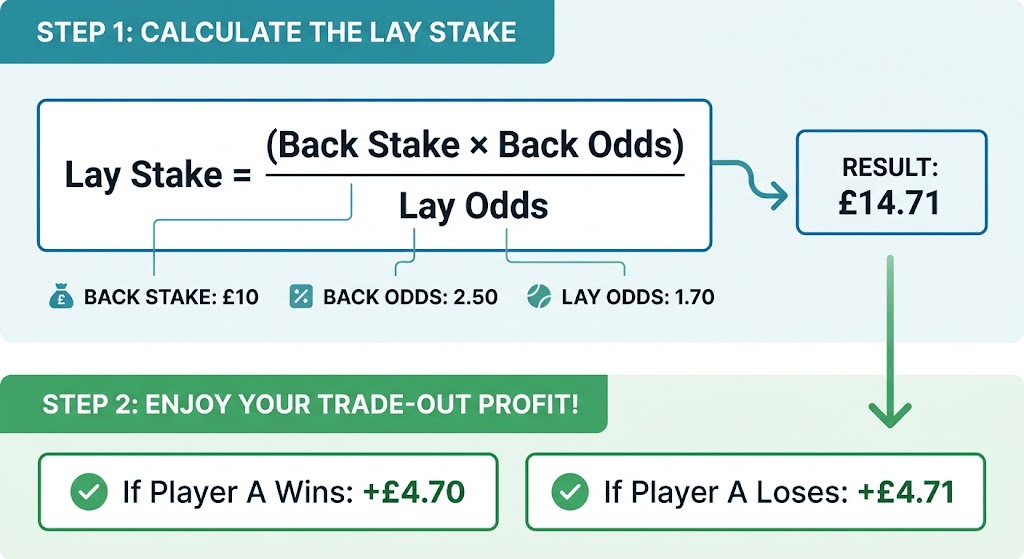
- Action: Lay Player A for £14.71 at 1.70.
The Resulting Profit Matrix:
- If Player A wins: You make £15 (from back) minus £10.30 (lay liability: $14.71 \times 0.70$) = +£4.70 profit
- If Player A loses: You lose £10 (from back) plus £14.71 (from lay stake) = +£4.71 profit
(Note: Exact figures will vary slightly depending on exchange commission fees.)
Regardless of who goes on to win the match, you have successfully locked in roughly £4.70 profit.
When Does This Strategy Work Best?
This trade relies on predicting an early shift in momentum or market sentiment. Look for matches where:
- Strong Servers: Players with heavy first serves who rarely get broken early on. A simple hold-and-break pattern in the first set triggers quick price contractions.
- Fast Starters: Players who statistically perform best in first sets, even if their overall match endurance is questionable.
- Favourable Surface/Head-to-Head: A player whose game style specifically counters their opponent on a given surface (e.g., a clay court specialist against a flat-hitter).
- Underestimated Chances: Situations where pre-match odds feel inflated due to a minor recent loss, creating value at entry.
Risk Management & What to Avoid
The single biggest danger when backing a favourite to trade out is a price drift. If your player starts slowly, gets broken early, or drops the first set, their odds will drift outwards (e.g., from 2.50 to 3.50+).
To protect your bankroll, always establish a clear plan before placing your initial back bet:
- Set a Target Exit: Know the price at which you will take your profit (e.g., exit when odds hit 1.70).
- Set a Stop-Loss: Determine the maximum price drift or scoreline (e.g., if Player A gets broken in Set 1) where you will accept a minor loss and exit the trade rather than hoping for a Miracle comeback.
- Avoid Holding to the End: Resist the temptation to convert a trade into a standard bet. The goal of tennis trading is consistency through active price management.
Final Thoughts
Backing the favourite and trading out is an ideal strategy for traders learning how to manage in-play odds movement. By focusing on early momentum and executing calculated exits, you turn unpredictable match outcomes into controlled, manageable trades.


1 Comment