Mastering Strategy #5: Trade a Player After They Lose Their Serve

In our overview post on Tennis Trading: The Different Trades You Can Make on a Tennis Match, we introduced the concept of backing a strong player after they drop a service game.

When a favourite gets broken, the market often overreacts, causing their back odds to drift significantly higher. This creates a prime value entry for traders anticipating an immediate bounce-back or a break-back in the following games. However, simply buying every broken favourite blindly is a fast track to draining your bankroll. Success requires precise entry criteria, clear profit targets, and disciplined stop-loss management.

Here is a deep dive into how to trade this setup, complete with real-world profitable and losing trade examples using a standard base stake of £10.

The Core Concept & Entry Checklist

When a player loses serve, their odds instantly jump (for example, moving from 1.40 up to 1.80 or higher). This strategy aims to back the broken player at inflated odds and exit the market once momentum stabilizes or a break-back occurs.

Before entering a position, run through this checklist:

  • Return Profile: Is the broken player a strong returner (high break-back percentage)?
  • Server Vulnerability: Is the opponent’s serve historically weak or unreliable under pressure?
  • Body Language/Stats: Is the favourite creating break points despite losing serve, or are they struggling physically/mentally?

Example 1: The Profitable Trade (Successful Break-Back)

Scenario Setup

  • Pre-match Favourite: Player A (Trading pre-match at 1.40)
  • Match Situation: Player A wins Set 1 easily (6–3). In Set 2, at 1–1, Player A plays a sloppy game and gets broken to go 1–2 down.

Trade Execution

  1. Entry Point: Following the break at 1–2, Player A’s odds drift from 1.42 up to 1.85. Seeing that Player A generated three break points in their previous return game, you back Player A for £10 at 1.85.
    • Outlay / Risk: £10 stake to return £18.50 (£8.50 potential profit).
  2. In-Play Dynamics: In the very next game (1–2), Player A applies heavy pressure on the return, forcing errors and successfully securing the break-back to level the set at 2–2.
  3. Exit Point: Immediately following the break-back, the market re-adjusts. Player A’s odds contract rapidly back down to 1.48. You lay Player A for £12.50 at 1.48 to trade out and green up across all outcomes.

Outcome & Profit

  • Back Stake: £10 @ 1.85
  • Lay Stake: £12.50 @ 1.48 (Liability = £6.00)
  • Result: Guaranteed profit of approximately £2.50 regardless of who goes on to win the match (before exchange commission), completely risk-free for the rest of the game.

Example 2: The Losing Trade (Disciplined Stop-Loss)

Not every broken favourite bounces back immediately. Having a hard stop-loss strategy is crucial to prevent a minor setback from turning into a devastating loss.

Scenario Setup

  • Pre-match Favourite: Player B (Trading pre-match at 1.35)
  • Match Situation: Set 1 is tied at 3–3. Player B serves poorly and suffers a break, putting them 3–4 down.

Trade Execution

  1. Entry Point: Player B’s odds drift from 1.40 to 1.75. You enter the market by backing Player B for £10 at 1.75, anticipating a swift response.
  2. Stop-Loss Strategy: Define a strict exit rule prior to entry: If Player B fails to break back on the next game AND faces serious pressure on their subsequent service game (or if their odds cross 2.25), close the position immediately.
  3. In-Play Dynamics:
    • Game 8 (3–4): Player B fails to convert break points; the opponent holds serve (3–5). Odds move to 1.95.
    • Game 9 (3–5): Player B drops to 0–40 on their own serve due to consecutive unforced errors.
  4. Exit Point (Stop-Loss Trigger): Rather than hoping for a miracle save from 0–40 down, execute your stop-loss and lay Player B for £10 at 2.25 to cap your loss.

Outcome & Loss Management

  • Back Stake: £10 @ 1.75
  • Lay Stake: £10 @ 2.25
  • Result: Total loss limited to £5.00 (or ~£2.22 if hedged equally across both outcomes).

By executing your stop-loss at 2.25, you prevented a potential £10.00 total loss had Player B gone on to lose the set 3–6 and drifted past 3.50.

Key Takeaways for Execution

  1. Pre-define Your Exit: Never enter a position without knowing the exact score line or odds trigger where you will cut your losses.
  2. Avoid “Hope Trading”: If a player drops serve because of double faults, sluggish movement, or visible physical pain, skip the trade—the price drift is justified.
  3. Lock in Green: When the break-back occurs, trade out immediately to secure your profit rather than holding out for a full match victory.

Mastering the “Back the Favourite and Trade Out” Tennis Strategy

If you are entering the world of exchange trading on platforms like Smarkets or Betfair, “Back the Favourite and Trade Out” is one of the foundational position trades you need in your toolkit.

Unlike traditional sports betting, where you back a player and pray they win the entire match, tennis exchange trading focuses purely on price movement. You enter a position when you believe a price is overly generous, wait for the market to adjust in your favor, and lay off the position to lock in a profit before the final handshake at the net.

In this guide, we break down exactly how this strategy works, walk through step-by-step mathematical examples, explore when to deploy it, and examine how to manage your risk when things don’t go to plan.


What is “Back the Favourite and Trade Out”?

At its core, this strategy involves backing a player at a higher price (decimal odds) with the intention of laying that same player at a lower price later in the match.

  • Backing: Betting on an outcome to happen (acting like a traditional bettor).
  • Laying: Betting against an outcome happening (acting like the bookmaker).

When you back a player and their odds drop—for example, because they won the opening set or broke their opponent’s serve—you can lay them at the new, lower odds. This locks in an equal profit across all outcomes or completely eliminates your financial exposure.

The key takeaway? You are trading the movement in price, not necessarily predicting the eventual match winner.


Step-by-Step Example

Let’s look at a concrete breakdown to see how the numbers play out in real-time.

Phase 1: The Entry

Imagine a ATP/WTA match where Player A is expected to perform well, but due to market conditions, is trading at decimal odds of 2.50.

  • Action: You Back Player A for £10 at 2.50.
  • Your Exposure: £10 (if Player A loses, you lose £10).
  • Potential Return: £25 total (£15 profit) if Player A wins without trading out.

Phase 2: The In-Play Shift

Player A starts strong, holding serve comfortably and breaking their opponent early to take the first set 6–3.

Because Player A is now in a dominant position to win the match, the market reacts quickly. Their odds shorten significantly from 2.50 down to 1.70.

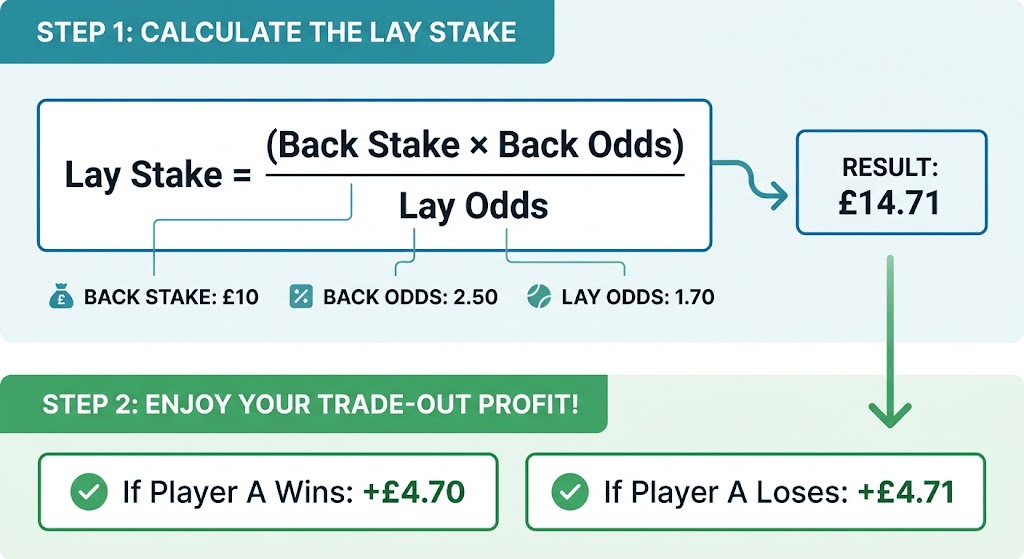
Phase 3: The Exit (Trading Out)

Instead of letting the match run and taking the risk of a comeback, you choose to trade out by laying Player A at 1.70.

To create an equal profit on both players (a “green screen”):

  • Action: Lay Player A for £14.71 at 1.70.

The Resulting Profit Matrix:

  • If Player A wins: You make £15 (from back) minus £10.30 (lay liability: $14.71 \times 0.70$) = +£4.70 profit
  • If Player A loses: You lose £10 (from back) plus £14.71 (from lay stake) = +£4.71 profit

(Note: Exact figures will vary slightly depending on exchange commission fees.)

Regardless of who goes on to win the match, you have successfully locked in roughly £4.70 profit.


When Does This Strategy Work Best?

This trade relies on predicting an early shift in momentum or market sentiment. Look for matches where:

  1. Strong Servers: Players with heavy first serves who rarely get broken early on. A simple hold-and-break pattern in the first set triggers quick price contractions.
  2. Fast Starters: Players who statistically perform best in first sets, even if their overall match endurance is questionable.
  3. Favourable Surface/Head-to-Head: A player whose game style specifically counters their opponent on a given surface (e.g., a clay court specialist against a flat-hitter).
  4. Underestimated Chances: Situations where pre-match odds feel inflated due to a minor recent loss, creating value at entry.

Risk Management & What to Avoid

The single biggest danger when backing a favourite to trade out is a price drift. If your player starts slowly, gets broken early, or drops the first set, their odds will drift outwards (e.g., from 2.50 to 3.50+).

To protect your bankroll, always establish a clear plan before placing your initial back bet:

  • Set a Target Exit: Know the price at which you will take your profit (e.g., exit when odds hit 1.70).
  • Set a Stop-Loss: Determine the maximum price drift or scoreline (e.g., if Player A gets broken in Set 1) where you will accept a minor loss and exit the trade rather than hoping for a Miracle comeback.
  • Avoid Holding to the End: Resist the temptation to convert a trade into a standard bet. The goal of tennis trading is consistency through active price management.

Final Thoughts

Backing the favourite and trading out is an ideal strategy for traders learning how to manage in-play odds movement. By focusing on early momentum and executing calculated exits, you turn unpredictable match outcomes into controlled, manageable trades.

Tennis Trading No 5 Dutching the Set Betting Market

With Wimbledon just around the corner I thought it might be interesting to explore the possibility of dutching the set betting market for the WTA as there is only 4 possible outcomes and using betangel’s dutching tool I can place orders into the market to ensure a 20% or better return on a £10 total stake.
The french Open is currently at the 4th round stage in the WTA competition and there are just 4 matches today (Sunday 4th June 2023)
The risk to reward on this is quite high depending on the odds offered. anything from a 50% risk up to a mighty 80% risk.
In this exercise I will be placing the margin stake onto the favourites 2-0 score
Match 1 Pavlyuchenkova v Mertens
This is an evenly matched match where both players are at around even money to win the match.
The screen shot below shows the bets placed

As you can see I have put the margin stake onto Mertens 2-0 scoreline at odds of 11
This is a massive risk to reward scenario as I am risking nearly 89% of my £10.00 stake for a 25% return. One of the factors that has helped me make this decision is that I have downloaded all the results from the previous 3 WTA French Opens into a spreadsheet and filtered the results into following criteria.
1. Winners price at the start of the match is between 1.90 and 2.10
2. 2-0 set result
3. 4th round matches only
Having filtered these factors the resulting percentage of matches that ended 2-0 are just 3 from a total of 24 4th round matches – just 12.5%
If we drill this down even further to include ALL matches that ended 2-0 where the winners odds were between 1.9 and 2.1 we find that from 381 WTA French Open matches that have been played in the previous 3 years there was just 20 that is just over 5%
What we also have to remember is that we are only interested in the odds selected for movement only need to move so far in order to be matched. In close matches such as this a first set score of 5-5 could be enough to convince the market that the match could go to 3 sets.

As I said there are four 4th round matches today and the next one is between Muchiva and El Avanesyan
Muchova is odds on favourite to win at odds of 1.27

In this dutching trade I am risking 53% of my stake for a 25% return
While the risk to reward is much less than the previous match if we look at the spreadsheet and input the same figures in relation to this match ie where the Winning favourite was between 1.25 and 1.3 there was just 1 (one) match in the fourth round that ended 2-0 and just 21 out of all 381 French Open Matches from the previous 3 years.

The 3rd match of the day is between Svitolina and Kasatkina. Kasatkina is favourite at odds of 1.66 to win the match

The final match today is Stephens v Sabalenka where Sabalenka is 1.25 to win the match

With all dutch trades in place I will post the logs and final tally tomorrow
My Maximum loss for these four trades should they all lose is £27.39 out of £40.00
My Maximum Profit is £10.17
This signifies a 37% reward to risk factor but considering the very basic research I explored I am hopeful for a 75% strike rate

Trading Tennis No 3. Dutching a Tennis Match

Dutching a Tennis match may seem a little bizarre as there are only 2 players but with the volatility of the market during in-play it is possible to trade in this way by backing the underdog at the outset at the same time as placing a back bet order into the market at odds higher than the current odds with the view that it will get matched at some point during the match. Some pre match research is essential when attempting this sort of trade so that you know roughly at what point your order is likely to be matched. This is done primarily with Bet Angels “Tennis Trader” tool. If you have read my previous posts on trading tennis you will know that this can be an invaluable way of predicting a feasible exit point for your trade and giving an insight to your potential risk to reward.
It is a fact that in Tennis the WTA is the most prolific for having breaks of service, even with the most accomplished players and the fact that that players who are vastly overwhelmed by their opponents experience can overcome some of that prowess by playing in “overdrive” in the first set. This can mean that players who start the match at odds in the region of 1.05-1.2 can see their odds of winning the match increase to a point where this strategy can yield a 10% return on your stake.
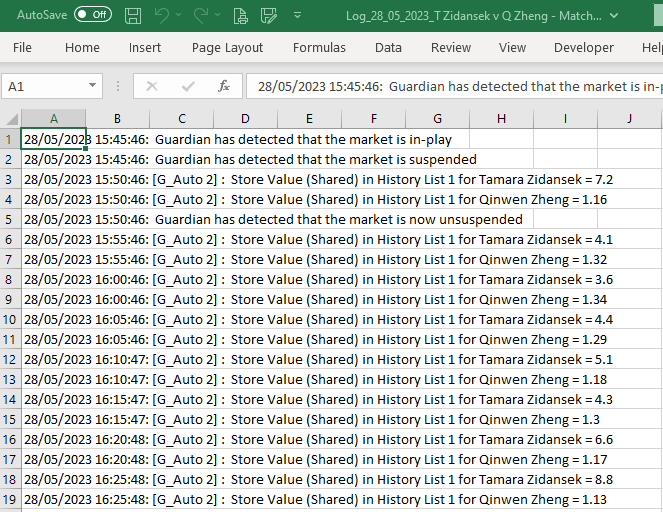
To illustrate this I have put a screenshot of the log I recorded yesterday of the match between Zidansek and Zheng. Zheng is seeded 19 and Zidansek is a qualifier.

As you can see Zheng started the match at odds of 1.16 but 10 minutes into the fist game her odds had risen to 1.34 before dropping back down to 1.18 and then back up to 1.3 and then back to 1.13. If we look at the actual game scores we can see that Zheng won the first two games breaking Zidansek’s serve in the second, but in the 3rd game Zidansek broke back to win the 3rd game and this is where these odds of 1.3 + would have occurred. This doesn’t mean that Zidansek was on to win the entire match it was just the market reacting to the in-play state of the match. Below is a screenshot of the first few games of the first set and as you can see Zidansek gave a fair account of herself.

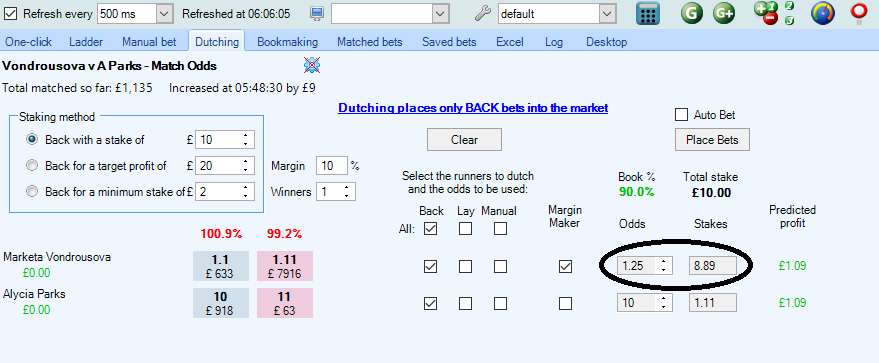
So when we look at matches such as these “uncompetitive” matches as far as the starting odds would have it, there are some distinct possibilities that occur during the match and in particular in the first set that we can take advantage of. This is the essence of the trade I am going to outline in this post. If you have read my previous posts on tennis trading we are looking for the most reward against the least risk taken and to that end I am going to show you one match where there are two possible ways of making the same trade. For this I am going to turn to Bet Angel once again because it is the easiest way to place this trade into the market but this can easily be done manually as well by using a simple dutching calculator available for free on the internet. I will show this method later in the post. But first to Bet Angel. The screenshot below shows the Bet Angel dutching screen and the match loaded is between Vondrousova and Parks. Vondrousova is odds on to win with odds available to back at 1.10 Parks, the rank outsider is 10.00. We know that Vondrousova will 90 times out of 100 win this match, the odds tell us this so we would expect Parks odds to drift out to 1000 by the end of the match and we would be able to get any odds between 10.00 and 1000 matched at somepoint in the match so logic tells us that we should back Vondrousova at the start of the match and put an order into the market on Parks that is pretty certain to be matched at some point.

The Bet Angel Dutching tool enables us to select a margin of profit and total stakes If you look at the screen shot above the software is set to back Vondrousova for a stake of £9.99 and place an order into the market for a penny at odds of 1000 this, if it were possible, would net us 97p at the end of the match if Parks lost. The problem we have in this trade is that we would be risking £9.99 for a reward of 97p
If we now switch this around so that we are backing Parks at the onset of the match and placing an order to be matched in play on Vondrousova the risk to reward has been turned upside down

This trade would now put an order into the market on Vondrousova at odds of 1.25 for £8.89 and place a bet that would be matched straight away on Parks for £1.11 at odds of 10.00. We now are risking just £1.11 for a reward of £1.09 – Even Money. So what are the chances of Vondrousovas back bet being matched in play? If we look at Tennis Trader (Screenshot below) We can see that it would only take a break of serve in Parks’ favour and for her to hold her serve until the 6th game for this bet to be matched.

It would not be advisable to blanket dutch all matches that have a favourite starting the match at odds of say 1.20 or less in this way as you would need to research the players to get some sort of feel that is the underdog capable of breaking the serve if he/she goes all out in the 1st set. But for the purposes of this post I will do just that on all of the WTA 1st round matches on day 2 in the French open today that have a favourite that starts at odds of 1.2 or less and post the results tomorrow.


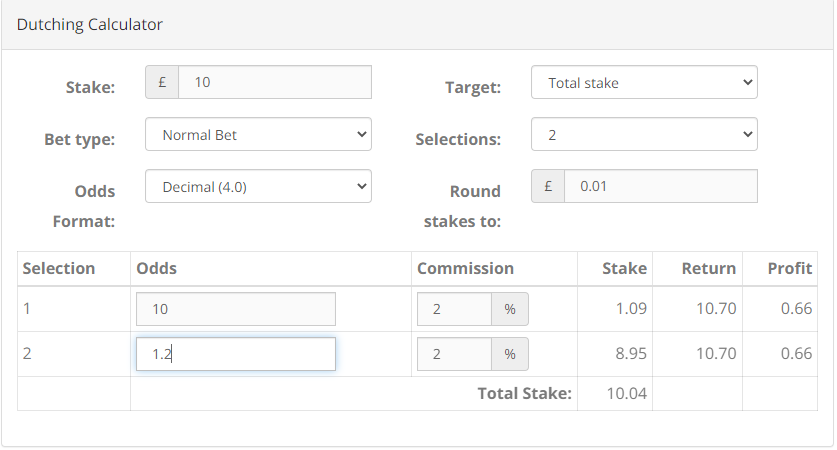
Now I said earlier that you can perform this trade without the aid of Bet Angel by using a simple Dutching Calculator. For this I will use OddsMonkeys very capable dutching calculator which is available to use for free (I will post a link below) In the sceenshot below I have populated the fields with all the relevant information
Stake £10
Parks Odds 10.00
Vondrousovas Odds 1.10
Commision 2% for both bets
I have set the stake to be split over all selections and for the individual stakes to be rounded to a penny.

As you can see we need to adjust the odds for Vondrousova to make the profit show our 10% target for this trade which is about a quid.

1.20 is not enough as it only produces a 66p profit over all

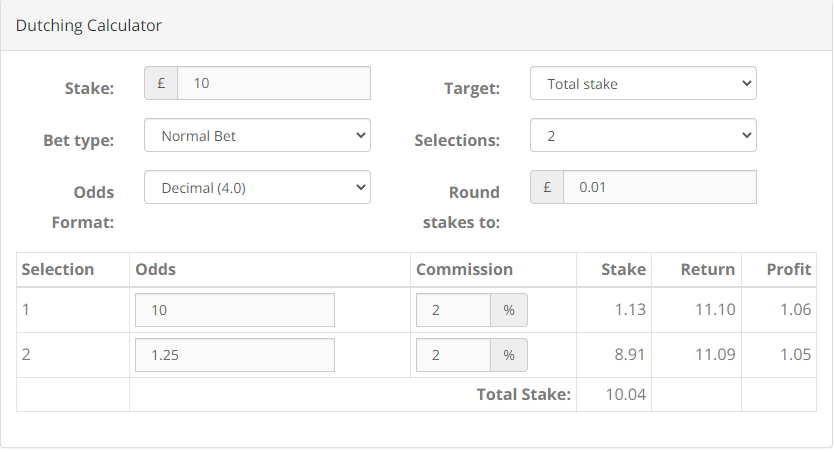
1.3 is too much as it gives a profit of £1.43

Bingo! we have our desired odds at which we will place our order on Vondrousova and what stakes to use AFTER we have placed our bet on Parks. There is just one thing to remember and it is vital. Once you have placed your Vondrousova order into the market you must set the bet to “KEEP” otherwise when the market goes in play your order would be cancelled and you would in effect have a quid on Parks to win only. One more thing to remember is that if you are doing this manually on betfair your minimum stake is £1.00 so you may need to adjust your total stake to bring that to that amount.

Link to OddsMonkey Calculators

If you are interested in using Bet Angel for free for 2 weeks click here for a 2 week free trial

Trading Tennis Matches

Photo by Pixabay on Pexels.com

Trading tennis might be quite daunting at first but when you actually look at some key points in tennis matches this can be a great introduction into the bewildering world of sports trading. There are so many opportunities to make (and lose) money in this activity, that many “match bettors” that have made the progression from having their betting accounts “gubbed” to gravitating to the only real option left open to them in their betfair account.
With there being so many markets available every day and so much “advice” being forced on naive beginners, many lose money and therefore lose interest.
In this series of blog posts I will aim to point out some of the more obscure trading opportunities I have discovered which are of less risk and more reward. Sports trading is a risk, and while you are never putting your full stake at risk there is always the greater probability that the trade will go against you and you will have to trade out of the market for a loss. This can be for a variety of reasons, lack of knowledge and lack of research being just 2. Many beginners to trading will perhaps watch a couple of YouTube videos where the presenter makes trading look so easy and lucrative that they just jump into a similar market that was shown and try and do exactly the same with catastrophic consequences.
As a potential trader you must have, at the very least a working knowledge of how various markets behave. Tennis, to my mind, could be the sport where this can be learned quite easily and with a relatively low risk to your stake.

Trading Tennis No 1 Break of Serve