Yesterday I showed you how to create a basic query in TSMs’ Selection Hunter to find some likely winners using the back test mode to discover any trends and it came up with the following 3 horses The selections are 13:50 Stage Star 14:25 Copperhead 15:00 Sunray Shadow.
13:50 Stage Star Stage Star met the provisional odds criteria of between 2.00 and 2.99 but went off at a BSP of 3.21. Our conditions of placing a bet with betangel were that the BSP had to be between 2.00 and 2.99 for the software to trigger. 3.21 was out of our range at 3.21 so no bet was made.
Stage Star only managed 4th out of 5
14:25 Copperhead Joe Tizzards’ Copperhead also qualified as the provisional odds were posted as 2.85 but again the BSP was outside of the criteria and went off at 3.5 giving us another miss fire from Betangel. Copperhead Won by 14 lengths!!!
15:00 Sunray Shadow The final selection was the Skelton trained and ridden Sunray Shadow who’s Provisional odds were posted at 2.5. Winning by a length and a 1/4 the BSP was well within the range at 2.23 and Betangel Fired the bet in 10 seconds before post time catching 2.25
Summary 2 of the 3 selections went off at odds outside the criteria one of them winning but alas one losing 2 of the 3 went off as favourites despite all 3 being ranked as provisional favourite. Betangel fired just one bet and this returned 125% ROI Given the strike rate of the criteria when back tested (68%) 2 actual winners from our query seemed to tentatively back this trend.
Cautionary note While this was a completely genuine test run you should not go out and back every Aintree runner with a BSP of between 2.0 and 2.99 even though I back tested over a period of nearly 2 years results you should always do as much research as you can and start with stakes that you can afford to lose.
Build your bank steadily Racing is not going to finish tommorrow!!!
The staking Machine software has limited use for free but If you want to take advantage of the Selection Hunter you will need to pay – It only costs £24 for 1 year – Twenty Four!! this is not a typo and can be paid via paypal That’s only 2 quid a month and if you had backed Sunray Shadow for a quid you would have made over 1/2 a months subscription already.
There is a new addition to the TSM armoury called the Selection Hunter and it does exactly what it says! By entering criteria in a series of easy to use drop boxes in its user interface you can quickly build a module/query that shows the runners for today. As a demonstration I will build a query for todays racing at Aintree using the backtest mode and then post the selections before racing starts. We need to open the selection hunter first and this is achieved by opening TSM and then clicking on the racecards tab at the top and then clicking on the “UK/IRE Horse Racing Selection Hunter” shown below.
This will open the selection Hunter Interface as shown below.
As you can see I have already produced some queries but for this demonstration I will start from scratch.
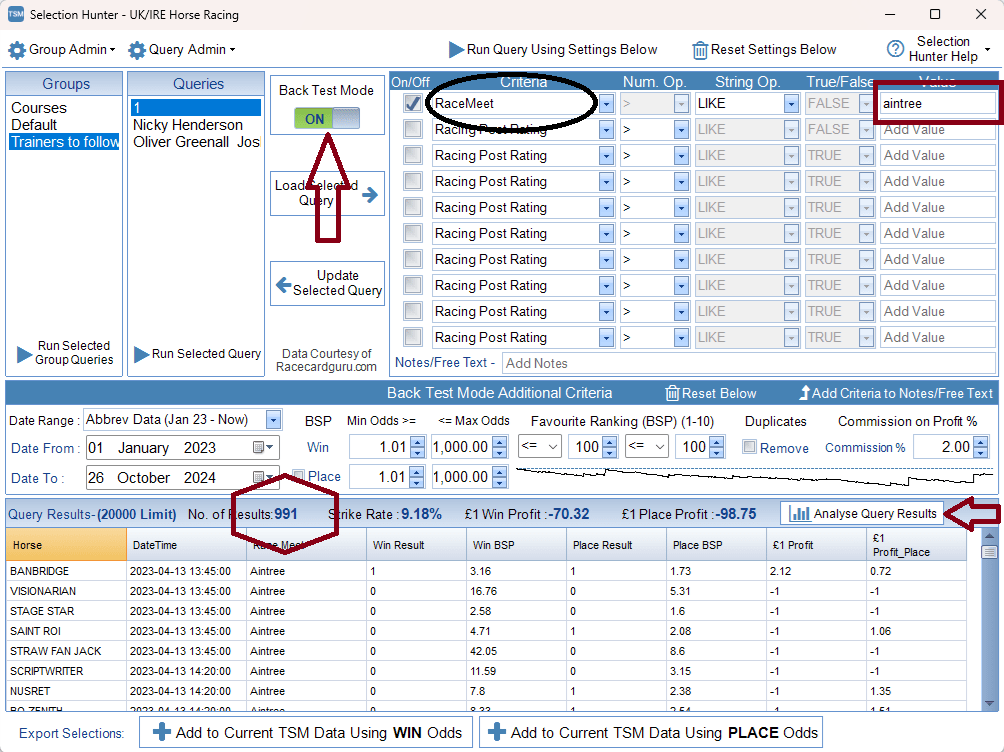
To start a new query click the first tick box and then, under criteria, select RaceMeet from the first dropdown box make sure “Like” is populated in the String Op box and Type the race course name into the value box as shown below.
Make sure the Back Test Mode switch is set to on and the date range is Jan 23 – Now by selecting it from the date range drop down box and then Click the run query using settings below at the top of the interface. This has produced 991 results which in effect is the number of horses that have run at Aintree since January 2023. We need to now analyse this queries results by clicking the box which is arrowed above. This will open the screen shown below
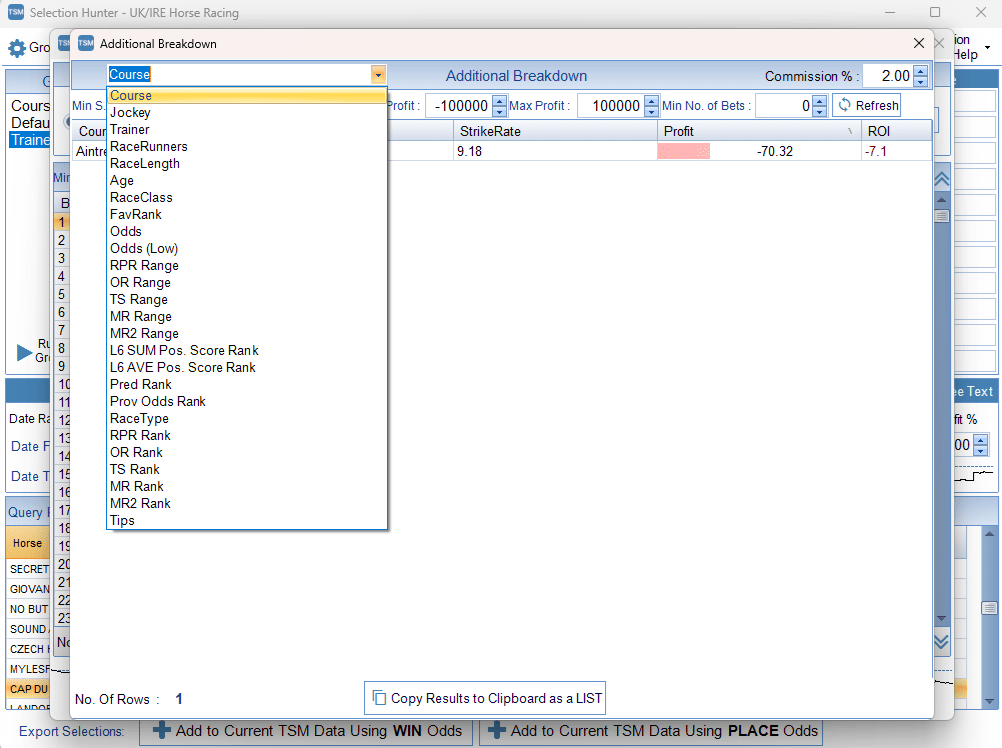
Next click the additional breakdown button arrowed to bring up the following screen.
We can now drill down our query to specific criteria such as Jockey, Trainer, Racerunners etc. For this demonstration I will select odds from this dropdown list to produce the following screen.
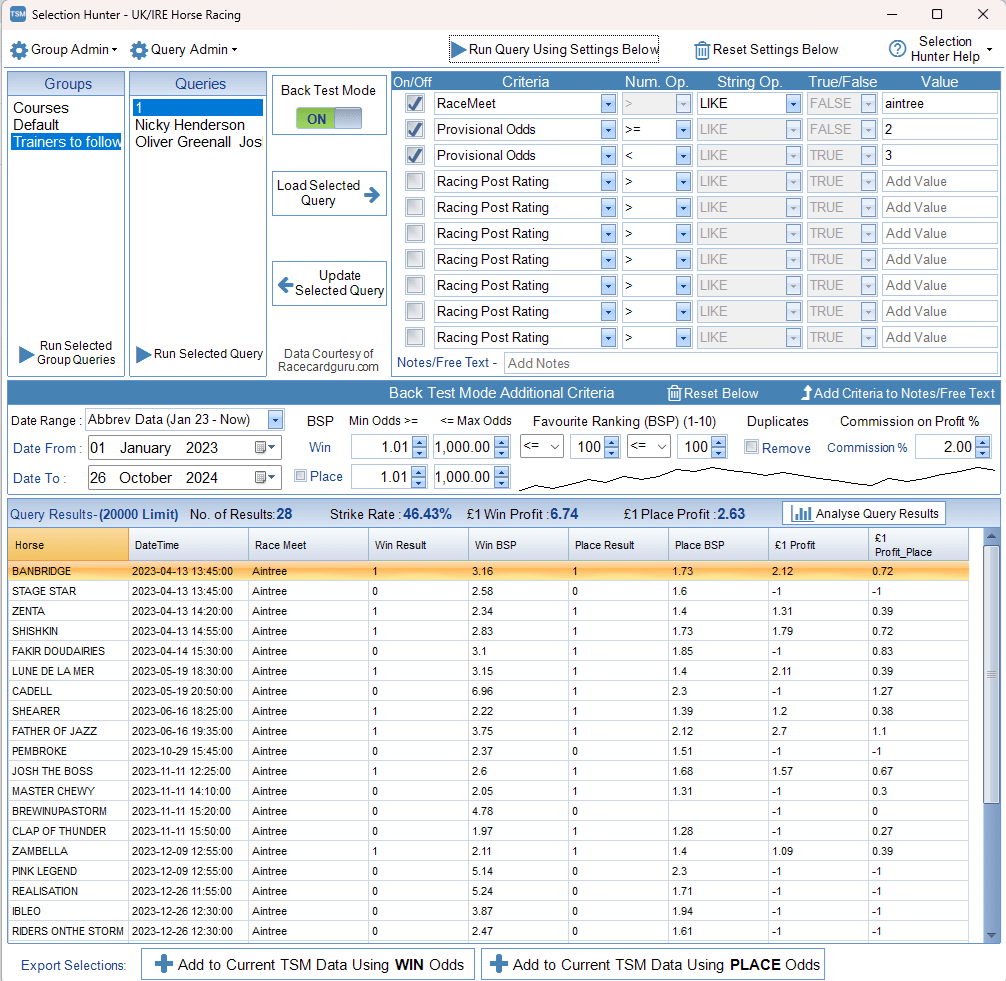
From this screen we can determine the optimum odds that produced the greatest strike rate and in this case with a strike rate of 68% odds of 2 to 2.99 BSP produced a return on Investment of 61.4% We can now enter these figures into the Selection Hunter interface as follows.
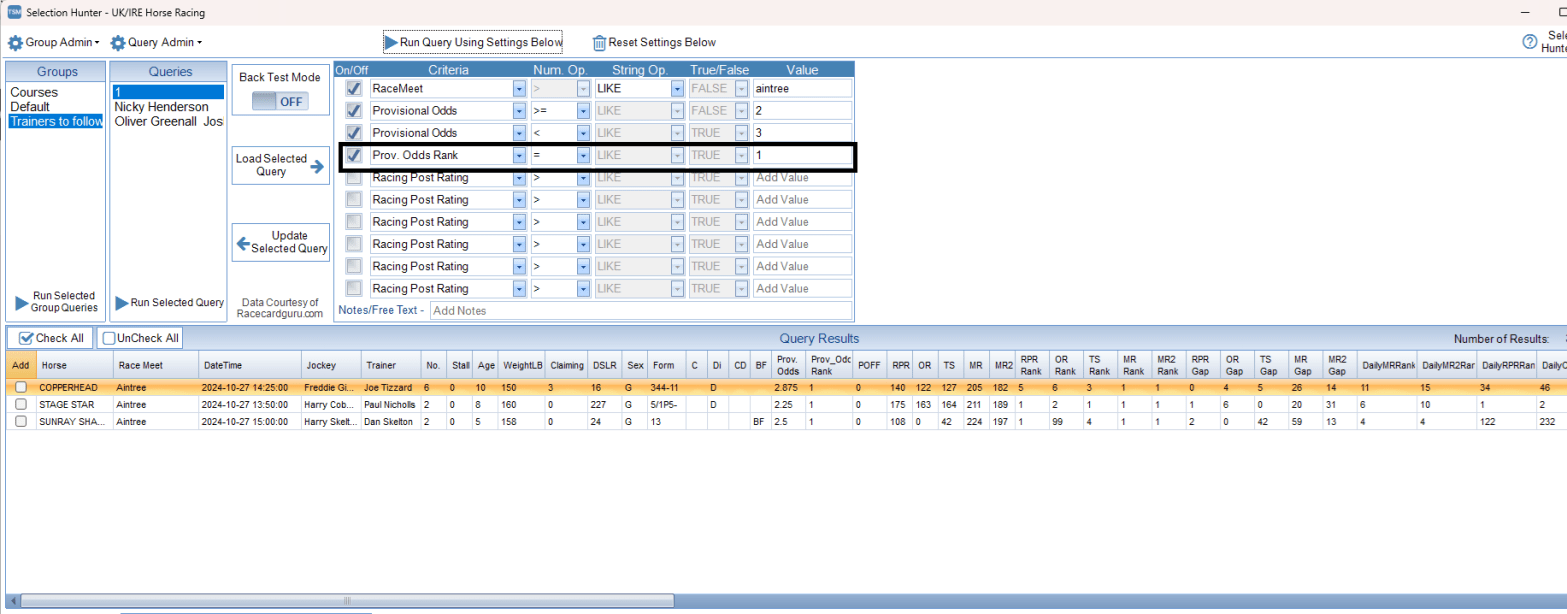
Under criteria and in the second dropdown box select “Provisional Odds” then in Num Op select >= then in the value box type 2 – this tells the query to look for horses that raced at Aintree in this period that had odds of 2.00 or more In the next box down select provisional odds again but in the Num Op box select < and the value type 3 – this tells the query to look for horses that had provisional odds of less than 3 Make sure both tick boxes are filled nest to provisional odds and click the Run Query button again This will bring up the next screen shown below.
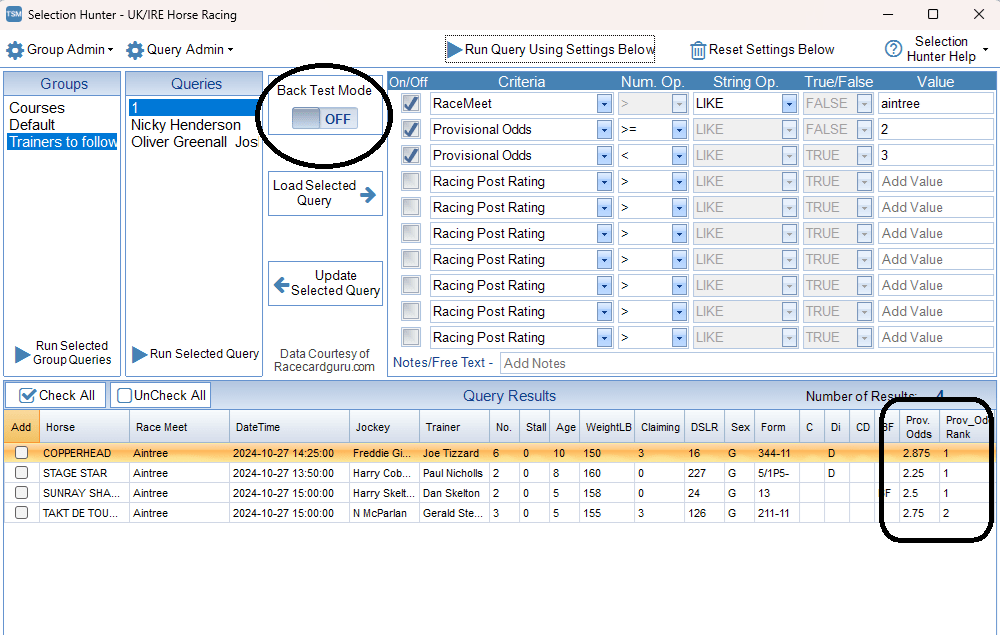
This is a very basic query which when run with the back test mode switched off will list all todays runners at Aintree that have a provisional starting price between 2.00 and 2.99 as shown below.
Thre are 4 runners today that meet this criteria and if you notice there are 2 selections for the 3 o clock – Sunray Shadow and Takt Des Touques. In the column next to Prov Odds you will see Prov Odds Rank and this is another factor that you can drill the criteria down by as shown below
In the screenshot above I have expanded the interface so this picture is not vey clear but if you click the image you will see a lot more information is readily available for each runner So we have our short list of runners and with the strike rate of this query being 68% we can expect 2 of the 3 to win as long as the BSP is between 2.00 and 2.99 We can use Betangel to place or bets for us at the BSP range specified. ie 2.00 – 2.99
The selections are 13:50 Stage Star 14:25 Copperhead 15:00 Sunray Shadow.
The “Percentage” staking plan is different to level stakes in the way you link the stake to your profit. With “The Staking Machine” software you can do some very clever things such as applying a different percentage to any profit and adding it to the base stake. In this post I will explore the myriad of settings to discover whether or not we can improve on the level stakes debarcle outlined in the main introductory post. If you have arrived here straight from google or some other entety other than the introduction post you can read it here
The first thing to do is to apply our desired settings to the relevant staking plan. To access this feature we click on the “Staking Plans” Tab at the top of the screen and then click the Edit Staking Plans Settings” button on the top left of the screen as shown below.
Accessing TSM staking plan settings.
To begin with we should set our “bank” to the same as level stakes and the initial stake percentage the same. We are also going to set the minimum stake allowed to that of the initial start stake to make the staking machine calculate a stake that will never go below 2.00, this is done by ticking the box marked “Minimum Stake equals start stake” We are also going to tick the box “Re-calculate after x amount of bets” and enter 1 into the box. This will instruct TSM (The Staking Machine) to recalculate the stake after each bet. This can be seen more clearly in the screenshot of TSM below
Click the image to open in a new tab for a clearer view.
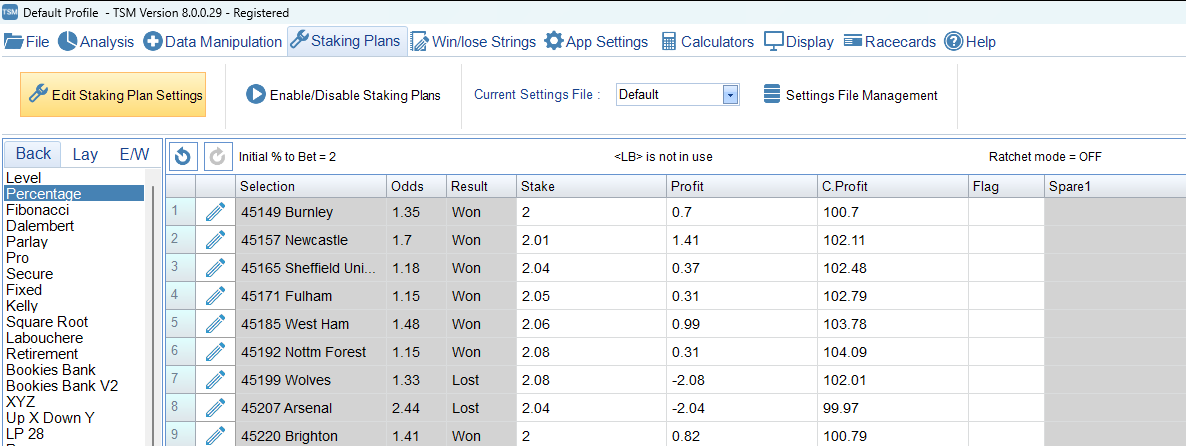
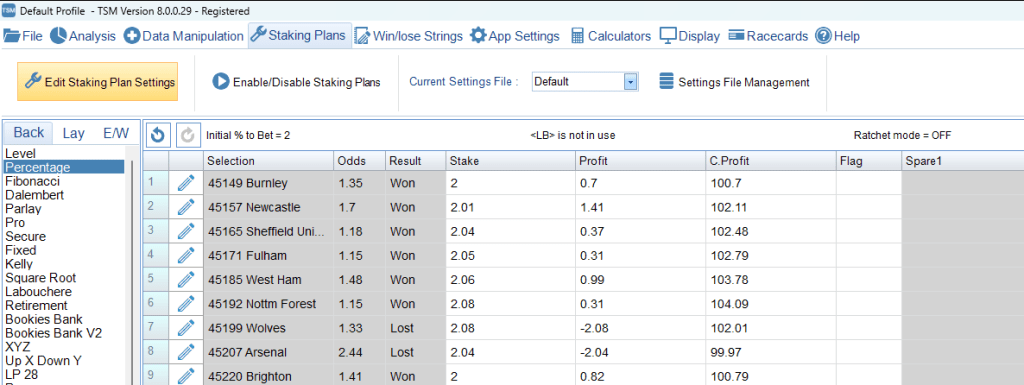
As you can see from the top image I have already loaded the data for last seasons Manchester Citys’ games and the software has calculated the stakes using the settings we have just entered, adusting the stakes for any profit or loss made. The same image is shown below and it clearly shows that when there was a profit made the stakes increased but when the cumulative profit became a loss the minimum stake rule kicked in and the minimum stake became £2.00. If we had left the “Minimum Stake Equals Start Stake” box unticked when Man City started losing you can see that the stakes reduced to 2% of our “Bank” – See bets 14 onwards shown below.
When the bank dips below its starting amount i.e. when you are no longer in profit TSM calculates the stake to 2% of the running bank if the minimum stake is unticked.
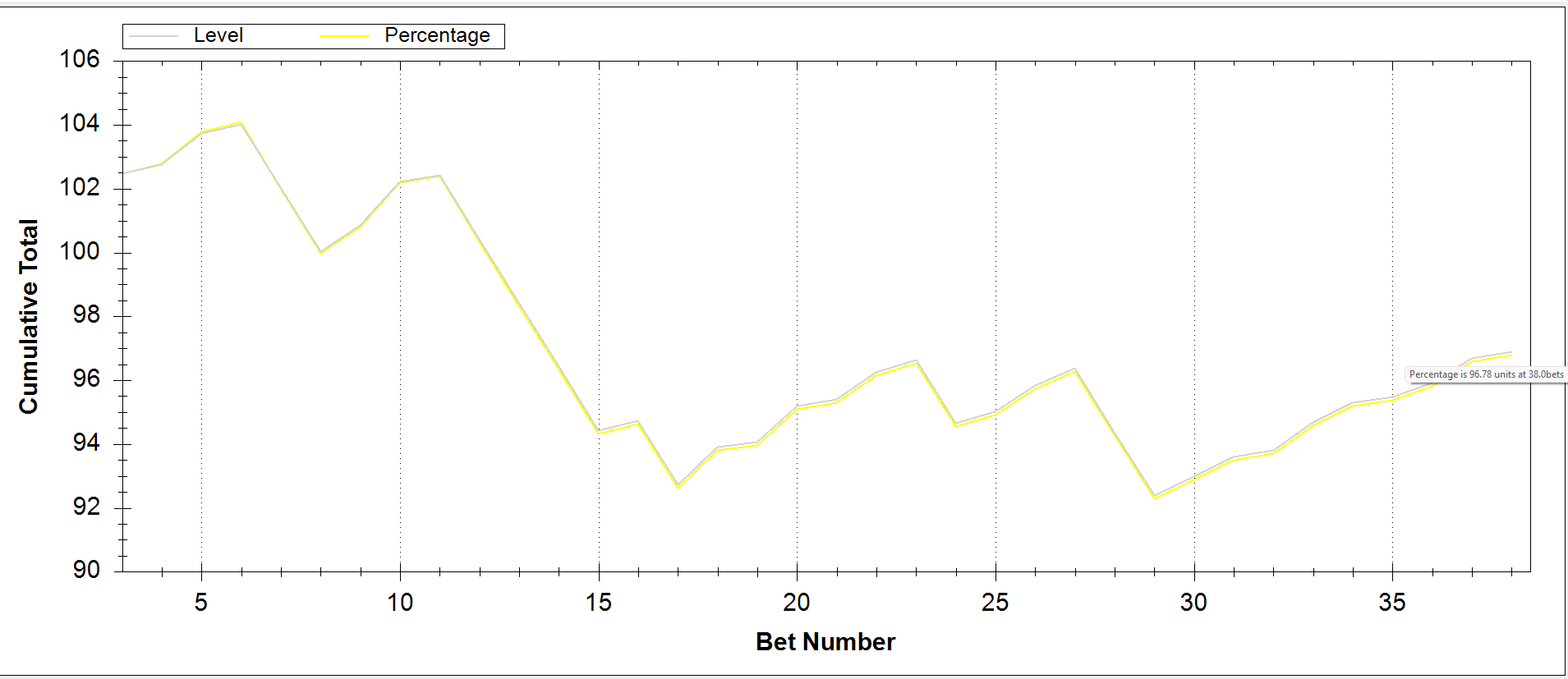
Because we are using the same data for level stakes as well as the percentage plan TSM can produce for us a graph that compares the two systems alonside each other. This is shown below.
A comparison of how the Percentage plan performed against level stakes using the initial settings determined above.
If you click the image above it will open in a new tab so that you can see from where i hovered my mouse above bet 38 on the percentage plan line that the plan ended with a further 10p loss compared with the level stakes plan. So on first impressions the percentage plan follows the level stakes plan very closely finishing with a very slight greater loss. There is however more setting that we can apply and one of these is to apply a different percentage to any profit and adding this to our base stake of £2.00 as the following shows. To turn this feature on we need to go back to our staking plan settings and tick the “Apply Different Percent % to Bet to any Profits” and enter the percent rate you would like to impement. I have entered 10%, this means that if we are £5 up it will add an additional 50p to the stake as shown below.
The following screenshot shows the increased stakes when this feature is implemented and the image immediately below that shows the normal percentage plan.
As you can see the percentage plan with the increased stakes the bank stands at £104.35 giving a profit of £4.35 where as the basic percentage plan the total is £104.09 or a £4.09 profit. When we start to lose however our increased stake means that on a losing bet the loss is greater. After Man City didn’t win the match against Wolves the basic plan shows a greater profit. If we get TSM to generate a new comparison graph using the new setting and compare it with level stakes the plans still follow similar paths but the percentage plan while rising above the level stakes plan at the end of the season it has under performed it by a further 40p loss.
Click image for a better view in a new tab
In quick summary for Manchester City it would seem that the percentage staking plan would not be suitable for bets involving very short odds even though the strike rate is quite high. What is becoming apparent is that if the strike rate is below the required strike rate determined by the average winning odds then you don’t stand much of a chance and it might be better to commit sacrilege and back your team to lose 😲. This we will explore later.
On to Tottenham and their creditable 5th place last season. As we saw in the introduction post Tottenham had a winning strike rate of 52.6% but their average winning odds of 1.81 dictated a required strike rate of 55.4% so even though the strike rate is still below the required strike rate can we recover losses with increased average odds or are we still doomed to failure and lining the bookies purse even more. The answer I am afraid is we lose even more than with the shorter odds. The screenshot below (which is another great feature of TSM) shows the comparisons to a greater detail with totals such as highest peak profit and lowest trough loss
You will need to click the image to gain a better and clearer view of this screenshot – it will open in a new tab.
This feature is accessed by clicking the Analysis Comparison button on the main screen which will open in a new window the entire comparison stats for all the staking plans on the system – I have just shown the two that we are looking at so far. If you click the image above it will open in a new tab so you can see more clearly the data it has produced The first column shows the largest single stake used so you can get some idea of the stakes involved, With the level staking system the largest and smallests stakes are obviously going to show £2.00 as this is our level stake and that stands to reason. With the Percentage Staking plan with the settings described above the largest single stake was £3.39 and the smallest being £2.00 as we set our stake to be never below this figure or 2% of our starting bank which if you remember was £100.00. In the 5th Column it shows total stakes used and in this case the level staking plan used £76.00 as you would expect (38 games x £2.00). With the percentage plan our total stakes came out at £90.46 The most interesting column for us is the second to last which shows cumulative profit. This is our end of season figure and the Percentage plan under performs the level stakes by £2.80 with the cumulative profit being -£6.54. We can see this a lot clearer with the comparison graph below.
Performance of the Percentage staking plan against the level staking plan for Tottenham 23/24 season
As with the Manchester City analysis we can bring up a bar chart that identifies when Tottenham performed to the match odds this is shown below
This graph shows the number of matches that tottenham played where the win odds are grouped and the number of time they won in those ranges
As you can see when the odds were below 1.5 Tottenham had a 100% strike rate. If we bring up the “Odds Report” we can see that the only grouping of odds where we would have made a profit was 2.0 and below.
Tottenhams strike rate when the match odds for them was below 2.0 was 88.89%
In summary then, using the percentage plan on matches that had win odds of 2.00 or below would have produced a profit of £7.51 over the season or a 41.07% Return on Investment.
We now move onto Crystal Palaces’ data and with £2.00 level stakes we would have profited by 11.48. If we remind ourselves Crystal Palaces winning strike rate was 34.2% for the 23/24 premiership season and they managed a creditable 10th place. Their average winning odds were 3.36 giving a required strike rate of 29.7%. Using the Percentage Staking Plan with the settings unchanged from the two studies above our maximum single stake would have been £2.88 and again the lowest £2.00. There is another odds report that is available in TSM and the grouping of the odds is a lot more precise see below.
This report groups the odds into more precise bands.
Analysis of this kind can be invaluable as we can identify odds ranges that are more likely to provide a profit for instance if you look at the “Range F” row you will see that the odds range between 2.0 and 2.5 with a total of 10 games in that range with a 60% strike rate. If we tick the box in “Apply Filter” column and click the “Apply Chosen Filters” button at the bottom as shown in the screenshot below then it will populate the main TSM screen with just those results.
By filtering out other odds ranges we can analyse specific results.
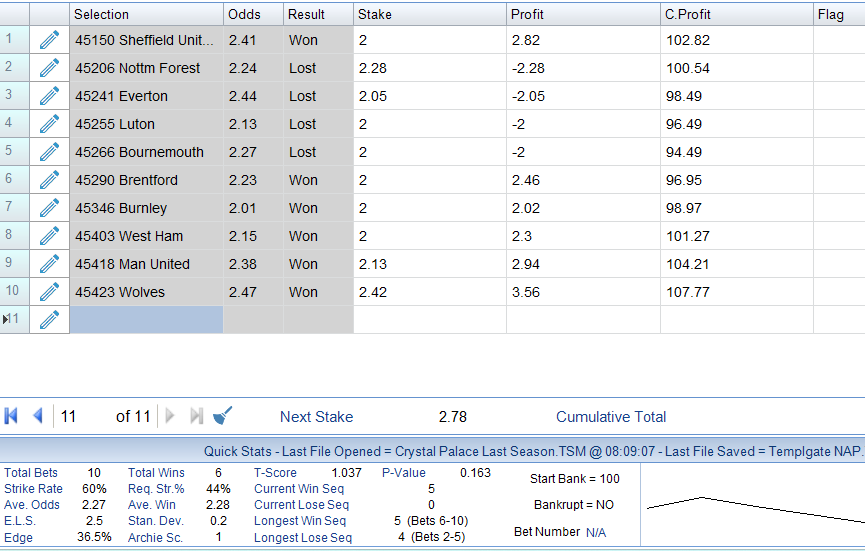
By filtering out unwanted odds ranges we can make a more detailed analysis of specefic matches we would be better advised to bet on as shown below.
This screenshot shows just the matches where the match odds for Crystal Palace were just from match odds ranging from 2.0 to 2.5
We can see from the quick stats panel at the bottom of the screen that the strike rate is 60% and the average winning odds from the 6 matches that Crystal Palace won came out at 2.28 requiring a strike rate of 44% to enable us to make a profit. Only backing matches that fall into this sort of odds ranges can make for a dull season but the aim of this small section where i have diverted from the bigger picture is that with detailed analysis such as this and the pure ease that TSM enables this you can analise all the teams in the premiership in this way – or any other league for that matter to improve your profit potential by having separate files for each team and using a plan for each such team individually.
Any way back to the full season comparison between level stakes and percentage plan for Crystal Palaces’ 23/24 season.
Comparison graph for Crystal Palace between Percentage and Level stakes staking plans.
This is the familiar comparison graph showing the track from bet 1 to bet 38 and as we have come to expect they follow each other very closely. In this particular instance the Level Staking plan out performed the percentage plan by 10p over the season.
In summary, generally the level stake staking plan is ahead as far as the ROI factor is concerned but there are factors that you should be aware of. Staking plans can, if the right research is done, provide profit where there is the right correlation between the Ave win odds and strike rates.













 Betornot